Cellular Chionablepsia (Ch. 5)
Membrane Macrology
(Ch. 6)
(Ch. 6)
Signal Shopocracy (Ch. 7)
Energetics Esemplasy
(Ch. 9)
(Ch. 9)
Miscellaneous Mabble (Misc.)
100
Single-celled organisms that store genetic information within a nucleoid; lack membrane-bound organelles. May use flagella for movement.
What is a prokaryote?
100
The difference in concentration of a soluble molecule across a semi-permeable membrane.
What is a concentration gradient?
Solutes will naturally want to move from [high] --> [low]!
100
A protein that is able to sense an external stimulus and produce a signal.
What is a receptor?
100
Organic molecule that acts as a source of energy for the body by storing potential energy in phosphate bonds.
What is ATP/adenosine triphosphate?
100
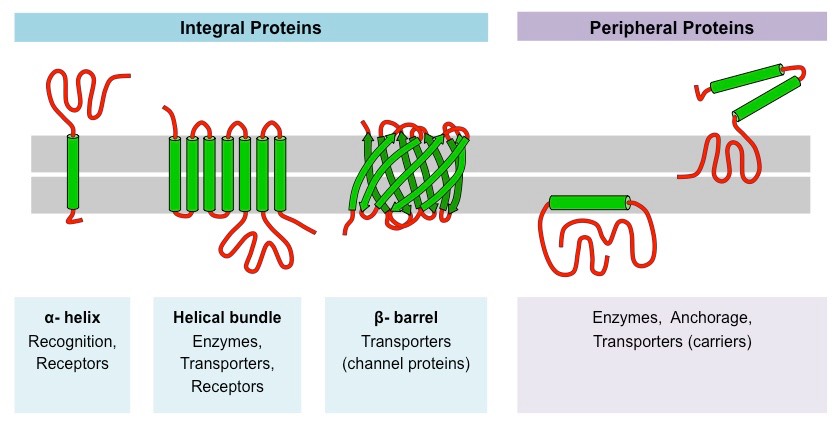
A protein embedded in a cell membrane that reaches across/spans the width of it.
What is a transmembrane protein?
200
The network of protein fibers that are responsible for maintaining a cell's shape
What is the cytoskeleton?
(Study microtubules + microfilaments)
200
Channel proteins that selectively move water (H2O) across cell membranes.
What is an aquaporin?
200
A molecule that acts as a specific chemical signal to a receptor protein by having a 3D shape that fits into its binding site.
What is a ligand?
200
The first step of in both cellular respiration or fermentation, turns 1 glucose into 2 pyruvate.
1 glucose + 2 ATP + 2 NAD+ --> 2 pyruvate, 2 NADH, 4 ATP
What is glycolysis?
200
Chemical process where a reactant gains electrons, often portrayed as forming a bond with hydrogen (H+).
What is reduction?
300
Phospholipid bilayer that encloses the cytosol and cellular organelles, separating the cytoplasm from the extracellular environment. Fluidity determined by ratio of saturated/unsaturated lipids (and presence of cholesterol).
What is the cell membrane?
300
Cell junctions that act as localized "spot welds"; cells are "glued" together at these spots.
What are desmosomes?
300
Chemical signals that bind to/affect cells near the releaser cell.
What are paracrine signals?
300
Chemical process where a reactant loses electrons, often portrayed as breaking a bond with hydrogen (H+).
What is oxidation?
300
A type of transmembrane protein receptor that is responsible for producing a variety of signals for a cell
What is a G protein-coupled receptor?
400
Vesicles that contains digestive enzymes, used by cell to break down macromolecules into monomers.
What is a lysosome?
400
Transmembrane protein that uses active transport to move 3 sodium (Na+) ions across the membrane while moving 2 potassium (K+) across the cell membrane in the opposite direction.
What is the sodium-potassium ATPase pump?
400
The multi-step molecular pathway triggered by the binding of a ligand in order to carry out a specific cellular response.
What is a signal transduction pathway?
400
ATP-generating metabolic process that does NOT use oxygen. Only produces 2 ATP per 1 glucose molecule.
What is fermentation/anerobic respiration?
400
Inhibiting molecules that chemically resemble ligands, can bind to and block their intended receptors.
What are antagonists?
500
Cell organelle made of a phospholipid bilayer - synthesizes lipids, contains NO ribosomes, chemically modifies small molecules
What is the smooth ER/endoplasmic reticulum?
500
Molecules move through channel/carrier proteins in direction of a chemical gradient established by another protein that uses ATP to move molecules against their concentration gradient.
What is secondary active transport?
500
A protein that phosphorylates other targeted proteins.
What is a protein kinase?
500
ATP-generating metabolic process that requires oxygen. Produces ~36 ATP per 1 glucose molecule.
Takes place in 3 main stages: glycolysis (+ link reaction), Krebs cycle, and electron transport chain.
What is (aerobic) cellular respiration?
500
Cell junctions made of groups of transmembrane channel proteins that physically link neighboring cells and allow direct exchange of communication signals.
What are gap junctions?