Thats a big word for Elmo part 2
Inside Out
Pop goes the weasel
You spin me right around
Making Greatness
100
What are the three parts of the cell theory?
What are
1} All living things contain cells.
2}All cells come from pre-existing cells.
3} Cells are the basic unit and structure of life.
100
This is found within all cells and codes for proteins
What is DNA?
100
Cancerous cells are a result of this.
What are DNA mutations?
100
This part of mitosis is shown below.
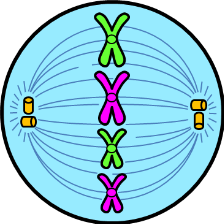
What is metaphase?
100
These are the four notrogenous bases
What are adenine, thymine, guanine, and cytosine?
200
All prokaryotic cells are these types of organisms.
What are bacteria?
200
These structures are found in all cells and are the site of protein synthesis.
What are ribosomes?
200
An abnormal mass of tissue that forms when cells grow and divide more than they should or do not die when they should
What is a tumor?
200
The growth phase of the cell in which it spends 90% of its life
What is interphase?
200
The enzyme responsible for adding free nucleotides and proofreading the strand
What is DNA Polymerase?
300
Name the major component that prokaryotic cells are lacking.
What is a nucleus?
300
Name 5 things that all cells have in common.
What are ribosomes, DNA, cytoplasm, cell membrane and cytoskeleton?
300
This is when the cell will lyse (break) itself as a result of failing a checkpoint.
What is apoptosis?
300
If this cell is in anaphase, how many chromosomes did the initial parent cell have?
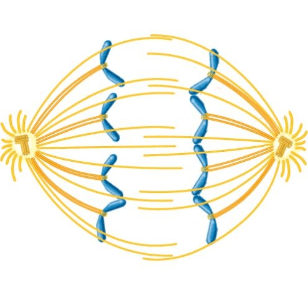
What is four?
300
Based on Chargraff's Rule, create the complementary strand.

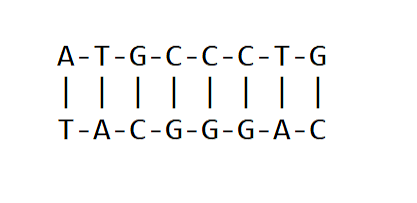
400
How many membrane-bound organelles do prokaryotic cells have?
What is prokaryotic cells have ZERO membrane-bound organelles.
400
Describe the differences among the vacuoles of plant and animal cells.
What is
In plant cells, the vacuole is a single, central vacuole that is large and stores water.
In animals, the vacuoles are smaller and used to store various substances.
400
These are the several points in the eukaryotic cell cycle at which the progression of a cell to the next stage in the cycle can be halted until conditions are favorable.
What are the G1, G2, and metaphase checkpoints?
400
The area of a plant cell in which the cytoplasm pinches in during telophase and cytokinesis.
What is the cell plate?
400
The time frame it takes to replicate a single strand.
What is 6-8 hours?
500
Which came first?
The prokaryote or the eukaryote.
It is hypothesized that prokaryotes were the first and oldest living things found on earth.
500
What is the function of the endoplasmic reticulum and what is the difference between smooth and rough endoplasmic reticulum?
What is
The function of the endoplasmic reticulum is to transport proteins and various substances within the cell.
Smooth ER does not have ribosomes; rough ER does have ribosomes.
500
These are the requirements of the G2 checkpoint.
What are is the cell big enough, is the environment favorable, is the DNA copied?
500
The second part of interphase in which the cell undergoes DNA replication and doubles the number of chromosomes.
What is S phase?
500
Explain why DNA replication is semiconservative
What is the DNA consists of an old parent strand and a new complemenatry daughter strand.
600
It takes much longer for a eukaryotic cell to replicate (make copies of itself) than a prokaryotic cell.
Based on what you know, hypothesize TWO reasons why it takes bacterial cells less time.
What is....
1. Prokaryotic cells are smaller.
2. Prokaryotic cells have less “stuff”. They do not have membrane bound organelles and are therefore less complex.
600
What is the function of the mitochondria and how is it different than all the other organelles?
Mitochondria converts sugar into ATP (usable energy for the cell).
Mitochondria has its own DNA.
600
This gene rsponsible for monitoring and repairing DNA. Explain it's role in apoptosis
What is the TP53 gene and it will produce the p53 protein to trigger apoptosis?
600
The phase that this cell is currently in
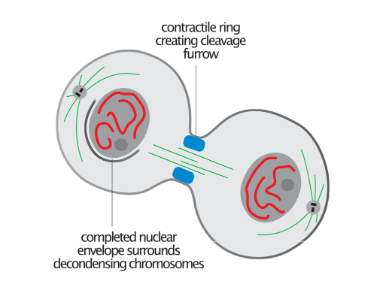
What is cytokinesis?
600
The step of replication that a complemanetary strand is made for each of the two strands of the original double helix AND the enzyme responsible.
What is step 2 and DNA polymerase?