active and passive transport
protein synthesis
lipid synthesis
cellular respiration
cell cycle
100
Describe the cell membrane
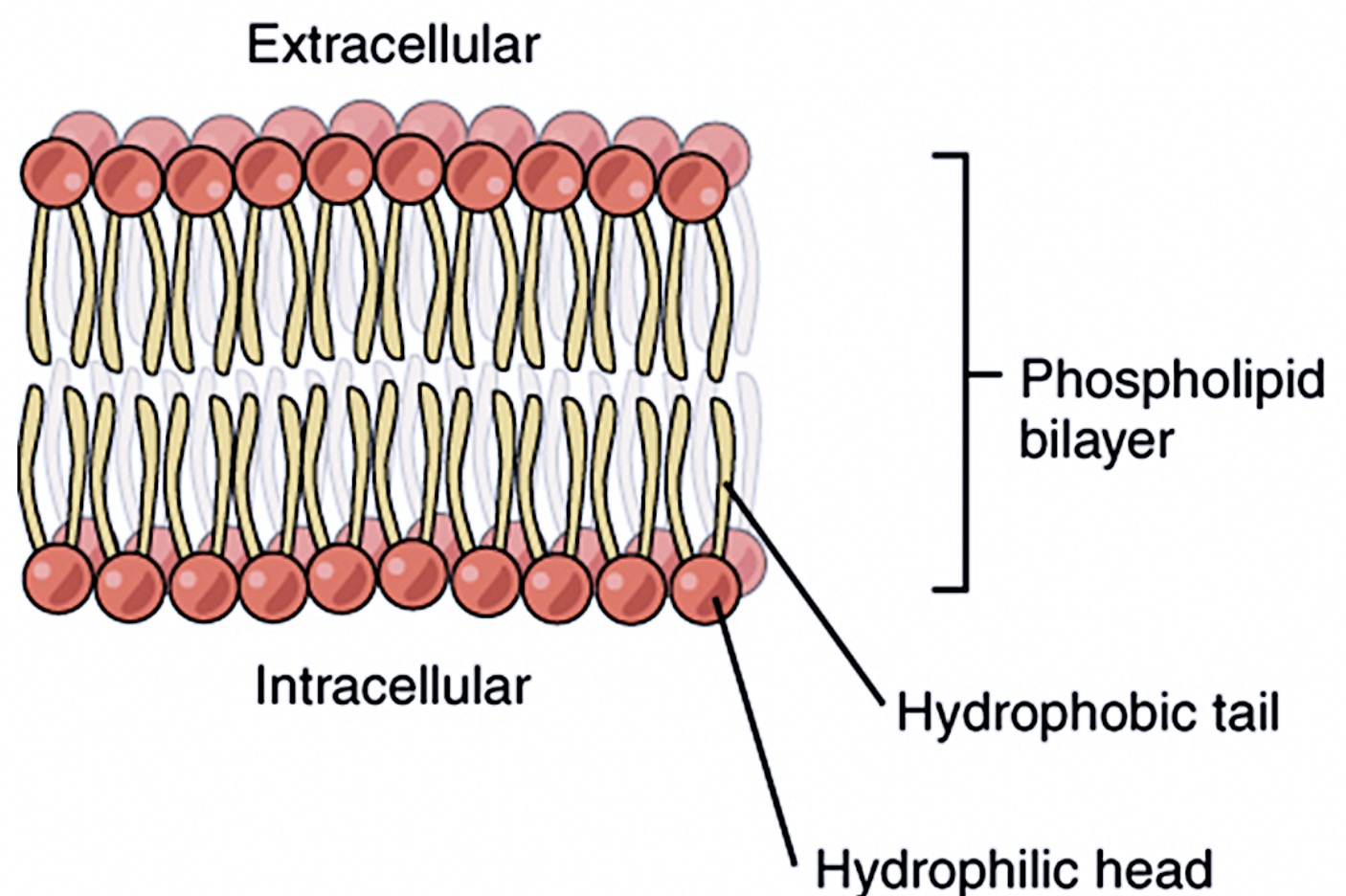
100
What is the path of mRNA after it is made?
exits nucleus --> locates a ribosome in the cytoplasm --> is used to code for polypeptide chain
100
What is the purpose of the golgi bodies in lipid synthesis?
modifies, sorts, and packages lipids received from the smooth endoplasmic reticulum (SER)
100
Where are the two locations that cellular respiration take place?
The cytoplasm and mitochondria
100
What is created at the end of the cell cycle?
Two genetically identical cells
200
Which of the following molecules will be ale to pass through the cell membrane through diffusion?
a) Nucleuic acids
b) Na+ ions
c) CO2
d)Amino acids
c) CO2
CO2 is a small, uncharged, and nonpolar molecule
200
What is the purpose of mRNA
template for DNA
Allows genetic info to leave the nucleus without DNA leaving the nucleus
200
A mutation prevents enzymes in a cell from converting fatty acids into phospholipids. Which cellular function would be most directly affected?
A) Storage of genetic information
B) Formation and maintenance of cell membranes
C) Production of ATP in mitochondria
D) Synthesis of proteins at ribosomes
B) Formation and maintenance of cell membranes
cell membranes are composed of phospholipid bilayers
200
Where is the location of the electron transport chain?
inner mitochondrial membrane

200
A cell has damaged DNA but continues through the cell cycle without stopping at checkpoints. Which outcome is most likely?
A) The cell will repair the DNA before dividing
B) The cell will produce less ATP
C) The cell will stop during cytokinesis
D) The cell may divide uncontrollably, increasing mutation risk and risk of cancer
D) The cell may divide uncontrollably, increasing mutation risk and risk of cancer
300
A patient is given a drug that inhibits ATP production in cells. Shortly after, cells begin to lose their normal ion balance. Which process is most directly affected by the lack of ATP?
A) Diffusion of oxygen into cells
B) Osmosis of water across the membrane
C) Active transport of K+ and Na+ ions across the membrane
D) Facilitated diffusion of glucose
C) Active transport of K+ and Na+ ions across the membrane
explanation:
sodium potassium pump is an example of active transport since it requires energy to move the ion concentrations against their gradient
300
A mutation changes a single nucleotide in a gene, resulting in a premature stop during translation. What is the most likely effect on the protein produced?
A) The protein will have one incorrect amino acid but function normally
B) The protein will be longer than normal
C) The protein will be shortened and likely nonfunctional
D) The protein will not be transcribed
C) The protein will be shortened and likely nonfunctional
300
A scientist adds a chemical that inhibits lipid production, but protein production remains the same. How was the endoplasmic reticulum affect affected by the chemical?
the smooth ER was affected by the chemical but the rough ER was not
300
How much ATP is produced from one molecule of Glucose?
~36 ATP molecules
300
Which protein is essential to move chromosomes to the correct location during mitosis?
spindle fibers
400
A researcher is testing how a toxin affects ion movement across a cell membrane. Cells are placed in a solution with a higher concentration of sodium ions outside the cell than inside. After adding the toxin, sodium ions stop moving into the cell, even though a protein channel is present. Which conclusion is best supported by this observation?
A) The toxin blocks facilitated diffusion through protein channels
B) The toxin increases the permeability of the membrane
C) Sodium ions move by simple diffusion even with the toxin
D) The toxin causes water to leave the cell
A) The toxin blocks facilitated diffusion through protein channels
The sodium ions to move from high to low concentration with the help of the protein channels (facilitated diffusion). The toxin prevented this from happening
400
A scientist treats cells with a chemical that prevents mRNA from leaving the nucleus.
Question:
Which step of protein synthesis is most directly affected?
A) Translation
B) Transcription
C) DNA replication
D) Protein folding
A) Translation
400
When is a cell most likely to produce lipids?
a) interphase
b) mitosis
c) anaphase
d) metaphase
a) interphase
400
Two cell types are compared. Cell A has many mitochondria, while Cell B has very few.Which statement best explains the difference between these cells?
A) Cell A likely requires more energy and produces more ATP
B) Cell B produces more ATP because it has fewer mitochondria
C) Cell A cannot perform glycolysis
D) Cell B relies more on oxygen for energy production
A) Cell A likely requires more energy and produces more ATP
400
Earth worms have 36 chromosomes. How many chromosomes will there be after a successful S phase of the cell cycle?
72 chromosomes
DNA replication occurs during S phase
500
A researcher studies two types of cells. Cell A is placed in a solution with a high concentration of glucose, while Cell B is placed in the same solution but treated with a chemical that blocks all membrane transport proteins. After one hour, glucose levels inside Cell A increase significantly, while Cell B shows no change. Which conclusion is best supported by this experiment?
A) Glucose enters cells primarily through simple diffusion
B) Glucose transport requires membrane proteins
C) Glucose moves against its concentration gradient using ATP
D) Water movement is responsible for glucose entering the cell
B) Glucose transport requires membrane proteins
500
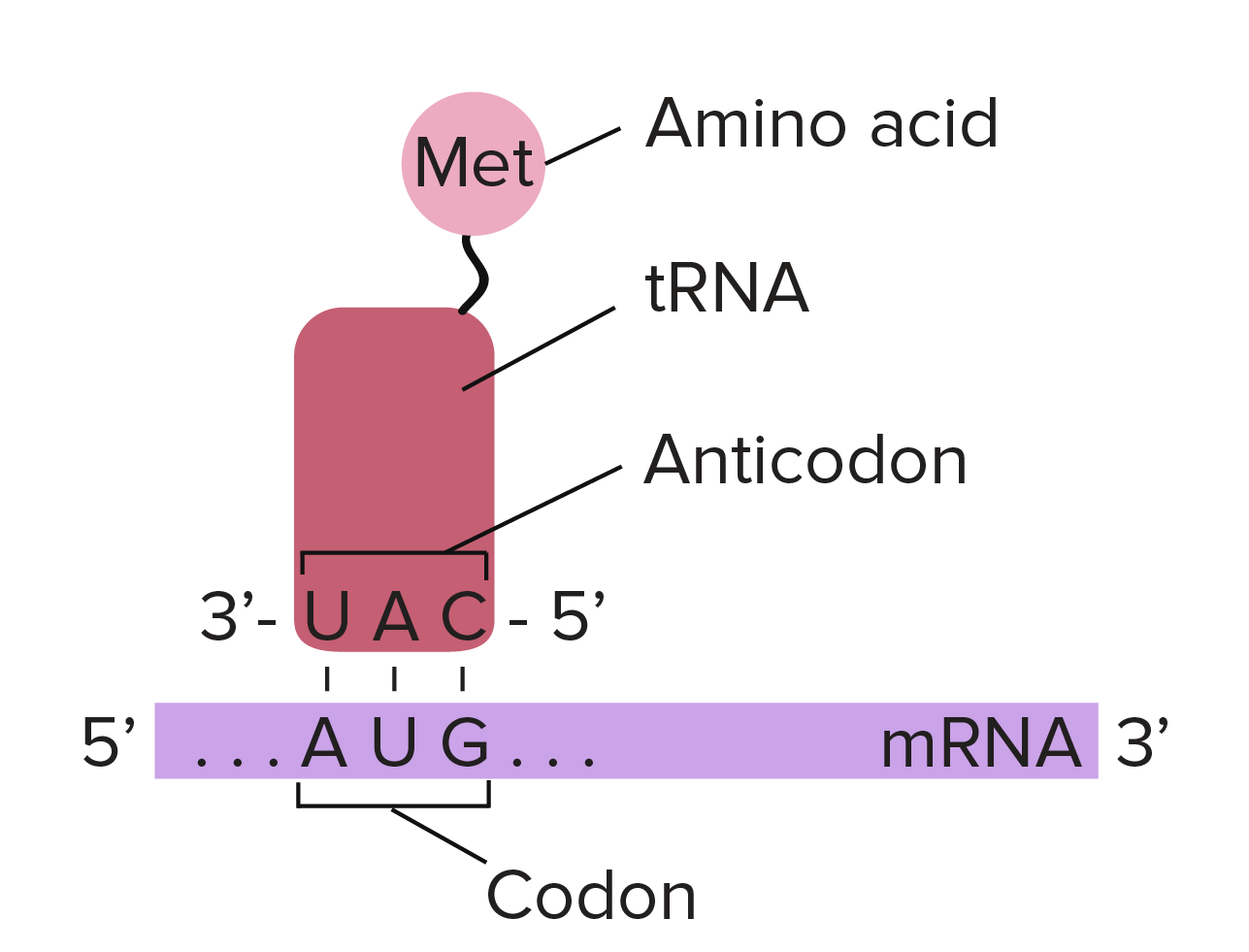
A cell has a shortage of a specific tRNA molecule that carries the amino acid MET shown above. What is the most likely result during protein synthesis?
A) The mRNA will not be transcribed
B) Ribosomes will stop at MET codons, disrupting polypeptide assembly
C) DNA will not unwind properly
D) Proteins will be made faster than normal
B) Ribosomes will stop at MET codons, disrupting protein assembly
The mRNA provides genetic information in what is needed for the specific polypeptide. The rRNA (Ribosome) assembles the polypeptide based on free floating amino acids available
500
A cell is producing phospholipids for its membrane in the smooth endoplasmic reticulum. As phospholipid levels increase, they begin to inhibit the enzymes responsible for their own production. What type of feedback is occurring?
negative feedback
500
Researcher observed that the Krebs cycle is showing minimal activity. What option best explains this observation?
A) Glycolysis is occurring inside the mitochondria
B) Electron transport chain needs more NADH
C) Glucose cannot enter the cell
D) Pyruvate cannot enter the mitochondria
D) Pyruvate cannot enter the mitochondria
Pyruvate is needed for the Kerbs cycle
500
 Why does the mass of the cell decrease after 24 hours? (hint: what phase is the cell in at this point?)
cytokinesis