DNA Structure/Function
Cell Cycle
Interphase
M-Phase
Meiosis
100
What is DNA?
The genetic material that organisms have inherited from their parent.
100
What is the Cell Cycle?
The name we give the process through which cells replicate and make two new cells.
100
The sequence of Interphase.
G1 --> S --> G2
(Gap 1 --> Synthesis --> Gap 2)
100
Two well-known steps of the M-Phase.
Mitosis and Cytokinesis.
100
Meiosis is...
...cell division that reduces the parent chromosome number by half to produce gametes (Eggs and sperm).
200
The monomer for DNA.

Nucleotides.
200
The importance of the Cell Cycle.
Growth and repair (healing).
200
The stage where the cell grows physically and increases the volume of both protein and organelles.
Gap 1 - (G1).
200
What is Mitosis?
A series of events where the (nucleus) DNA splits into two identical sets.
200
The amount of divisions completed in Meiosis.
Two divisions. (Meiosis I and Meiosis II)
300
Label the parts.
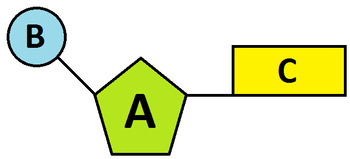
A. Deoxyribose (Sugar)
B. Phosphate Group
C. Nitrogenous Base (Guanine, Cytosine, Adenine, Thymine)
300
The two phases of the cell cycle.
1. Interphase
2. M-Phase
300
The stage where a genetic copy is made with information of a cell.
Synthesis - (S).
300
What is Cytokinesis?
The separation of the cytoplasm and organelles into two new cells.
300
When eggs and sperm fuse.

Fertilization.
400
The Complementary Base Pair Rule for DNA.

Guanine must pair with Cytosine. (G - C)
Adenine must pair with Thymine. (A - T)
400
Which section does Cell Division take place?
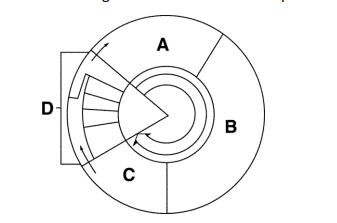
Section D.
400
What happens during the three stages of Interphase?
The cell grows rapidly, replicates DNA to form an identical copy, and prepares for division.
400
Describe the cells produced after Mitosis.
Two diploid daughter cells that are identical.
400
Why is Meiosis important?
Sexual reproduction provides genetic variation in the offspring, which allows resistance and adaption to environments.
500
How does the structure of DNA relates to its function?

Complementary Base Pairing allows DNA to be copied correctly. The enzyme that replicates DNA adds a nucleotide to the growing stand that is complementary to the other strand.
500
Which section does DNA Replication take place?
Section B.
500
Interphase prepares for...
...division during Mitosis with all the nutrients used for growth and replicating itself.
500
What is the difference between Mitosis and Meiosis?
Mitosis is cell division for somatic cells and for the asexual reproduction of unicellular eukaryotic cells, whereas Meiosis is cell division for gamete (reproductive) cells.
500
Describe the terms Crossing Over and Independent Assortment in Meiosis.
1. Crossing over is when homologous (one each from both parents) chromosomes pair up to increase genetic variation.
2. Independent Assortment is when homologous pairs randomly line up with different assortments from the homologous chromosomes. It is the end product of Meiosis which is four unique haploid gamete cells.