The Numbers of Hierarchy
Atomic Math
Bonding & Electronegativity
The pH Scale
Water etc..
100
These four elements combined account for 96% of living mass
Carbon, Hydrogen, Oxygen, and Nitrogen
100
An atom has 12 protons, 12 neutrons, and 12 electrons. What is its atomic mass?
24
100
This is the type of bond where electrons are shared equally between two atoms.
non-polar covalent bond
100
If a solution has a pH of 7, it is described as being this.
Neutral
100
This is the amount of energy needed to raise the temperature of 1g of a substance by 1°C.
Specific Heat
200
Atoms → Molecules → ______ → Tissues → Organs
Cells
200
Magnesium (Mg) is in the second column of the periodic table. How many valence electrons does it have?
2
200
While covalent bonds are "intramolecular," this specific interaction is an intermolecular association often depicted by dashed lines, formed between a partial positive (δ+) hydrogen and a highly electronegative atom in a different molecule.
Hydrogen bond
200
In any aqueous solution, the pH plus the pOH must always equal this number.
14
200
This term describes water’s ability to "stick" to other surfaces, like a glass straw or a leaf
Adhesion
300
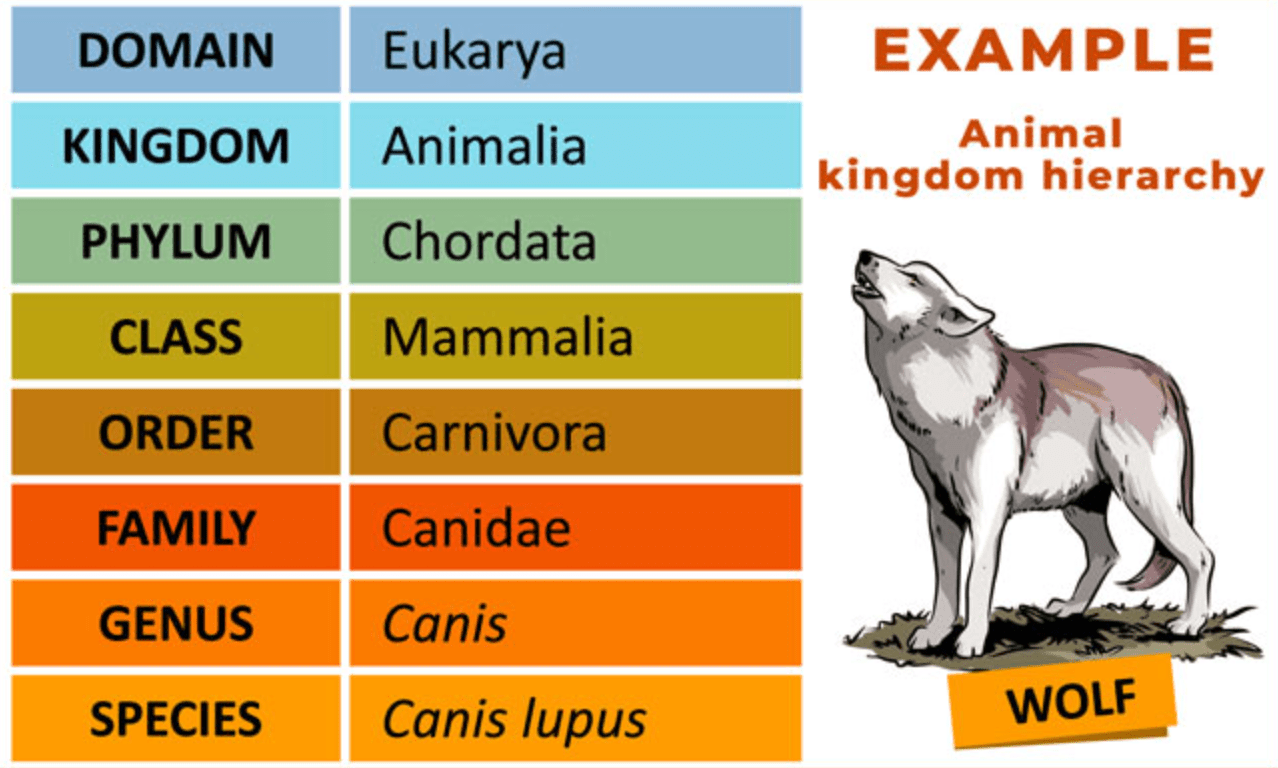 Based on the Linnaean Hierarchy of a wolf, if you move one taxonomic rank broader (higher) than the order Carnivora, you reach this group, which contains all mammals
Class Mammalia
300
This subatomic particle's quantity is the only thing that changes between different isotopes of the same element.
Neutrons
300
Using H=2.2 and Cl=3.16, calculate the electronegativity difference for HCl
and determine if the bond is polar or non-polar based on the 0.50
threshold
0.96 and Polar
300
If a solution has a pOH of 2, calculate its pH.
12
300
This is the quantity of heat a liquid must absorb for 1g of it to be converted from a liquid to a gas.
Heat of Vaporization
400
To completely hydrolyze a polymer that is 50 monomers long, you must add this many molecules of water.
49
400
Based on the "Octet Rule," if an atom has 6 valence electrons, this is the number of covalent bonds it typically "wants" to form
2
400
Is Carbon Tetraflouride (CF4) polar or non-polar? Why?
It's symmetrical, so the 4 fluorines pull in opposite directions with equal force, resulting in no net movement of electrons.
400
A solution with a pH of 3 is this many times more acidic than a solution with a pH of 5.
102 or 100
400
Draw the skeletal and lewis structure for acetic anhydride (C4H6O2)
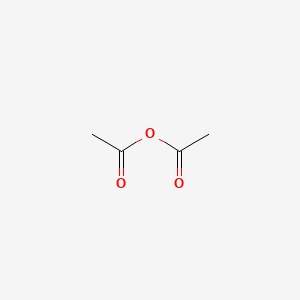
500
A macromolecule is formed by linking 4 molecules of C4H8O2 through dehydration reactions. Calculate the final molecular formula of this macromolecule.
C16H26O5
Calculation:
4×(C4H8O2)=C16H32O84. Subtract 3 waters (H2O) lost during the 3 bonds formed
500
Balance the following chemical equation:
__C3H8+__O2→__H2O+__CO2__
C3H8+5O2→4H2O+3CO2
500
calculate the total number of electrons being shared in a molecule that contains one double covalent bond and two single covalent bonds.
8
Double bond = 4 electrons
two single bonds = 4 electrons
4+4=8
500
If the concentration of
[H+] is 1×10-41 cross 10 to the negative 4 power, what are the pH,pOH and [OH−] values?
pH=4, pOH=10, [OH−]=1×10⁻¹⁰
500
What functional groups do you see in Penicillin? (ignore A)
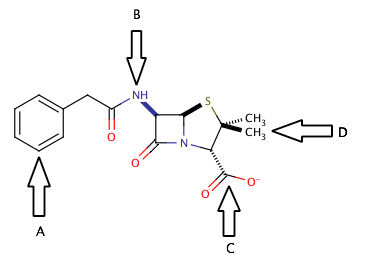
B- Amide
C- Carboxyl
D- Methyl