Kingdoms & Cladograms
Food Webs & Population
Cycles & Human Impact
Macromolecules & Enzymes
Organelles
100
Which feature would most likely place an organism in Kingdom Plantae rather than Kingdom Animalia? A. Presence of peptidoglycan cell walls
B. Ability to photosynthesize with chloroplasts
C. Having organelles but no nucleus
D. Motility by cilia or flagella
B. Ability to photosynthesize with chloroplasts
100
Which term describes a species that has a large effect on community structure relative to its abundance?
A. Producer
B. Keystone species
C. Primary consumer
D. Invasive species
B. Keystone species
100
Which process converts atmospheric nitrogen into a form plants can use?
A. Photosynthesis by plants
B. Weathering of rocks
C. Respiration by animals
D. Nitrogen fixation by bacteria
D. Nitrogen fixation by bacteria
100
Which macromolecule stores and transmits hereditary information?
A. Lipids
B. Carbohydrates
C. Proteins
D. Nucleic acids
D. Nucleic acids
100
What is the primary function of the cell membrane? A. Make energy for the cell
B. Control what enters and leaves the cell
C. Store genetic information
D. Synthesize proteins
B. Control what enters and leaves the cell
200
Which piece of evidence would scientists most likely use to show that a prokaryote belongs to the domain Bacteria and not Archaea?
A. Presence of organelles
B. Multicellularity
C. Cell wall with peptidoglycan
D. Presence of a nucleus
C. Cell wall with peptidoglycan
200
If a population near carrying capacity has slowed growth because of crowding-related disease, this is an example of:
A. Density-dependent factor
B. Density-independent factor
C. Abiotic limiting factor only
D. Random catastrophic event
A. Density-dependent factor
200
Which human activity is directly linked to biodiversity loss? (Choose the best single answer for this question)
A. Natural reproductive isolation
B. Habitat destruction and fragmentation
C. Seasonal migration
D. Pollination by insects
B. Habitat destruction and fragmentation
200
A lab sample contains only C, H, and O and leaves a greasy stain on paper. Which biomolecule is most likely present?
A. Nucleic acids
B. Carbohydrates
C. Lipids
D. Proteins
C. Lipids
200
Which organelle would you expect to be abundant in active muscle cells that require lots of ATP?
A. Lysosome
B. Golgi body
C. Mitochondrion
D. Ribosome
C. Mitochondrion
300
On a cladogram, two species that share the most recent common ancestor are considered closest relatives. Which statement best identifies the closest relative of species D?
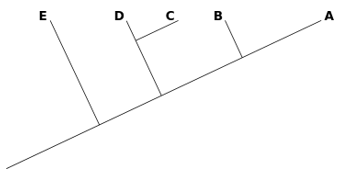 A. A species that shares a unique branch point with D not shared by others
B. Any species that evolved earlier than D
C. The species farthest from D on the tree
D. A species that has similar size to D
A. A species that shares a unique branch point with D not shared by others
300
A food chain transfers energy from producers to top predators. When a shark eats a tuna, which of these will receive the SMALLEST percentage of the original sunlight energy?
A. Producer
B. Primary consumer
C. Secondary consumer
D. Tertiary consumer
D. Tertiary consumer
300
Which transfer does NOT move carbon from animals to decomposers in a carbon cycle model?
A. As waste
B. In dead carcasses
C. As carbon dioxide exhaled by animals
D. As discarded food scraps
C. As carbon dioxide exhaled by animals
300
Which statement correctly compares elemental composition of major macromolecules?
A. Carbohydrates and lipids contain C, H, O; proteins also contain nitrogen in addition to those elements.
B. Carbohydrates and proteins both contain sulfur instead of oxygen.
C. Lipids contain nitrogen while proteins do not.
D. Proteins contain lithium uniquely.
A. Carbohydrates and lipids contain C, H, O; proteins also contain nitrogen in addition to those elements.
300
Which plant cell structure is the site of photosynthesis?
A. Chloroplast
B. Golgi apparatus
C. Vacuole
D. Centriole
A. Chloroplast
400
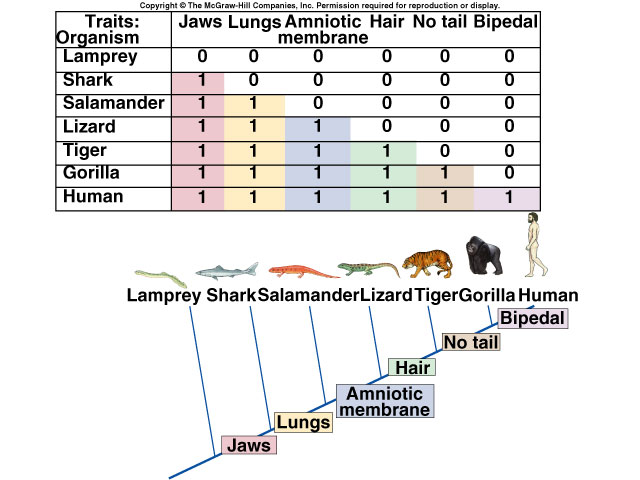 A cladogram lists these animals in order: Lamprey → Shark → Salamander → Lizard → Tiger → Gorilla → Human. The derived traits shown along the branches are: jaws, lungs, amniotic membrane, hair, loss of tail, and bipedalism. Which group of species most likely possesses lungs according to this cladogram?
A. Lamprey only
B. Shark and later descendants (Shark, Salamander, Lizard, Tiger, Gorilla, Human)
C. Salamander and all species that branch after it (Salamander, Lizard, Tiger, Gorilla, Human)
D. Only Tiger, Gorilla, and Human
C. Salamander and all species that branch after it (Salamander, Lizard, Tiger, Gorilla, Human)
400
Using a population graph where moose numbers level off around 1,500 individuals, which is the best estimate of carrying capacity?
A. 2,500
B. 50
C. 1,500
D. 30
C. 1,500
400
Which combination correctly pairs a density-dependent and a density-independent limiting factor in an aquarium?
A. Waste accumulation (density-dependent); extreme temperature change (density-independent)
B. Chemical spill (density-dependent); competition (density-independent)
C. Food shortage (density-independent); disease (density-dependent)
D. Oxygenation level (density-independent); shelter availability (density-dependent)
A. Waste accumulation (density-dependent); extreme temperature change (density-independent)
400
An enzyme breaks down starch best at 40°C, but activity drops at 60°C. Which explanation fits the pattern? A. Higher temperature always increases enzyme activity.
B. The enzyme has an optimal temperature near 40°C and denatures at higher temperatures.
C. The substrate converted into a different enzyme at high temperature.
D. The enzyme is inactive below 60°C. An enzyme breaks down starch best at 40°C, but activity drops at 60°C. Which explanation fits the pattern?
A. Higher temperature always increases enzyme activity.
B. The enzyme has an optimal temperature near 40°C and denatures at higher temperatures.
C. The substrate converted into a different enzyme at high temperature.
D. The enzyme is inactive below 60°C.
B. The enzyme has an optimal temperature near 40°C and denatures at higher temperatures.
400
A student identifies organelle #3 on an animal cell diagram. It generates ATP through cellular respiration. Which organelle is this?
 A. Flagellum
B. Mitochondrion
C. Nucleus
D. Vacuole (or vesicle for storage)
B. Mitochondrion
500
A plant branching diagram shows, from earliest to most recent: mosses & liverworts (leftmost), ferns & horsetails, cone-bearing plants, then flowering plants (rightmost). Traits listed for the groups include whether they require water for reproduction and whether they produce seeds or flowers. If a derived trait (point Z) appears on the branch leading to cone-bearing plants and flowering plants but after ferns, which trait is Z most likely to represent?

C. Production of flowers
D. Production of seeds
D. Production of seeds
500
In a lake food web, sea stars consume mussels and removing sea stars causes mussel numbers to explode and reduce biodiversity. Which role do sea stars play and why?
A. Primary producer — they increase energy flow
B. Keystone predator — they prevent mussel dominance
C. Invasive species — they outcompete natives
D. Mutualist — they help mussels reproduce
B. Keystone predator — they prevent mussel dominance
500
Select three human-caused factors that contribute to biodiversity loss (pick the best trio).
A. Habitat loss and fragmentation; invasive species; illegal wildlife trade
B. Reproductive isolation; natural interspecies competition; seasonal changes
C. Random mutation; volcanic activity; plate tectonics
D. None of the above
A. Habitat loss and fragmentation; invasive species; illegal wildlife trade
500
An enzyme’s three-dimensional shape is maintained by bonds and interactions between amino acid side chains. If high heat disrupts these interactions and the enzyme can no longer bind substrate, which statement best explains how the enzyme’s structure relates to its function?
A. The enzyme’s active site is unchanged by heat, so function is unaffected.
B. Denaturation alters the enzyme’s shape, preventing substrate binding and stopping catalysis.
C. High heat converts the substrate into a different molecule that the enzyme prefers.
D. The enzyme evolves a new active site instantly to handle higher temperatures.
B. Denaturation alters the enzyme’s shape, preventing substrate binding and stopping catalysis.
500
Which observation best supports that viruses are nonliving under the cell theory?
A. They lack nuclei.
B. They are not composed of cells and require a host to reproduce.
C. They cannot move.
D. They lack DNA entirely.
B. They are not composed of cells and require a host to reproduce.