Vocab
Vocab
Food Chains and Webs
Ecological Pyramids
Mystery
100
Think of a forest. Give an example of an abiotic factor and biotic factor in that environment.
Abiotic: nonliving parts of the environment (Ex: temperature, moisture, light, soil, air currents, etc.)
Biotic: all the living organisms in an environment (ex: plants, animals, humans, etc.)
100
What is transpiration?
Transpiration is the process by which moisture is carried through plants from roots to small pores on the underside of leaves, where it changes to vapor and is released to the atmosphere. Transpiration is essentially evaporation of water from plant leaves.
100
What is the difference between a food chain and food web?
Food Chain: when energy flows from one trophic level to the next
Food Web: when more than one organism consumes more than one organism

100
What is the 10% rule?
The 10% Rule means that when energy is passed in an ecosystem from one trophic level to the next, only ten percent of the energy will be passed on. 
100
What is homeostasis? Provide one example.
Homeostasis: a stable state of conditions in the body that are necessary for life.
-sweating to cool down body-shivering to warm up body
-pH balance
200
What is carrying capacity?
The maximum population size that can be supported by the available resources.
200
What is a climax community?
Climax Community: a biological community of plants, animals, and fungi which, through the process of ecological succession in the development of vegetation in an area over time, have reached a steady state.

200
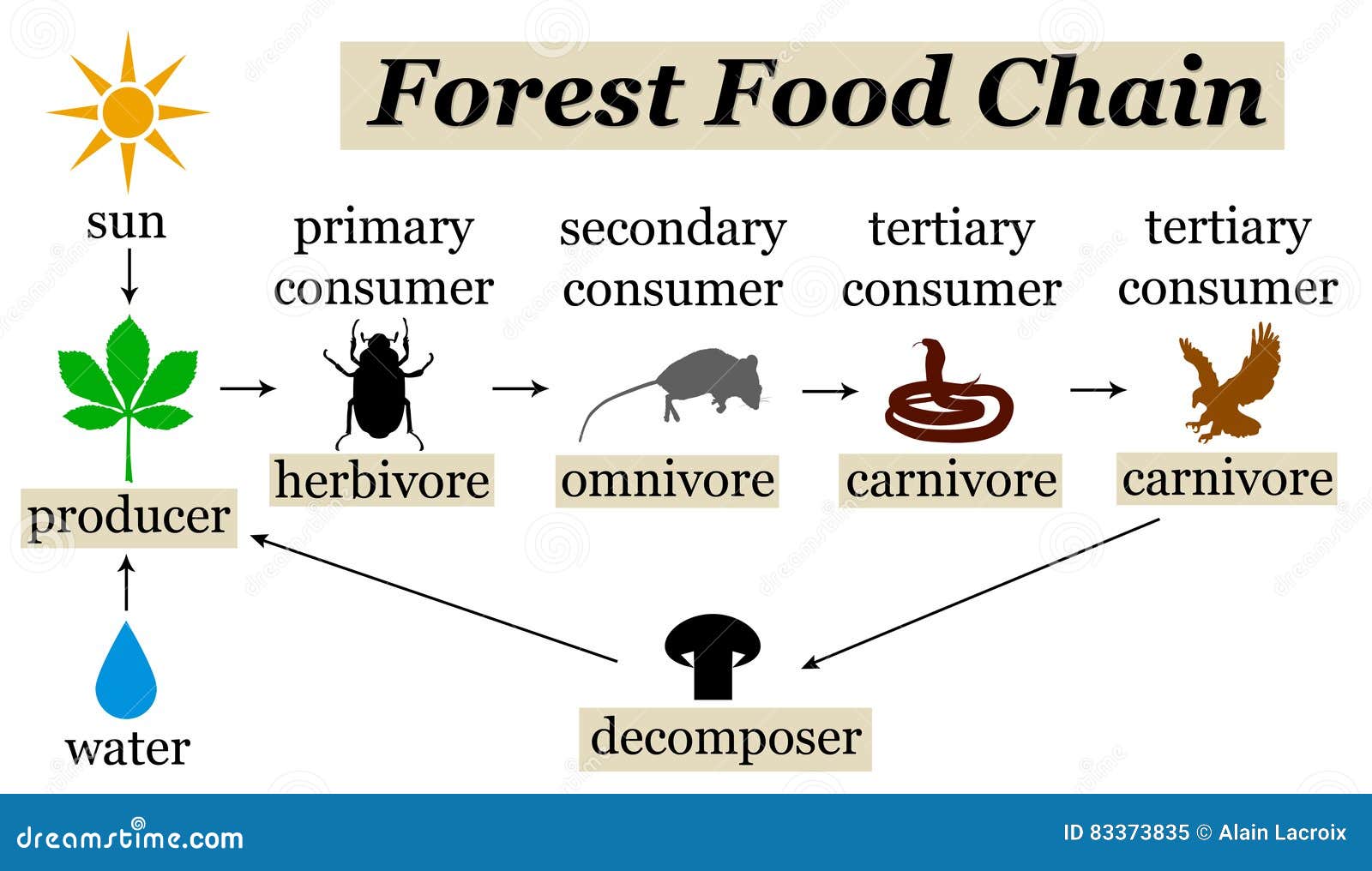
In order, list the different trophic levels in a food chain.
autotroph/producers -> primary consumers -> secondary consumers -> tertiary consumers
200
As you move up an energy pyramid, the energy __________ (increases/decreases).
As you move up an energy pyramid, the energy decreases.
200
What is symbiosis?
Symbiosis is any type of a close and long-term biological interaction between two different biological organisms.
It may be it mutualistic, commensalistic, or parasitic. The organisms may be of the same or of different species.
300
What is the difference between a population and community?
A population is a group of organisms, ALL THE SAME SPECIES, which interbreed and live in the same place at the same time.
A community is all the populations of DIFFERENT SPECIES that live in the same place at the same time.
300
What is biomagnification?
Biomagnification is the process by which substances become more concentrated in the bodies of consumers as one moves up the food chain (trophic levels)

300
What is a decomposer? Provide an example.
Decomposers absorb any dead materials and break it down into simple nutrients or fertilizers.
Examples: bacteria, mushrooms, etc.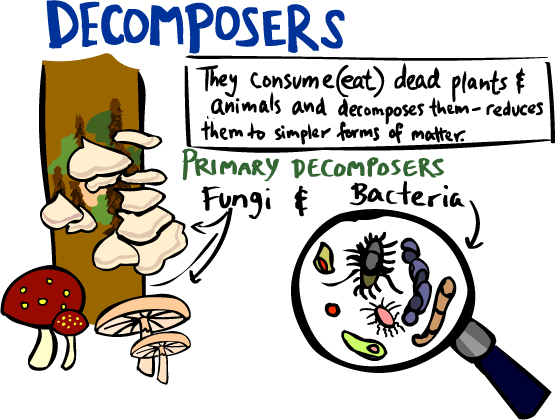
300
What are the three types of ecological pyramids?
Energy
Biomass
Numbers
300
What are the 8 characteristics of life?
1. Cellular Organization
2. Reproduction
3. Metabolism (obtaining and using energy)
4. Homeostasis
5. Heredity
6. Responsiveness
7. Growth and Development
8. Adaptation
400
What is the difference between parasitism, mutualism, and commensalism?
Parasitism: Symbiotic relationship in which one organism lives in or on another organism (the host) and harms the host.

Mutualism: Symbiotic relationship in which both species benefit from the relationship.

Commensalism: Symbiotic relationship in which one organism benefits and the other is not helped or harmed.
:max_bytes(150000):strip_icc()/caribbean-bahamas-little-bahama-bank-lemon-shark-negaprion-brevirostris-with-remora-597294394-58306beb3df78c6f6a314a05.jpg)
400
What is ecological succession?
Provide an example of primary succession.
Provide an example of secondary succession.
Ecological succession is the process of one community replacing another as a result of changing abiotic and biotic factors.
Primary succession: the establishment of a community in an area of bare rock that does not have topsoil. For example: a volcano erupts, lava covers the ground, and eventually hardens into bare rock. Lichens then begin to grow on the rock and thus are a pioneer species. After the pioneer species die, their decay begins the first stages of soil development and other plants begin to grow.
Secondary Succession: the orderly and predictable change that takes place after a community of organisms has been removed but the soil still remains. Example: a fire or flood disrupts a community and pioneer species begin the process of restoring the habitat.

400
Line K on this map represents what?
Line K represents the carrying capacity.
Carrying capacity: the number of people, other living organisms, or crops that a region can support without environmental degradation.
400
What are the four trophic levels represented in an ecological pyramid?
1. Producers/autotrophs
2. Primary consumers
3. Secondary consumers
4. Tertiary consumers
400
What is the independent variable?
What is the dependent variable?
IV: The factor that is changed and tested.
DV: The factor that is measured or observed. The dependent variable DEPENDS in the independent variable.
500
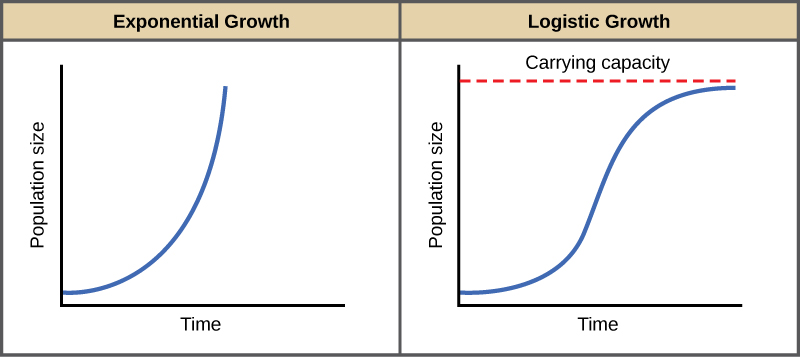
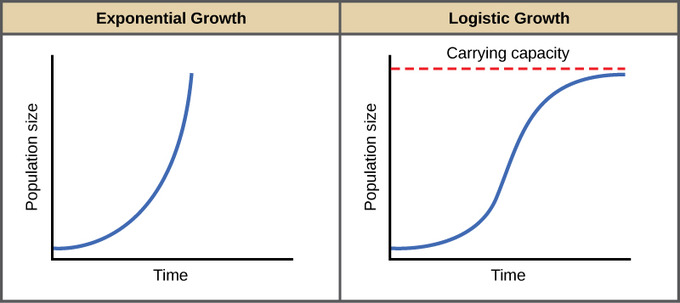
What is the difference between exponential growth and logistic growth? What shaped curve is associated with each?
Exponential Growth: Exponential growth of a population occurs when a population has a continuous birth rate throughout time, and is never hindered by the absence of food or the abundance of disease. It produces a J-shaped curve.
Logistic Growth: In real world situations, it is very common for populations to be restricted by a lack of food, and the presence of predators and diseases. As conditions become crowded, the population approaches the upper limit of the number of individuals the environment can support. This upper limit is referred to as its “carrying capacity.” Thus, in logistic growth patterns, we can expect the population to increase exponentially up to a point, and then suddenly level off as resources become scarce. It produces an S-shaped curve.
500
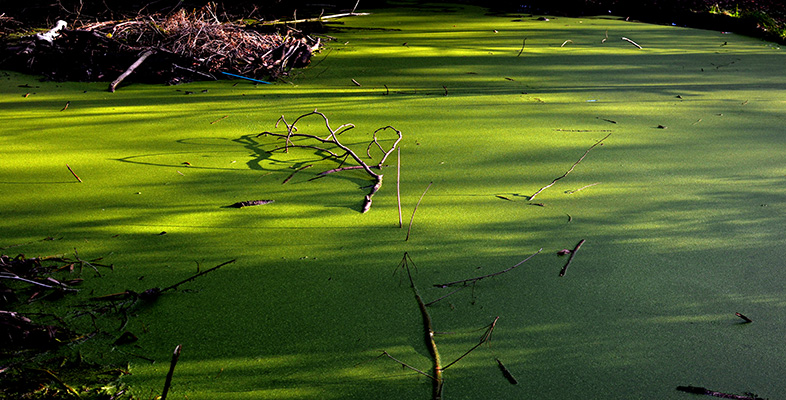
What is eutrophication? What are the six stages of the eutrophication process?
Eutrophication is when lakes, streams, and estuaries are over-fertilized, causing plants and algae to bloom and eventually die, causing the ecosystem to crash due to lack of oxygen.
1. Addition of nitrates
2. Growth of plants
3. Death of plants (due to lack of sunlight)
4. Growth of bacteria (decomposers to eat dead plants)
5. Lack of oxygen
6. Suffocation
500
What is a keystone species?
Keystone Species: a species that has a disproportionately large effect on the communities in which it occurs. Such species help to maintain local biodiversity within a community either by controlling populations of other species that would otherwise dominate the community or by providing critical resources for a wide range of species.
Example: The sea otter is a keystone species in the kelp forest ecosystem found along parts of North America's Pacific coast. A major part of its role in the kelp forest is to keep sea urchin populations in check.

500
What are heterotrophs, autotrophs, and chemotrophs?
Heterotroph: organism that DOES NOT make its own food. Also called consumers. Examples: humans, animals
Autotroph: an organism that uses the sun's energy to convert water and carbon dioxide into glucose (food). Also known as producers. Examples: plants, algae
Chemotroph: get energy from inorganic substances. They live deep down in the ocean where there is no sunlight. Examples: bacteria, deep sea worms
500
Define density-independent factors.
Define density-dependent factors.
Provide an example of each!
Density Independent Factors: abiotic factors in the environment that affect populations regardless of their density. Examples: storms, habitat destruction, drought, temperature.
Density Dependent Factors: Biotic factors in the environment that have an increasing effect as population size increases. Examples: disease, competition, parasites.