Cells
DNA & RNA
Organism
100
Which phase of cell replication involves the synthesis of new DNA strands?
A. G1 Phase B. S Phase
C. G2 Phase D. M Phase
B. S Phase
The S phase is where new DNA strands are synthesized during cell replication.
100
Which amino acid sequence can be coded from the DNA sequence CAG - TAG - CGA
A. Valine - Isoleucine - Glycine
B. Valine - Aspartic Acid - Alanine
C. Valine - Isoleucine - Alanine
D. Valine - Phenylalanine - Alanine
C. Valine - Isoleucine - Alanine
100
In which order would the following cellular processes lead to the development of a mature organism from a single fertilized egg?
A. Differentiation, meiosis, mitosis, fertilization
B. Fertilization, mitosis, differentiation, meiosis
C. Meiosis, differentiation, mitosis, fertilization
D. Fertilization, mitosis, meiosis, differentiation
B. Fertilization, mitosis, differentiation, meiosis
- Fertilization: The sperm and egg combine to form a zygote with a full set of chromosomes.
- Mitosis: The zygote undergoes multiple rounds of cell division (mitosis) to form a multicellular embryo.
- Differentiation: Cells in the embryo specialize into different types needed for the development of various tissues and organs.
- Meiosis: Meiosis occurs during the formation of gametes (sperm and egg), not during the development of the organism from a single fertilized egg.
200
During which phase of mitosis do the chromosomes condense and become visible under a light microscope?
A. Prophase B. Metaphase
C. Anaphase D. Telophase
A. Prophase
Prophase is where chromosomes condense and become visible under a light microscope as they prepare for division.
200
Which statement best describes a chromosome?
A. A structure composed of DNA and proteins found in the nucleus of a cell.
B. A segment of RNA that carries genetic information from DNA to the ribosomes.
C. A specialized cell structure that contains only maternal genetic material.
D. A small molecule that encodes the genetic instructions for an organism.
A. A structure composed of DNA and proteins found in the nucleus of a cell.
A chromosome is a condensed structure composed of DNA and proteins (such as histones) that carries genetic information in the form of genes. Chromosomes are located in the nucleus of eukaryotic cells.
200
Which cell characteristic is most indicative of a cell found in nerve tissue?
A. Cell 1, because it contains the most glycogen
B. Cell 2, because it has the highest concentration of neurotransmitters
C. Cell 3, because it lacks a nucleus
D. Cell 1 or Cell 2, because they both contain myelin
B. Cell 2, because it has the highest concentration of neurotransmitters.
Nerve tissue, which includes neurons, relies heavily on neurotransmitters for transmitting signals between cells. Neurotransmitters are chemicals that neurons release to communicate with other neurons, muscles, or glands. Therefore, a cell found in nerve tissue would typically have a high concentration of neurotransmitters to facilitate efficient communication.
300
During which phase of mitosis do the sister chromatids separate and move towards opposite poles of the cell?
A. Prophase B. Metaphase
C. Anaphase D. Telophase
C. Anaphase
Anaphase is where the sister chromatids separate and move towards opposite poles of the cell.
300
Based on the Gel Electrophoresis which of the following conclusion is correct?
A. Male 2 must be the father because the DNA fingerprints have the best match.
B. Male 1 must be the father because he has half of DNA in common with the child and the DNA fingerprints have the best match.
C. Male 2 must be the father because he has more than half of DNA in common with the child and the DNA
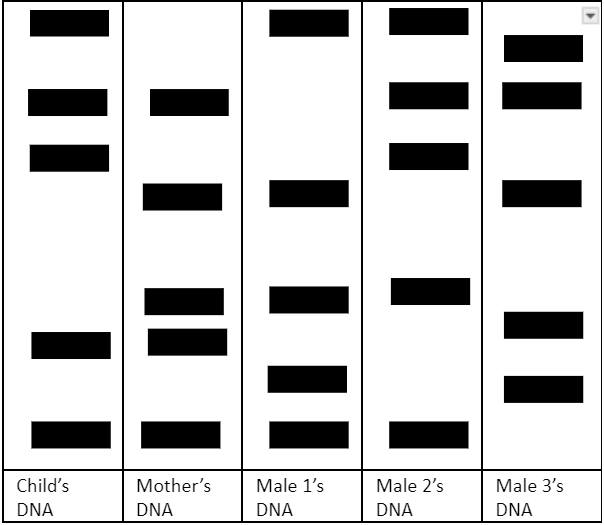
A. Male 2 must be the father because the DNA fingerprints have the best match.
300
Original DNA Sequence: ATCGATGGC Mutated DNA Sequence: ATCGATCGC
What is the consequence of this mutation?
A. The mutation will result in a frameshift, changing the entire amino acid sequence downstream.
B. The mutation will change the amino acid at position 4 from Valine to Alanine.
C. The mutation will result in a silent mutation, with no change in the amino acid sequence.
D. The mutation will introduce a stop codon, truncating the protein prematurely.
C. The mutation will result in a silent mutation, with no change in the amino acid sequence.
This mutation does not alter the amino acid encoded by the codon. In the original sequence, the codon at this position is GGC, which codes for Glycine. In the mutated sequence, the codon is CGC, which also codes for Glycine. This type of mutation, where the change in nucleotide sequence does not result in a change in the amino acid sequence, is known as a silent mutation.
400
Here is a table that shows the presence of various cell structures in an organism, which can help classify it as plant, animal, Prokaryote or Bacteria.
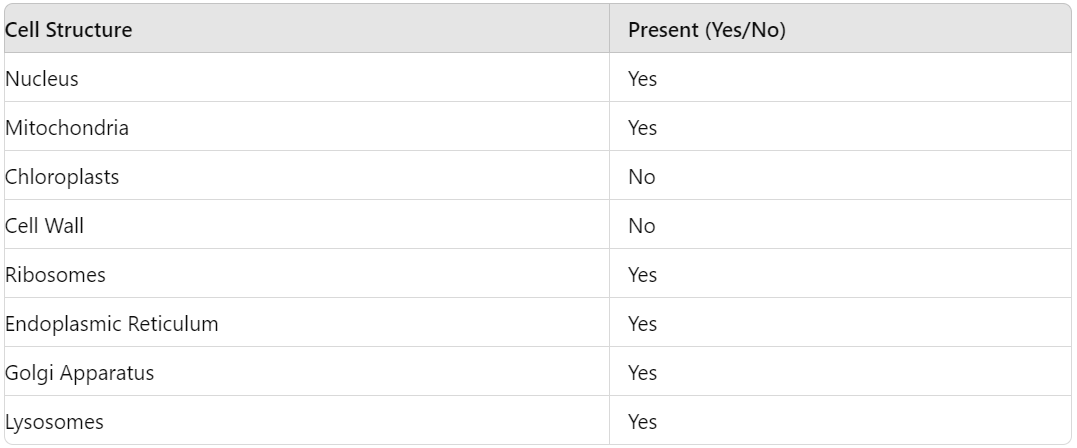
Based on the table provided, the organism should be classified as an animal cell. Here's the reasoning:
Presence of a nucleus and membrane-bound organelles (mitochondria, endoplasmic reticulum, Golgi apparatus, lysosomes) indicates it is a eukaryotic cell.
Absence of chloroplasts and cell wall indicates it is not a plant cell or an algal cell.
So, the correct classification is an animal cell.
400
In ducks, blue feathers (B) are dominant to green feathers (b). A female duck with blue feathers (genotype Bb) mates with a male duck that also has blue feathers (genotype BB). What is the probability that their offspring will have green feathers
A. 0% B. 25%
C. 50% D. 75%
A. 0%
All offspring (100%) will have the dominant phenotype (blue feathers).
Since both parents are homozygous or carry the dominant allele (B), none of their offspring can have green feathers. Therefore, the correct answer is A) 0%.
400
The graph below represents the effect of pH on three different enzymes at normal body temperature.

The graph illustrates that enzymes 1, 2, and 3
A. work best at different pH levels
B. are not affected by pH
C. work best in a low-pH environment
D. work best in a high-pH environment
A. work best at different pH levels
500
Which mutation would most likely result in cells being unable to maintain proper ion balance?
A. Change in the shape of the cell membrane, causing it to become more rigid
B. Change in the shape of an ion channel protein, causing its pore to narrow
C. Change in the mitochondria, causing them to produce less ATP
B. Change in the shape of an ion channel protein, causing its pore to narrow
This mutation would impede the proper flow of ions across the cell membrane, disrupting the cell's ability to maintain ion balance.
500
Which of the following is a key difference between DNA and RNA?
A. DNA contains thymine; RNA contains uracil.
B DNA is single-stranded; RNA is double-stranded.
C. DNA uses ribose sugar; RNA uses deoxyribose sugar.
D. DNA is found in the nucleus; RNA is found in the cytoplasm.
A. DNA contains thymine; RNA contains uracil.
500
In humans, hair color is determined by multiple genes. If black hair (dominant, represented by 'B') is crossed with blonde hair (recessive, represented by 'b'), what is the probability of their offspring having black hair?
B b
B | BB | Bb |
b | Bb | bb |
A. 25% B. 50%
C. 75% D. 100%
C. 75%