Plants
Animals
Genetics
Organelles
DNA
100
What process do plants perform to make their own food?
Photosynthesis
100
What kind of animals are human?
Mammals
100
A (adenine) pairs with ______ in a DNA sequence
G (guanine) pairs with________in a DNA sequence
Adenine pairs with Thymine and Guanine pairs with Cytosine in a DNA sequence.
100
What organelle is often called "the powerhouse of the cell," and creates energy for the cell.
Mitochondria
100
What is the scientific name of the structure of DNA?
Double Helix
200
What gases do plants take in? What gases do please release?
Plants take in Carbon Dioxide (CO2) and release oxygen (O2).
200
You might be called this animal if someone says your afraid. This animal migrates in a flock.
What animal am I?
Chicken
200
Is Dd usually a recessive trait or a dominant trait?
Is DD usually a recessive trait or dominant trait?
Is dd usually a recessive trait or a dominant trait?
Dd is a dominant trait.
DD is a dominant trait.
dd is a recessive trait.
200
What organelle is DNA found?
The nucleus
200
What does the A stand for in "DNA?"
Acid (Deoxyribonucleic acid)
300
Name 3 organisms that spread pollen from flower to flower.
1. Bee 2. Bird 3. Butterfly's 4. Beetles 5. Moths 6. Bats
300
Are animals heterotrophs or autotrophs?
Animals are heterotrophs because they do not make their own food.
300
How many chromosomes does a person usually have?
How many pairs of chromosomes does a person usually have?
Humans have 46 chromosomes.
Humans have 23 pairs of chromosomes.
300
I am a jelly-like substance that keeps organelles in their place. I am in both plants and animals.
What organelle am I?
I am a Cytoplasm.
300
What two scientists discovered DNA? (last names are acceptable)
James Watson, Francis Crick, and Rosalind Franklin
400
Which picture is a gymnosperm and which picture is a angiosperm?
:max_bytes(150000):strip_icc()/sunflowers-56a09b665f9b58eba4b205d1.jpg)

The sunflower is the angiosperm because it produces flowers.
The pine bush is a gymnosperm because it produces "naked seeds" such as pine cones.
400
Which cell is larger and more complex? Hint: This is an animal cell
A eukaryote or prokaryote?
Eukaryote
400
Define:
phenotype
genotype
heterozygous
homozygous
phenotype- an individual's observable traits (ex. hair color, widows peak)
genotype- genetic makeup representing the pair of alleles inherited for a particular trait
heterozygous- different alleles in a genotype (ex. Bb)
homozygous- same alleles in a genotype (ex. BB or BB)
400
What organelle make proteins? (hint: I am on the rough endoplasmic reticulum)
The organelle that make proteins are called ribosomes.
400
Chad has a genetic mutation called Down Syndrome. What is a genetic mutation? (Don't need to know what the specific gene mutation is)
A genetic mutation is an abnormal strand in DNA that results in a disorder.
FYI:
Down Syndrome is called Trisomy 21 which means Chad has three chromosomes
on chromosome 21.
500
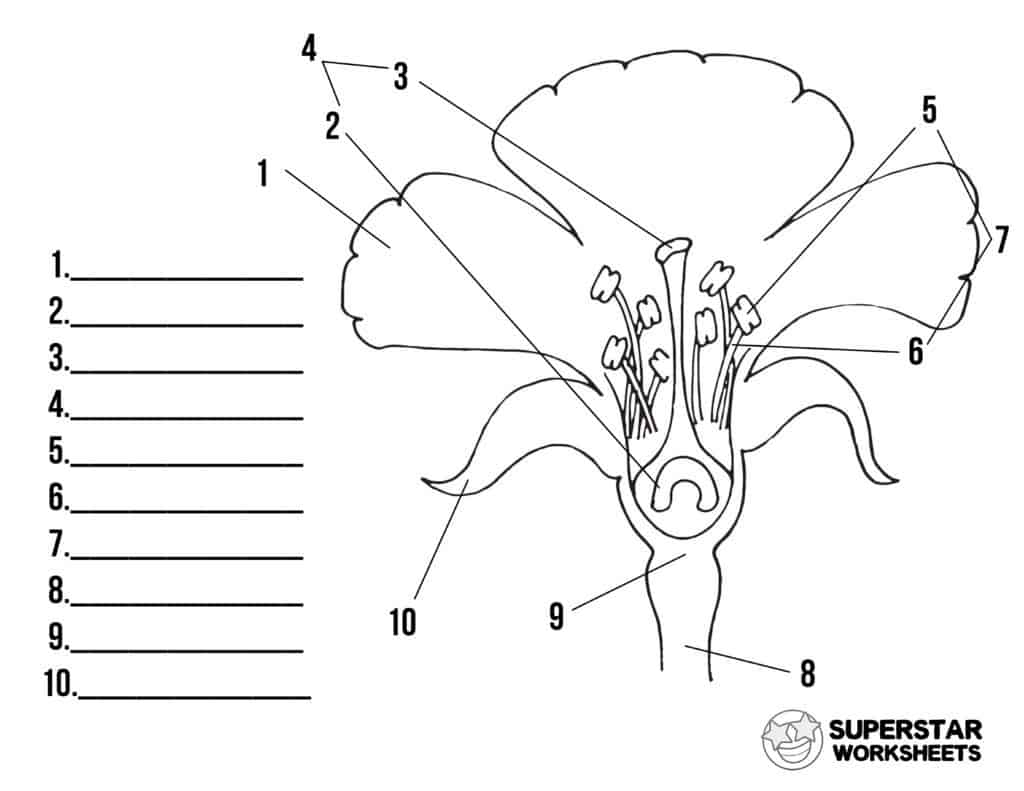
1. Petal 6. Filament
2. Ovary 7. Stamen
3. Stigma 8. Stem
4. Pistol 9. Reciprocal
5. Anther 10. Sepel
500
What are the six kingdoms of Life?
1. Archaebacteria 2. Eubacteria 3. Protista (protists) 4. Fungi 5. Plants 6. Animalia (animals)
500
In a group of cats (a clowder), some individuals have a furry body and others have a hairless body. The hairless body is recessive. The mom is homozygous recessive. The dad is heterozygous for a dominant trait. Use the letter h.
Complete the Punnett square to show all possible genotypes of the offspring from a cross between two cats. What percentage of cats have a hairless body? What percentage of cats have a body full of fur?

50% hairless body
50% furry body
500
Name 2 different organelles that plants do but animals do not?
1. Chloroplasts- the site of photosynthesis and contains chlorophyll
2. Cell wall- a "fence" around a plant cell
3. Large central vacuole- for water storage/pressure
500
What is the complimentary pair to the DNA sequence:
A T C A A G C G A T ?
T A G T T C G C T A