Evolution & Darwin
Natural Selection & Evidence
Taxonomy & Classification
Climate, Biomes & Succession
Classification of Organisms
Challenge Genetics & DNA
200
Darwin’s theory of evolution suggests that species do this over time.
Change
200
Fossils are preserved remains of these organisms.
Ancient/Dead organisms
200
A group at any level of taxonomic organization is called this.
Taxon
200
The average year-after-year conditions of temperature and precipitation in a region are called this.
Climate
200
Animals that are warm-blooded, have body hair, and produce milk are in this class.
Mammalia
200
A sperm with genotype Abc fertilizes an egg with genotype ABc. The zygote genotype is this.
AABbcc
400
Darwin made many famous observations on these islands.
The Galapagos Islands
400
Similar genes are evidence of this.
Common ancestry
400
The scientific naming system that gives each species a universally accepted name is called this.
Binomial nomenclature
400
An increase in Earth’s average temperature from carbon dioxide and other gases is called this.
Global warming
400
An organism that feeds only on plants is called this.
Herbivore
400
Hemophilia is recessive and X-linked. If a carrier female and normal male have children, this percent of male offspring are expected to have hemophilia.
50%
600
Darwin called the ability of an organism to survive and reproduce in its environment this.
Fitness
600
Natural selection favors inherited adaptations that maximize this.
Fitness
600
In the scientific version of a species name, this term is capitalized.
Genus
600
Ponds and lakes are this type of aquatic ecosystem.
Standing-water ecosystems
600
The domain Archaea includes organisms that often live in this type of environment.
Extreme environments
600
Eye color is an example of this type of trait controlled by multiple genes.
Polygenic trait
800
The V in the the VIDA acronym used to describe the process of adaptations by a species. It means, "Different"
Variation
800
The term to describe the number if different species in an area.
biodiversity
800
The domain containing unicellular organisms that live in extreme environments is this.
Archaea
800
Primary succession can begin after this type of volcanic event.
A lava flow
800
All organisms have this in common: they use these two molecules to pass on information.
DNA and RNA
800
Three amino acids require this many codons.
3
1000
Darwin observed species on the Galapagos Islands that were somewhat similar but had traits suited to these.
Their particular environments/niches
1000
Scientists consider these when they perform cladistic analysis.
Derived characters
1000
Organisms in Protista, Plantae, Fungi, and Animalia all belong to this cell type group.
Eukaryotes
1000
The two biomes with the least precipitation are these.
Tundra and desert
1000
Primary succession begins on newly exposed surfaces, while secondary succession begins on this.
Soil
1000
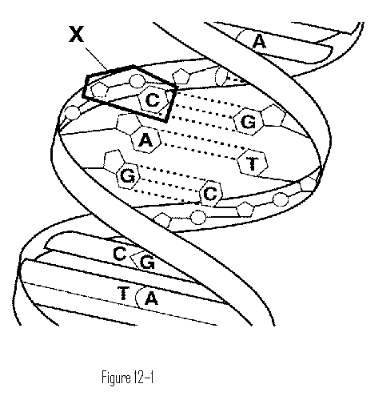 In the DNA figure from the test, the structure identified as X is this.
Nucleotide