Ecology
Chemistry
Cells
Genetics
Evolution
Anatomy
Mystery
100
What are 3 solutions to human's impact on the environment?
Reduce, Reuse, Recycle
Stop littering
Stop cutting trees down
Use renewable resources
Stop using single-use plastics
100
How is carbon related to all living things?
All life is made up of Carbon.
100
If a cell's mitochondria malfunctioned, what can't it do?
Provide or create energy
100
Where are genes located?
On chromosomes
100
What is natural selection?
Survival of the fittest
Nature choosing who survives
100
Why are leaves important to a plant?
That's where the majority of photosynthesis happens.
100
What would happen is organisms couldn't adapt to their environment?
Start mutating or move to another area
200
What correlations can be seen using the graph between the lynx and hare populations?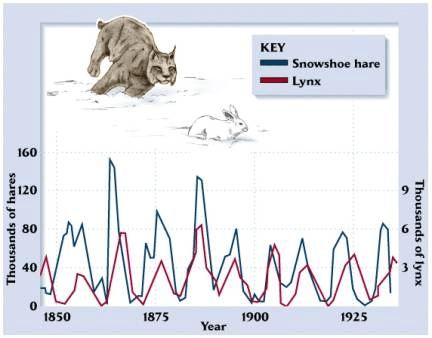
Their populations are connected.
As one goes up, so does the other, and as one goes down, so does the other.
200
Why are carbohydrates important to living things?
It's the main source of energy used in our bodies.
200
What is mitosis?
Cell division
200
What might cause mutations?
Changes in the environment
Personal choices(smoking, drinking, places you work, diet)
200
How can reproductive isolation lead to speciation?
Populations get separated, reproduce in their new groups, change over time to new species
200
How can technology help with organ issues?
3-D print organs
Robotic surgeries
Running tests/scans
Seeing the inside of the body without cutting it open
200
Why is water needed for life?
digestion, brain function, lubricate joints, keeps muscles elastic, produce saliva and bile, gets rid of toxins, keeps blood flowing...
300
How is water a limiting factor to organisms in an ecosystem?
The amount of water will determine how many organisms can live in an area.
300
Why are nucleic acids important to living things?
It holds all of our genetic information.
300
What is the difference between eukaryotic and prokaryotic cells?
Pro- no nucleus
Eu-has nucleus
300
How do dominant and recessive traits work in your DNA?
Dom- Always expressed when present
Rec- Only expressed when no dominant present
300
How does classifying organisms help with identifying evolutionary changes?
We can see who they share characteristics with and how the organisms are connected.
300
How do bacteria become antibiotic resistant?
We don't take medicine properly, bacteria mutate and become stronger than before.
300
Why do scientists use scientific names?
Consistent across the world
400
What is the difference between autotrophs and heterotrophs?
Auto- make their own energy
Hetero- consume their energy
400
How can enzymes in cells help organisms on a larger scale?
They break things down or build them up together
400
How are photosynthesis and cellular respiration related?
Both are processes for making energy for organisms.
400
How will mutations in gametic cells affect the organism as a whole?
Any mutations will affect the organism and can be passed on to their offspring.
400
Why does evolution happen?
Changes in the environment force changes in the organisms
400
How is oxygen related to your cells?
All cells need oxygen to live, and our RBC carry oxygen
400
Why are lipids important to living things?
provides energy and stores as energy
500
Give an example of how abiotic factors affect biotic factors.
Fires, rain, hurricanes, tornados, freezes, drought...
500
How does the endocrine system contribute to the homeostasis of a whole organism?
Endocrine system releases hormones that control and balance all things in our bodies.
500
What is mitosis' role in the production, growth, and maintenance of systems within complex organisms?
Mitosis makes new cells that help to repair damage and keep body systems in the best state they can be in. Each cell makes only their type of cell.
500
How does DNA determine what we look like?
DNA tells the proteins how to form, which makes up our bodies
500
Why might sexual reproduction be better than asexual reproduction?
Sexual- creates variation
Asexual- no variation
Variation is needed for survival
500
How is the structure of the heart best for its function?
Right side is less muscular-sends blood to lungs(surrounding heart)
Left side- stronger/thicker- sends blood to the entire body
500
How does natural selection lead to adaptations?
As nature selects the positive traits, they build up over time making the organism more adapted to their environment.