Cell Theory
Organelles
Homeostasis
Cell Transport
Cell Division
100
What is the basic unit of life?
Cell
100
This organelle is known as the control center of the cell.
Nucleus
100
What structure forms the boundary between the cell and its environment?
Cell membrane
100
Which type of transport does not require energy?
Which type of transport does require energy?
Passive
Active
100
What are the two reasons cells divide in organisms?
Growth and repair
200
Which type of cell does not have a nucleus?
Prokaryotic cell
200
This organelle makes proteins.
Ribosomes
200
What is the main purpose of homeostasis?
To maintain stable internal conditions.
200
What are the three types of passive transport?
Simple diffusion, facilitated diffusion, and osmosis
200
What are sister chromatids?
Identical copies of a replicated chromosome
300
Classify these organisms as prokaryotic or eukaryotic.
Plant, bacteria, animal, and fungi
Prokaryotic: bacteria
Eukaryotic: plant, animal, and fungi
300
Three organelles unique to plant cells?
Cell wall, chloroplasts, and large central vacuole.
300
A person's body temperature rises, so they sweat to cool down. What feedback mechanism is this an example of?
Negative feedback
300
What are three types of active transport?
Molecular pumps, endocytosis, and exocytosis
300
What are homologous chromosomes?
Chromosome pairs that contain the same types of genes, with one chromosome inherited from each parent.
400
What four components do both prokaryotic and eukaryotic have?
Genetic Material
Ribosomes
Cytoplasm
Cell Membrane
400
What two organelles are unique to animals cells?
Centrioles and lysosomes
400
Which type of feedback mechanism amplifies or increases the original change?
Positive feedback
400
A cell is placed in a hypertonic solution. Where will water move and how is the cell affected?
Water will leave the cell and the cell will shrink.
400
Draw a diagram of what anaphase looks like?
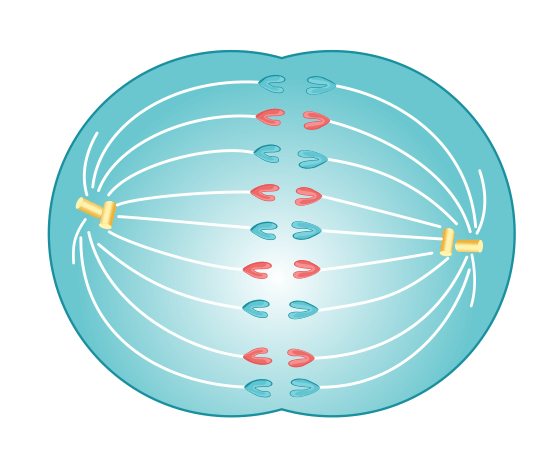
500
What are all three parts of the cell theory?
All living things are made of cells
Cells are the basic unit of life
All cells come from pre-existing cells
500
Which organelle would you expect to be especially numerous in muscle cells?
Mitochondria
500
The cell membrane is made of a ________ head and __________ tail.
Hydrophilic head and hydrophobic tail
500
A cell contains 30% solute. The surrounding solution contains 20% solute. Which way will water move? How do we describe the cell? Solution?
Into the cell.
Cell: hypertonic
Solution: hypotonic
500
List all of the steps in order that make up the full cell division cycle.
Interphase (G1, S G2), Prophase, Metaphase, Anaphase, Telophase, Cytokinesis