Mechanisms of Microevolution
Patterns of Evolution
Evidence of Evolution
Phylogeny
Natural Selection
100
What is microevolution?
evolution on a small scale (single population)
100
What are the two types of extinction we talked about?
gradual extinction and mass extinction
100
Paleontology is the study of prehistoric life through what record?
the fossil record
100
On this phylogenetic tree, what two organisms are the most closely related?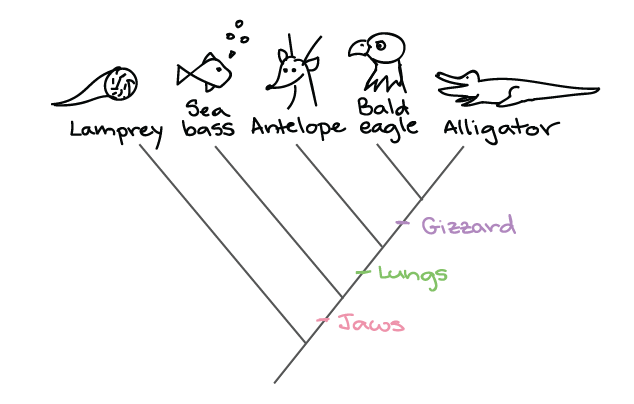
The bald eagle and the alligator
100
Who is known as the "father of Natural Selection"?
Charles Darwin
200
Peacocks and their beautiful tails that attract mates, but also predators are an example of this mechanism of microevolution
sexual selection
200
What is the difference between divergent and convergent evolution?
divergent - a number of species arise from a common ancestor
convergent - unrelated species evolve similar characteristics due to similar environments
200
Which two types of structures show evidence of divergent evolution (morphology)?
Homologous structures and vestigial structures
200
What characteristics would the antelope have?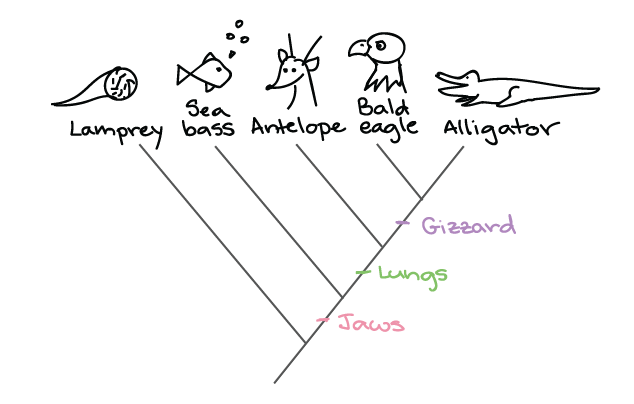
Jaws and lungs
200
What is known as the measure of how well you can survive in your environment?
fitness
300
What is the difference between genetic drift and gene flow?
genetic drift - random change in the frequency of alleles over time
gene flow - movement of genes in/out of a population
300
What is the definition of a species? What must happen for speciation (forming a new species by evolution from a pre-existing species) to occur?
species - group of organisms that can interbreed and produce viable, fertile offspring
some type of isolation must occur
300
Name an example of an analogous structure and how it may have developed.
wings, fins
similar environments (convergent evolution)
300
Which species is more closely related to the Emu, the kiwi or the Tinamou?
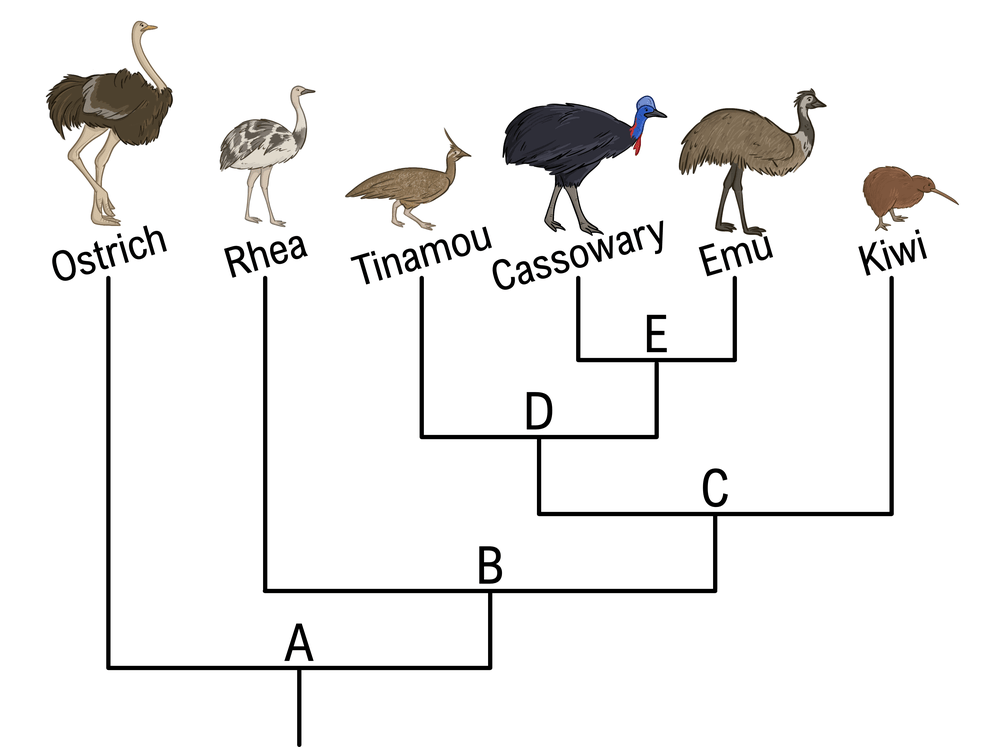
The Tinamou
300
What are the four principles of Natural Selection?
overproduction of offspring, variation, adaptation, and decent with modification
400
What is the ultimate source of variation?
Mutations
400
Plants evolve toxic chemicals to deter herbivores (e.g., milkweed), while herbivores evolve specialized resistance to those toxins (e.g., monarch butterfly caterpillars)
What pattern of evolution is this?
Coevolution
400
Which are most closely related based on the chart below? (biochemistry)
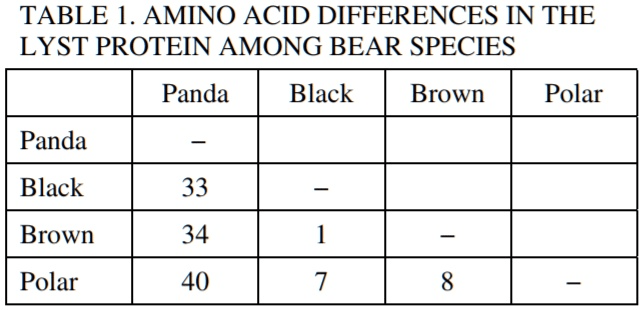
Brown bear and black bear (only 1 AA difference)
400
What does "maximum parsimony" mean?
the simplest explanation with the fewest evolutionary changes
400
During a period of droughts in the Mojave Desert, seeds that are small and easily eaten become more and more rare, leaving mostly seeds that are large with hard-cased shells behind. The only birds that can eat these particular seeds are those with large beaks. If the drought continues for several more years, what should be expected to happen as a result of natural selection?
More small-beaked birds will die than larger-beaked birds. The offspring produced in the following generations will have a higher percentage of birds with larger beaks.
500
What are the 5 conditions that need to be met for evolution NOT to occur?
Large population, random mating, no mutations, no migration, and no natural selection
500
A population of mollusks are living in a stable ecosystem in the ocean. A rapid change in sea level causes the formation of a lake, which isolates a group of them from the rest. This causes rapid evolutionary change, and large shelled mollusks quickly become more prevalent due to genetic drift.
What pattern of evolution is this?
Punctuated equilibrium
500
What is an endemic species and what piece of evolution evidence does it belong to?
A species found in only one geographic region
biogeography
500
Arrange the following from broadest to most specific:
Domain, Phylum, Kingdom, Genus, Species, Family, Order, Class
Domain, Kingdom, Phylum, Class, Order, Family, Genus, Species
500
What are alleles? Why might some alleles increase in frequency over time?
Versions of genes.
versions that make organisms better suited for their environment would increase in frequency because the organisms that possess them will be able to survive and produce more offspring