Blood
Vessels
Vessels
Blood vessels are organized into these two divisions.
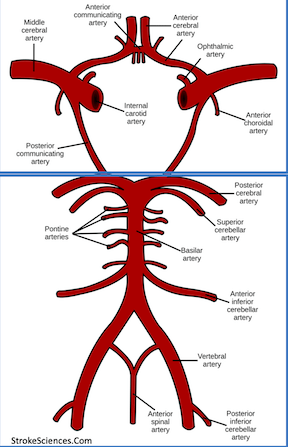
What are the anterior and posterior circulation?
A patient presents with right-sided weakness and sensory loss accompanied by garbled, slurred speech that is effortful and frustrating to her.
What is a left MCA syndrome?
A patient with longstanding uncontrolled HTN, T2DM, and HLD presents with weakness and sensory loss of right face, arm, and leg. She had no changes in her language.
What is small vessel disease?
The imaging modality of choice in assessment of a patient with acute stroke-like symptoms.
What is a (non-contrast) CT scan of the head?
This medication can be started in a patient who presents outside the tPA, endovascular window with a subacute ischemic lacunar stroke.
What is Aspirin?
The most common cause of intracerebral hemorrhage.
What is hypertension?
An area of the brain where blood supply is provided by the terminal branches of two main blood vessels.
What is a watershed (borderzone) area?
Pure hemisensory loss of face, arm, and leg.
What is a thalamic stroke syndrome?
A patient presents with new onset chest pain, palpitations, and acute infarcts in the left anterior and right posterior circulations.
What is cardioembolic?
The imaging modality of choice in the ED when a patient presents with an acute large vessel stroke and no hemorrhage is seen on CT head.
What is a CT angiography of the head and neck?
Its goal is to treat stroke risk factors such as HTN, T2DM, HLD in addition to smoking cessation to prevent another stroke from happening in the future.
What is secondary stroke prevention?
The most common sites for this are the basal ganglia, thalamus, pons, and cerebellum.
What are the most common sites of hypertensive hemorrhage?
It terminates into the middle cerebral artery (MCA) and the anterior cerebral artery (ACA)
What is the ICA?
This disorder is caused by occlusion of the posterior cerebral artery that leads to infarction of the occipital lobe and splenium of the corpus callosum.
What causes alexia without agraphia?
What is a hypercoagulable state?
A patient presents with an acute right MCA and left PCA infarct. You suspect atrial fibrillation but his cardiac auscultation and ECG show normal sinus rhythm. This test will better evaluate if paroxysmal atrial fibrillation is the cause of their strokes.
What is telemetry (or long-term cardiac monitoring such as loop recorder or holter monitor)?
Prior to giving this clot-busting medication, a patient must have an NIHSS, blood glucose, and blood pressure within treatment guidelines.
What is tPA?
The etiology of this bleed.
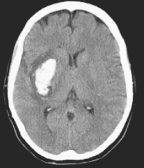
What is hypertensive hemorrhage?
The two arteries that join to form the Basilar artery.
What are the vertebral arteries?
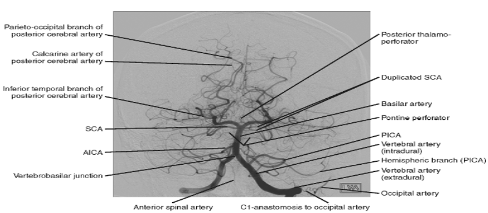
A patient presents with a depressed level of consciousness and oculomotor dysfunction.
What is the top of the basilar syndrome?
A patient reports 3 episodes of monocular vision loss described as "curtain-dropping."
What is artery-to-artery emboli (from large artery athero disease)?
The radiologist reads an acute infarct on a brain MRI with a hyperintensity on DWI sequence which correlates with a hypointense area on _____.
What is an ADC sequence?
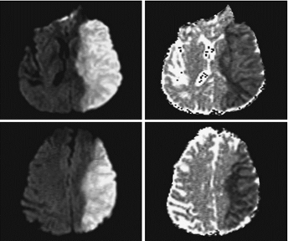
A patient presents with 3 hours of left hemineglect, left hemiparesis and sensory loss and was found to have a large acute R MCA occlusion on CTA. He was given tPA and transferred to a larger hospital to receive ___.
What is mechanical thrombectomy (endovascular recanalization therapy)?
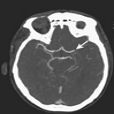 Left MCA occlusion
The name of this type of hemorrhage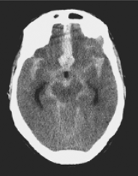
What is a subarachnoid hemorrhage?
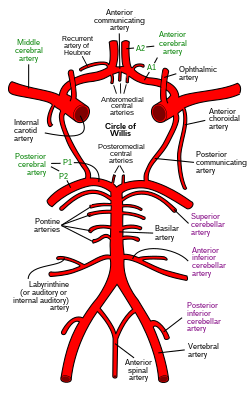
A circulatory anastomosis that connects the anterior and posterior circulation.
What is the circle of Willis?
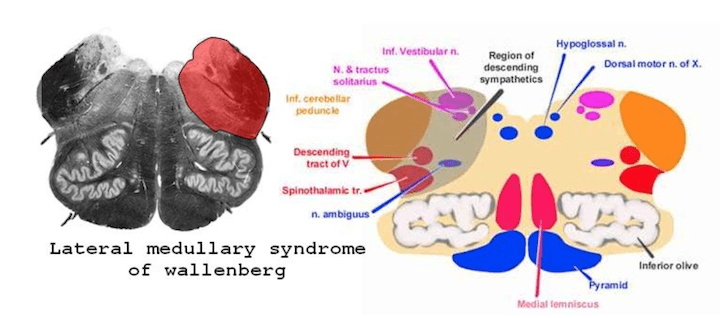
A patient presents with hoarseness, dysphagia, vertigo, vomiting, and contralateral loss of arm/leg pain/temperature sensation as well as ipsilateral loss of facial pain/temperature sensation, ataxia, and a Horner's.
What is lateral medullary syndrome (Wallenberg Syndrome)?
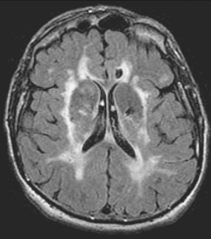
A 58 y/o man with history of dementia and migraines is brought in to the ED for symptoms of acute stroke. His MRI shows an acute right thalamocapsular infarct in addition to numerous chronic bilateral subcortical infarcts.
What is CADASIL?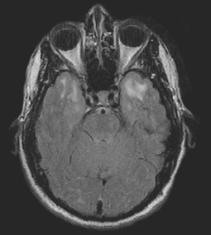
Diagnostic imaging modality for a pregnant woman presents with a few cortical acute infarcts that do not conform to typical vascular territories.
What is CT or MRI venography?
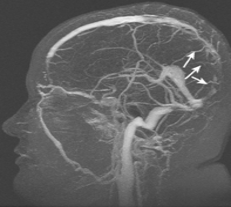
CVST
A patient presents with acute stroke and found to be in atrial fibrillation. His aspirin 81mg was stopped and he was started on ____ for secondary stroke prevention.
What is anticoagulation?
Patients with this condition often present with numerous cortical microbleeds as seen in image.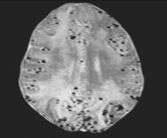
What is amyloid angiopathy (CAA)?
