DOE vs POE
Healing- Acute
Healing- Repair
Pain Physiology
Pain Control
Range of Motion
Flexibility
Chronic Pain Article
100
This type of evidence focuses on clinician-rated measures like ROM, swelling, strength, and RTP testing and is primarily related to pathophysiology.
What is Disease-Oriented Evidence (DOE)?
100
This initial vascular response briefly decreases blood flow to help control bleeding immediately after injury.
What is vasoconstriction?
100
This phase of healing follows inflammation and is characterized by collagen production and tissue rebuilding.
What is the fibroblastic repair phase?
100
These free nerve endings respond to mechanical, thermal, and chemical stimuli and initiate the pain pathway.
What are nociceptors?
100
This neurotransmitter is released at the synapse between first- and second-order nociceptive neurons in the spinal cord.
What is Substance P?
100
This device is used to measure joint angles during ROM assessment.
What is a goniometer?
100
This neurologic receptor senses changes in muscle length and speed of stretch, and is active during dynamic stretching.
What is the muscle spindle?
100
These support cells in the central nervous system help regulate neural activity and can influence pain signaling.
What are glial cells?
200
This component of the ICF model includes ligament damage, reduced ROM, and muscle weakness following a lateral ankle sprain.
What are impairments?
200
These primary connective tissue cells proliferate during the fibroblastic repair phase and are responsible for producing collagen to help form scar tissue.
What are fibroblasts?
200
As scar tissue matures during the remodeling phase, it gradually loses its blood supply and becomes firm and non-elastic, ultimately becoming this.
What is avascular?
200
[DAILY TRIPLE] These nerve pathways transmit sensory information from receptors to the central nervous system.
What are afferent pathways?
200
This theory proposes that non-nociceptive input from large-diameter afferent fibers can inhibit transmission of pain signals at the spinal cord level.
What is the Gate Control Theory?
200
Normal hip flexion range of motion is approximately this many degrees.
What is 125 degrees?
200
During reciprocal inhibition, when one muscle contracts to create movement, the opposing muscle must relax. These two muscle roles describe the contracting muscle and the relaxing muscle.
Both must be named correctly for points.
What are the agonist and the antagonist?
200
These receptors on glial cells, when activated by cannabinoids, reduce inflammatory signaling and decrease pain.
What are CB2 receptors?
300
This component describes difficulty walking upstairs or driving after injury.
What are activity limitations?
300
According to this law, connective tissue remodels along lines of tensile stress applied during rehabilitation.
What is Wolff’s Law? (Specifically, Davis' Law)
300
[DAILY DOUBLE] Because collagen fibers are laid down rapidly and in a disorganized fashion, healed tissue never completely restores its capacity to tolerate this specific directional pulling force.
What is tensile stress?
300
This neurotransmitter is released by nociceptors and facilitates the transmission of pain signals across the synapse in the spinal cord.
What is Substance P?
300
This pain control mechanism involves signals traveling from the brain down to the spinal cord to inhibit nociceptive transmission.
What is descending control?
300
This type of range of motion is used to aid synovial fluid movement and joint nutrition without requiring muscle contraction.
What is passive range of motion (PROM)?
300
In this static stretch, the hamstrings will eventually relax after 6-8 seconds due to what mechanism?
What is autogenic inhibition?
300
Chronic use of these drugs can activate glial cells, increase the release of pro-inflammatory signaling molecules, and paradoxically lead to heightened pain sensitivity.
What are opioids?
400
This ICF category refers to inability to return to sport, work, or social roles due to injury.
What are participation restrictions?
400
This cellular process removes necrotic tissue and pathogens through engulfment and enzymatic breakdown during the inflammatory phase.
What is phagocytosis?
400
This fluid, produced within synovial joints, provides lubrication and nutrition to articular cartilage but can negatively affect ligament scar maturation if excessive.
What is synovial fluid?
400
These two fibers enter the spinal cord and transmit fast sharp pain and slow dull pain, respectively.
Both answer must be correct to get points.
What are A-delta fibers and C fibers?
400
[DAILY DOUBLE] Following tissue injury, this protective response decreases motor activation and muscle function due to nociceptive input, potentially delaying rehabilitation.
What is neural inhibition?
400
This ROM intervention involves uninterrupted mechanical movement of a joint for extended periods, often up to 24 hours per day.
What is continuous passive motion (CPM)?
400
The antagonist muscle group in this picture.
What are external rotators?
400
[DAILY DOUBLE] In chronic pain states, activated glial cells release these inflammatory chemical messengers that increase the excitability of second-order neurons and contribute to central sensitization.
What are cytokines?
500
These two contextual categories influence recovery and include factors such as home support, motivation, and access to care.
Both answers must be correct in order to get points.
What are environmental factors and personal factors?
500
These substances are responsible for vasodilation, increased vascular permeability, and attracting leukocytes during the inflammatory phase, like histamine for example.
What are chemical mediators?
500
Loss of this ligament function following injury contributes to decreased neuromuscular control and increased risk of reinjury.
What is proprioception?
500
A-alpha and A-beta fibers are examples of this category of neurons that transmit information such as touch or pressure to the central nervous system and can inhibit pain transmission in gate control theory.
What are sensory fibers?
500
According to Spinal Adaptation Syndrome, restoration of this mechanism through graded activity reestablishes normal motor output and reduces pain inhibition.
What is central control?
500
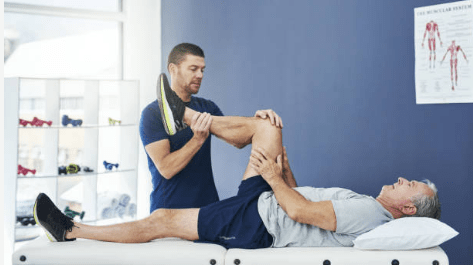
This would be the missing degrees in the patient's knee flexion ROM.
What is 50 degrees?
500
The elbow is stuck in this type of contracture.
What is a flexion contracture?
500
These endogenous opioid peptides are released by inhibitory interneurons in the dorsal horn and suppress transmission between first- and second-order nociceptive neurons.
What are enkephalins?
1000
[FINAL JEOPARDY] This is what PNF stands for.
Proprioceptive Neuromuscular Facilitation