Atom
Periodic Table
Bonds
Reactions
Thinkers
100
Positively charged particles in the nucleus of the atom
What are protons?
100
Elements are separated into these three categories on the periodic table
What are metals, nonmetals, and metalloids?
100
Bonds are formed when atoms donate or share these
What are electrons?
100
The substance formed as the result of a reaction
What is a product?
100
Water is a compound of these two elements
What are hydrogen and oxygen?
200
Name the negatively charged particles that orbit the nucleus
What are electrons?
200
Copper has an atomic number of 29. This tells us what about copper atoms
What is one copper atom has 29 protons?
200
Atoms of two or more elements bond together to form this
What are compounds?
200
The substances involved in a reaction
What is a reactant?
200
The number of states of matter represented on the periodic table
What is three?
300
Neutrons have this type of charge
What is no charge?
300
Elements in the same ________ share similar properties
What is a group/column?
300
When atoms share electrons, they form this type of bond
What is a covalent bond?
300
Give 1 example of an endothermic reaction AND 1 example of an exothermic reaction
Endothermic: Photosynthesis, cooking, anything that requires energy
Exothermic: Turning on a light bulb, turning on the stove, anything that releases energy
(See Mr. Harris for other acceptable answers)
300
Challenge: Salt is a compound formed by these two elements
What are sodium and chlorine (NaCl)
400
The total number of protons and neutrons is known as the _________ number
What is the mass number?
(Atomic mass is also acceptable)
400
Name an element that would most likely be a good conductor of electricity
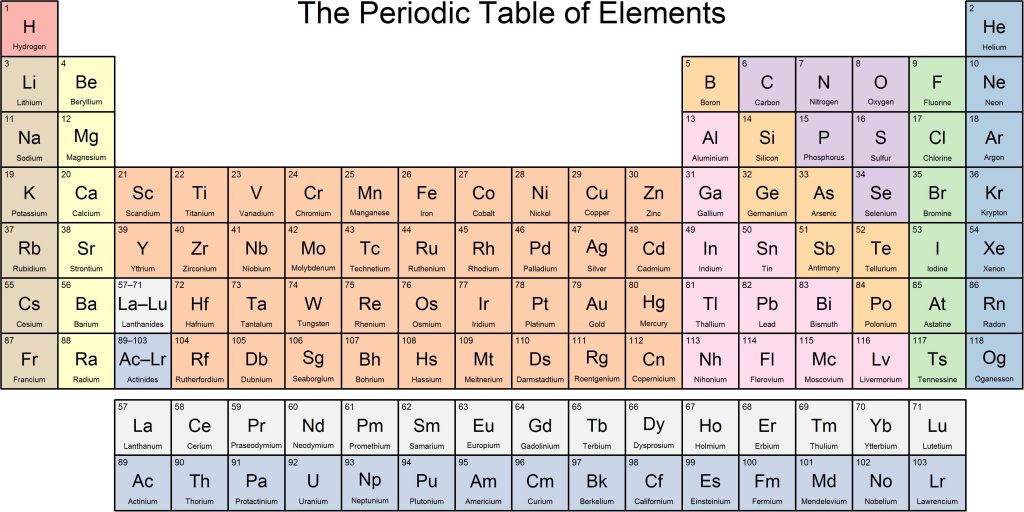
Answer: Any element on the metal side of the table (except Hydrogen)
(See Mr. Harris if no one in your group is sure)
400
In order for an ionic bond to form metallic atoms must do this for a nonmetallic atom
What is donate an electron?
400
Tommy pours baking soda into a bottle of vinegar and it causes a balloon to inflate. He determines this is an exothermic reaction because gas was released in the process and the bottle was cold. Is his reasoning correct? Why or why not?
What is no? Gas is matter not energy. The cold temperature shows that energy was not released. If heat energy was released the bottle would have been warm.
400
A student combined table salt and hydrogen peroxide in a beaker, added small pieces of steel, and placed a thermometer in the beaker. After one minute, the student measured the mass of the contents in the beaker. The student measured the contents in the beaker again at 10 minutes and discovered the mass had decreased slightly. The student's observations are shown in the table.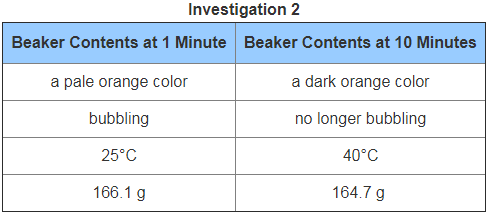
There is evidence of an exothermic reaction because ____________
The temperature increased
500
An atom of this element has 2 protons in its nucleus
What is helium?
500
Name one element that would have some metallic properties and some nonmetallic properties?
What is Boron, Silicon, Germanium, Arsenic, Antimony, Tellurium or Polonium?
500
Atoms are stable. Once an atom loses or gains an electron it becomes charged. An atom with a charge is known as this
What is an ion?
500
Challenge: Think of a process that would start as an exothermic reaction but end as an endothermic reaction
What is turning on the stove to cook
Turning on the stove would be exothermic, but once you use the heat to cook it becomes endothermic.
500
The student combined table salt and hydrogen peroxide in a beaker, added small pieces of steel, and placed a thermometer in the beaker. After one minute, the student measured the mass of the contents in the beaker. The student measured the contents in the beaker again at 10 minutes and discovered the mass had decreased slightly. The student's observations are shown in the table.
In the example above hydrogen peroxide and table salt would both be considered ______
What are reactants?