12.1 Angles and Degree Measure
12.2 Trig Functions of Acute Angles
12.3 Trig Functions of General Angles
12.4 Values of Trig Functions
12.5 Solving Right Triangles
12.6 The Law of Cosines
12.7 The Law of Sines
12.8 Solving General Triangles
12.9 Areas of a Triangle
100
Express in decimal degrees to the nearest hundredth of a degree
33°15'
15/60=0.25
33.25°
100
Use the diagram to solve the triangle. a=3 c=6
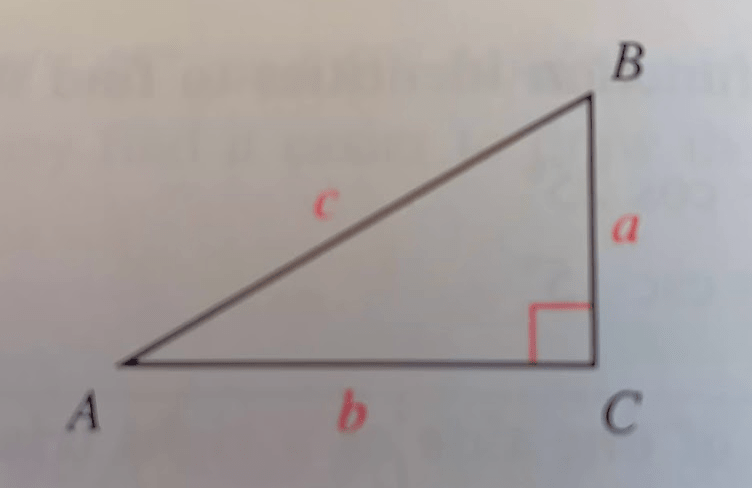
b=3sqrt(3)
A=30°
B=60°
C=90°
100
Name the quadrant and reference angle of -400°
-400+360=-40°="reference angle"
Quadrant 4
100
"Find "csctheta=3.000
sintheta=1/3
sin^(-1)(1/3)=theta=19.47°
100
The height of an isosceles trapezoid is 6 units, and the bases have lengths 4 units and 20 units. Find the measure of the angles.
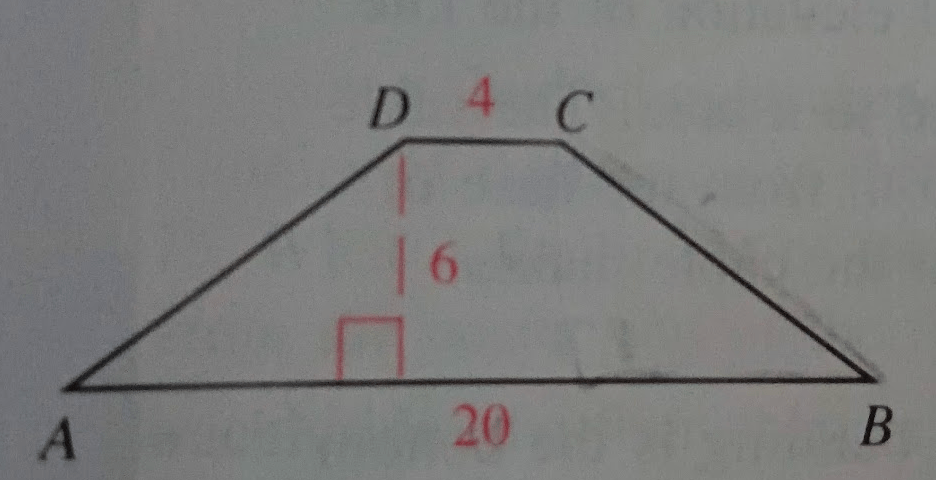
20-4=16
each triangle has sides 6, 8 and 10.
sinA=6/10
sin^-1(6/10)=36.86°=A=B
180-90-36.86=53.14
90+53.14=143.14=C=D
100
A compass with legs 3in long is opened to measure the diameter of a circle. If the diameter is 5in, what is the angle between the legs of the compass?
Because you have a SAS situation, you need to use the law of cosines. Because you are solving for an angle, you should use the rearranged version.
cosC=(a^2+b^2-c^2)/(2ab)
cosC=(3^2+3^2-5^2)/(2*3*3)=(9+9-25)/(18)=(-7)/18
C=cos^(-1)(-7/18)=112.9°
100
Two angles of a triangle measure 75° and 51°. The side opposite the 75° is 25in. How long is the shortest side?
Angles of the triangle are 75°, 51°, and 54°. That means the shortest side is across from 51°.
sin(75)/25=sin51/x
x=(sin51*25)/sin75=20.11"in"
100
Solve ∆ABC given A=60°, a=4, and b=10
sin60/4=sinB/10
sinB=(10*sin60)/4=2.17
The sine of an angle cannot be greater than 1 so this triangle has no solution
100
Find the area of ∆ABC given: b=14cm, c=9cm, and A=52°
Use the formula
K=1/2bcsinA
K=1/2(14)(9)sin(52)
K=49.64cm^2
200
Express 13.24° in degrees, minutes, and seconds
.24*60=14.4
.4*60=24
13°14'24"
200
Find x in the diagram below
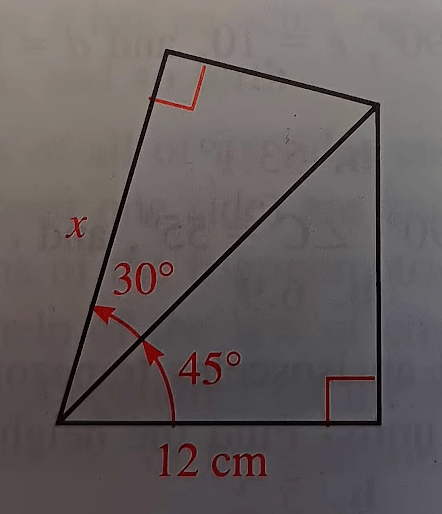
cos45=12/r
r=16.97
cos30=x/16.97
x=14.70
200
If
cos(theta)=-3/4 and sin(theta)<0 " find" tan(theta)
cos is negative and sine is positive so we are in quadrant 2.
3^2+b^2=4^2
9+b^2=16
b=root()(7)
tan(theta)=-root()(7)/-3=root()(7)/3
200
"If "costheta = 0.5606" and "90°<theta<360°", find "theta" to the nearest tenth of a degree"
360-55.9=304.1°
200
Solve the ∆ABC if A=30°50', b=53.5 and C=90°
50/60=.83
cos(30.83)=53.5/c
c=62.30
sin(30.83)=a/62.30
a=31.93
90-30.83=59.17°=B
200
A triangular lot of land has sides of length 130m, 150m, and 80m. What are its angles?
cosC=(130^2+150^2-80^2)/(2(130)(150))
C=32.2°
(sin32.2)/80=sinB/130
B=60°
180-60-32.2=87.8°=A
200
Solve ∆DEF if D=32°, E=108°, and f=12
F=180-108-32=40°
(sin40)/12=(sin108)/e=(sin32)/d
e=17.75
d=9.89
200
Solve ∆ABC if A=40°, a=6, b=8
(sin40)/6=(sinB)/8
sinB=.857
B=59°" or " 121°
C=81°" or " 19°
(sin40)/6=(sin81)/c
(sin40)/6=(sin19)/c
c=9" or " 3
200
Find the area of ∆ABC given: A=35°, B=105°, and c=10m
we need to find the other angle if we wish to find the area using the equation
K=1/2c^2(sinBsinA)/sinC
C=40°
K=1/2*10^2(sin105sin35)/sin40=43.10m^2
300
Find two angles, one positive and one negative, that are coterminal with 285°
285-360= -75°
285+360= 645°
300
Give the six trigonometric functions of θ
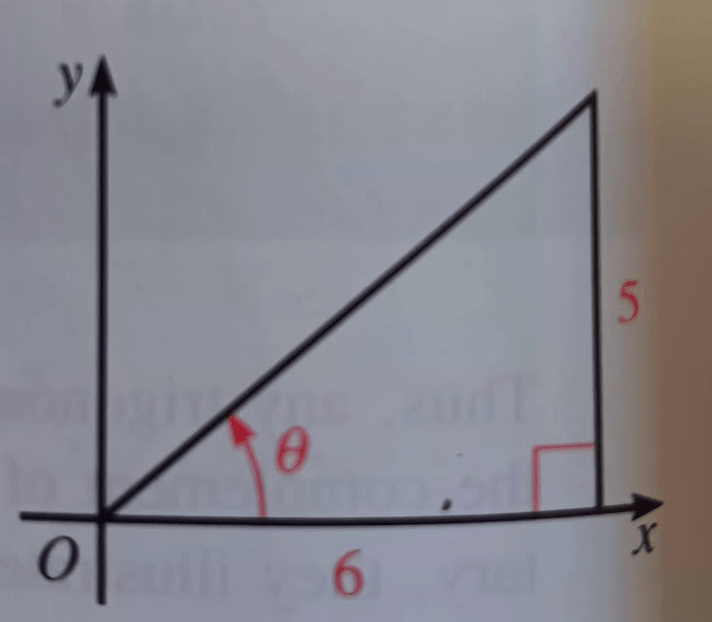
5^2+6^2=c^2=25+36=61
c=sqrt(61)
sintheta=(5sqrt(61))/61
costheta=(6sqrt(61))/61
tantheta=5/6
cottheta=6/5
csctheta=(sqrt(61))/5
sectheta=(sqrt(61))/6
300
Give the exact values of the six trigonometric functions of 240°
Quadrant 3 so sin<0 cos<0 tan>0
240-180=60°
sin(240)=-sin(60)=(-sqrt(3))/2
cos(240)=-cos(60)=-1/2
tan(240)=tan(60)=sqrt(3)
csc(240)=((-2 sqrt(3))/3)
sec(240)=(-2)
cot(240)=(root()(3))/3
300
First give the quadrant then find the five other trigonometric functions.
sectheta=13/5, sintheta<0
sin<0 and cos>0 so quadrant 4
a^2+b^2=c^2
5^2+b^2=13^2
169-25=b^2=144
b=12
costheta=5/13
sintheta=-12/13
csctheta=-13/12
tantheta=-12/5
cottheta=-5/12
300
The angle of elevation from an observer on the street to the top of a building is 55.6°. If the observer is 150 ft from the base of the building, how tall is the building?
tan(55.6)=h/150
219.07ft tall
300
A parallelogram has sides 6cm and 8cm and a 65° andlge. Find the lengths of the diagonals. (Recall that adjacent angles of a parallelogram are supplementary)
c^2=8^2+6^2-2(8)(6)cos(65)=59.43
c=7.7cm
180-65=115
c^2=8^2+6^2-2(8)(6)cos(115)=140.57
c=11.86
300
Two surveyors are on opposite sides of a swamp. To find the distance between them, one surveyor locates a point T that is 180m from her location at point P. The angles of sight from T to the other surveyor's position, R, measure 72° for angle RPT and 63° for angle PTR. How far apart are the surveyors?
180-72-63=45° = PRT
sin(45)/180=sin63/(RP)
RP=226.8 m
300
In quadrilateral ABCD, AB=3, BC=4, CD=5, and DA =6. The length of diagonal BD is 7. Find the length of the other diagonal.
A picture helps alot with this one.
We will need angle B or angle D to find the other diagonal using the law of cosines. So first we will need to use the law of cosines to find the components of B or D with the other diagonal triangle.
Let's do angle B. Angle B is composed of angle ABD and angle CBD.
Angle ABD can be found with the law of cosines.
cosABD=(3^2+7^2-6^2)/(2(3)(7))=.523
ABD = 58.41°
Angle CBD can be found with the law of cosines.
cosCBD=(4^2+7^2-5^2)/(2(4)(7))=.714
CBD=44.42°
B=58.41+44.42=102.83°
Now using the law of cosines we can find the other diagonal AC of ∆ABC.
AC^2=3^2+4^2-2(3)(4)cos102.83=30.33
AC=5.51
300
Find the area of the triangular plot of land if the sides have length 200m, 150m, and 100m.
Use herons formula
s=(200+150+100)/2=225
K=sqrt(225(225-200)(225-150)(225-100))=sqrt(225(25)(75)(125))=7261.84m^2