11.1 Limits
11.2 Methods for Solving Limits
11.3 Tangent and Secant Lines
11.4 Limits with Infinity
11.5 Area Problem
100
Complete the table to estimate the limit.
lim_(x->2)(x-2)/(3x^2-4x-4)


limit is 1/8 or 0.125
100
Find the limit if it exists
lim_(x->8)(|8-x|)/(8-x)
We need to look at the limit from both sides to see if this exists. Do this with a graph
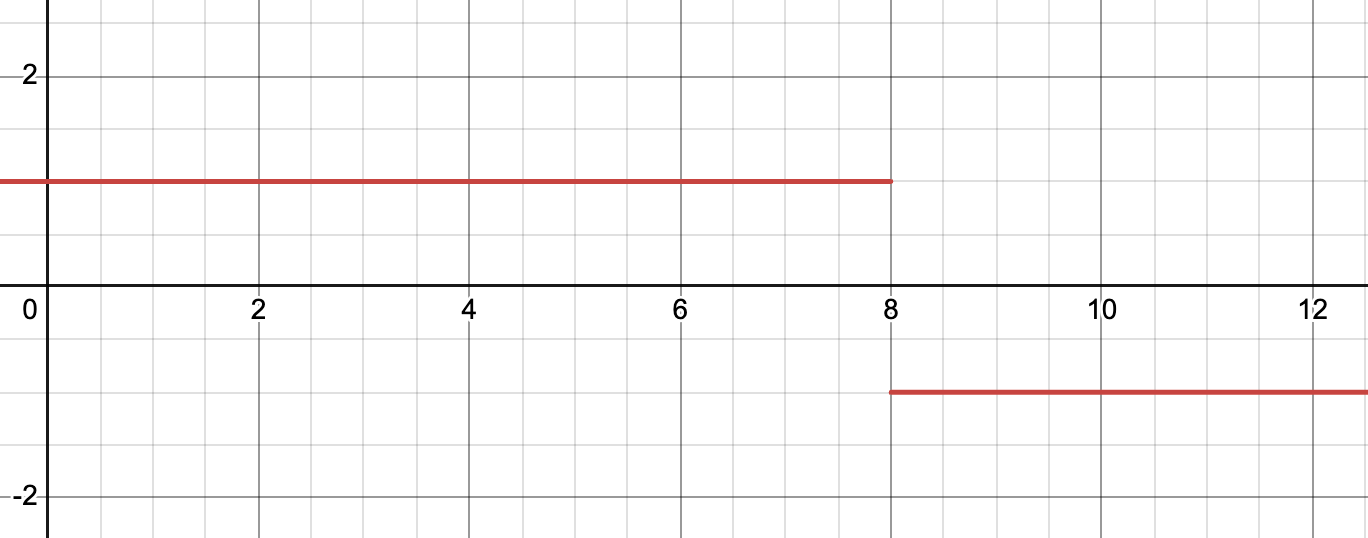
When we look at the limit from the left, we get
lim_(x->8^-)(|8-x|)/(8-x)=1
When we look at the limit from the right, we get
lim_(x->8^+)(|8-x|)/(8-x)=-1
Because they do not match, the limit does not exist
100
Find the derivative of the function.
y=3x
We know from slope-intercept form that this line will have a slope of 3 always, but let's use the derivative formula
f^'(x)=lim_(h->0)(f(x+h)-f(x))/h
f^'(x)=lim_(h->0)(3(x+h)-3x)/h=(3h)/h=3
100
Find the limit if it exists
lim_(x->infty)(7x)/(14x+2)
Divide the function (numerator and denominator) by the highest power of x
lim_(x->infty)(7x)/(14x+2)=7/(14+2/x)=7/14=1/2
100
Evaluate the sum
sum_(i=1)^100(i+3)^2
Multiply it out first
sum_(i=1)^100(i^2+6i+9)
Then split it into three sums
sum_(i=1)^100i^2+6sum_(i=1)^100i+sum_(i=1)^100(9)
We can then rewrite each using formulas
((n(n+1)(2n+1))/6)+6((n(n+1))/2)+9n
then we can plug in our n=100 for each
((100(100+1)(2(100)+1))/6)+6((100(100+1))/2)+9(100)=338350+30300+900=369550
200
Find the limit by direct substitution
lim_(x->2)(3x+5)/(5x-3)
lim_(x->2)(3(2)+5)/(5(2)-3)=(6+5)/(10-3)=11/7
200
Find the limit if it exists.
lim_(x->3)(t^2-9)/(t-3)
lim_(x->3)((t+3)(t-3))/(t-3)=(t+3)/1=(3+3)/1=6
200
Find the derivative of the function.
f(t)=sqrt(t+5)
f^'(x)=lim_(h->0)(f(x+h)-f(x))/h
f^'(x)=lim_(h->0)(sqrt(t+h+5)-sqrt(t+5))/h
(sqrt(t+h+5)-sqrt(t+5))/h*(sqrt(t+h+5)+sqrt(t+5))/(sqrt(t+h+5)+sqrt(t+5))=((t+h+5)-(t+5))/(h(sqrt(t+h+5)+sqrt(t+5)))=h/(h(sqrt(t+h+5)+sqrt(t+5)))=1/(sqrt(t+h+5)-sqrt(t+5))
lim_(h->0)1/(sqrt(t+h+5)+sqrt(t+5))=1/(2sqrt(t+5))
200
Find the limit if it exists
lim_(x->infty)[2-(2x^3)/(x+1)^2]
First multiply it out
lim_(x->infty)[2-(2x^3)/(x+1)^2]=[2-(2x^3)/(x^2+2x+1)]
We can see that the degree of the denominator is less than the degree of the numerator, so this will approach either positive or negative infinity. Let prove it.
Then we can divide everything by the highest power of x in the denominator, which is x^2
lim_(x->infty)[2-(2x)/(1+2/x+1/x^2)]=[2-infty]=-infty
200
Use summation formulas and properties to rewrite the sum as a rational function S(n) then find
lim_(n->infty)S(n)
sum_(i=1)^n((4i^2)/n^2-i/n)(1/n)
First we will distribute the 1/n and then split both of the sums into two sums
sum_(i=1)^n((4i^2)/n^3-i/n^2)
4/n^3sum_(i=1)^ni^2-1/n^2sum_(n->infty)^ni)
Now we can substitute sum formulas
4/n^3((n(n+1)(2n+1))/6)-1/n^2((n(n+1))/2)
Now, combining the terms and simplifying
(4n(n+1)(2n+1))/(6n^3)-(n(n+1))/(2n^2)=(8n^2+12n+4-3n^2-3n)/(6n^3)=(5n^2+9n+4)/(6n^2)=S(n)
Now we can find the limit of S(n)
lim_(n->infty)S(n)=lim_(n->infty)(5n^2+9n+4)/(6n^2)=5/6
300
Use the graphs to find the limit if it exists. If it does not exist, explain why.
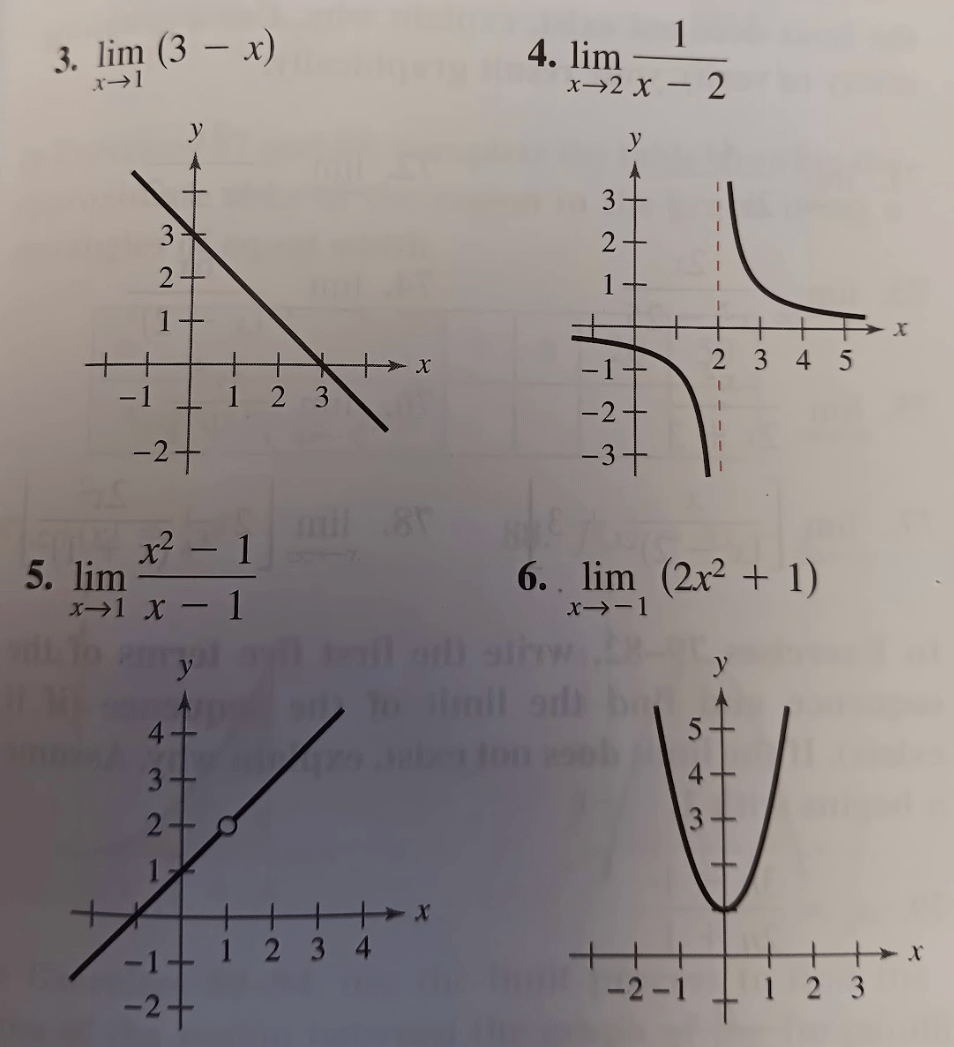
3. the limit as x approaches 1 is 2
4. The limit does not exist because the graphs approach negative and positive infinity at 2
5. The limit as x approaches 1 is 2 even though there is a gap you can approximate it.
6. The limit as x approaches -1 is 3
300
Find the limit if it exists
lim_(x->1)(sqrt(3)-sqrt(x+2))/(1-x)
lim_(x->1)(sqrt(3)-sqrt(x+2))/(1-x)
300
Find the formula for the slope of the graph. Then use it to find the slope at the two points
f(x)=x^2-4x
a) (0,0)
b) (5, 5)
Use the derivative formula to find an equation for slope.
lim_(h->0)(f(x+h)-f(x))/h
lim_(h->0)(((x+h)^2-4(x+h))-(x^2-4x))/h=(x^2+2hx+h^2-4x-4h-x^2+4x)/h=(h^2+2hx-4h)/h=(h+2x-h)/1
lim_(h->0)(h+2x-4)=2x-4
At (0,0) the slope would be -4
2(0)-4=-4
At (5,5) the slope would be 6
2(5)-4=6
300
Find the first 5 terms of the sequence and find the limit of the sequence if it exists.
a_n=n/(n^2+1)
1/2,2/5,3/10,4/17,5/26
lim_(n->infty)n/(n^2+1)=1/n=0
The limit is 0 because the denominator is one degree higher than the numerator so the denominator will increase greater than the numerator causing it to approach 0
300
Find the area of the region between the graph of the function and the x-axis over the specified interval
f(x)=8(x-x^2)
Interval [0,1]
We can use the formula
lim_(n->infty)sum_(i=1)^nf(a+((b-a)i)/n)(b-a)/n
this can be broken down into width and height of each rectangle.
Width
w=(b-a)/n=(1-0)/n=1/n
Height
f(a+((b-a)i)/n)=f(0+((1-0)i)/n)=f(i/n)
Now we will find the sum of the height multiplied by the width
sum_(i=1)^n((8i)/n-(8i^2)/(n^2))(1/n)
Now we will split them into two sums and pull out constants
8/n^2sum_(i=1)^ni-8/n^3sum_(i=1)^ni^2
Now we can substitute sum formulas for each sum
8/n^2((n(n+1))/2)-8/(n^3)((n(n+1)(2n+1))/6)
Now we can find a common denominator and simplify
(12n^2+12n)/(3n)-((8n^2+12n+8)/(3n^2))=(4n^2-8)/(3n^2)
Now we can take the limit of this to find the area. Since the degree of both the numerator and the denominator are the same the limit will be equal to the coefficients.
lim_(n->infty)(4n^2-8)/(3n^2)=4/3