Quadratic Functions and Functions of Higher Degree
Zeros and Fundamental Theorem of Algebra
Division and Complex Numbers
Graphs of Rational Functions and Asymptotes
100
Identify the vertex and x-intercept(s) of the function. Sketch a rough draft of the graph.
f(x)=(x-4)^2-4
vertex at (4,-4)
x-intercepts (2,0) and (6,0)
100
Find the zeros of the function
f(x)=x^4-x^3-2x^2
f(x)=x^2(x-2)(x+1)
0 d.r., 2, and -1
100
What is the complex conjugate of
-4+i
-4-i
100
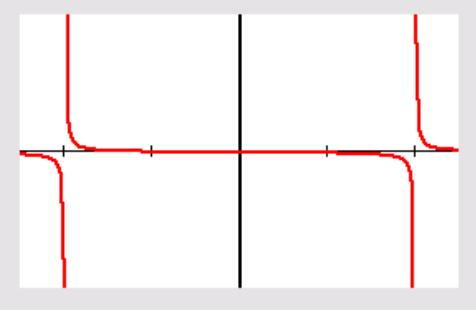
Find the horizontal and vertical asymptotes of
f(x)=(2x)/(x^2-4)
Horizontal - y=0
Vertical - x=2, x=-2
200
What are the transformations for the following graph
y=x^4
a)
f(x)=(x+5)^4
b)
f(x)=x^4-4
c)
f(x)=3+x^4
d)
f(x)=1/4(x-2)^4
a) to the left 5
b) Down 4
c) Up 3
d) to the right 2 and flatten by 1/4
200
Use Descartes's Rule of Signs to determine the possible number of positive and negative real zeros of the function.
h(x)=-2x^5+4x^3-2x^2+5
Positive - 3 possible positive roots
Negative - 2 possible negative roots
h(-x)=2x^5-4x^3-2x^2+5
200
Use Long Division to Divide
(24x^2-x-8)/(3x-2)
8x + 5 + 2/(3x - 2)
200
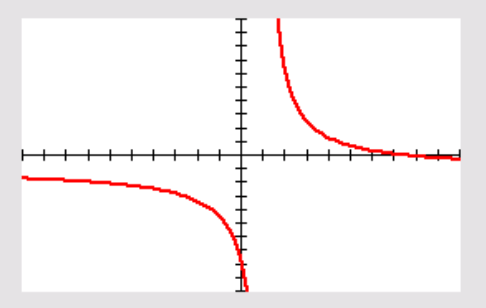
Find the horizontal and vertical asymptotes of
f(x)=(x-8)/(1-x)
x=1
y=-1
300
What are the transformations for the following graph
y=x^3
a)
f(x)=-x^3+4
b)
f(x)=(x+2)^3-1
c)
f(x)=-1/3x^3+1
d)
f(x)=-(x+8)^3
a) Up 4 and flip over x axis
b)Down 1 and left 2
c)Up 1, flip over x axis and flatten by 1/3
d)Left 8 and flip over x axis
300
Use the rational zero test to list all possible rational zeros of f.
10x^3+21x^2-x-6
(+-1,+-2,+-3+-6)/(+-1,+-2,+-5,+-10)
+-1,+-(1/2),+-(1/5),+-(1/10),+-2,+-(2/5),+-3,+-(3/2),+-(3/5),+-(3/10),+-6,+-(6/5)
300
Use Synthetic Division to Divide
(2x^3+6x^2-14x+9)/(x-1)
- Quotient: 2x² + 8x - 6
- Remainder: 3
300
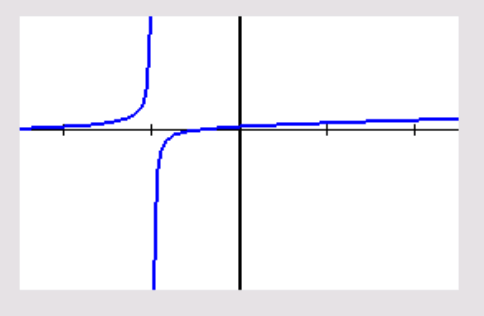
Find the Vertical, Horizontal, and Slant asymptotes of
(x^2-x+1)/(x-3)
Horizontal - none
Vertical - x=3
Slant - y=x+2
400
Identify the vertex and intercept(s)
f(x)=3x^2-12x+11
The vertex is (2,-1)
The y-intercept is (0,11)
The x-intercepts are
(2+-sqrt3/3,0)
400
Find all the zeros of the function.
f(x)=5x^4+126x^2+25
x=±isqrt(5 )/ 5,+-5i
400
Write the quotient in standard form
(1-7i)/(2+3i)
(-19 - 17i)/13 = -19/13 - 17/13i
400
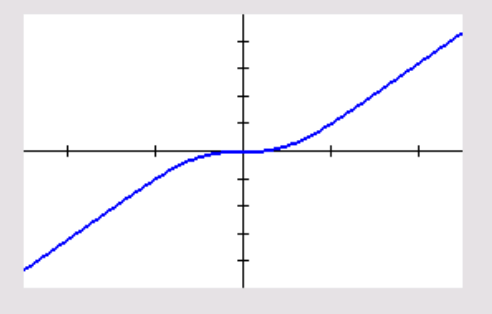
Sketch the graph by hand and check for intercepts, vertical asymptotes, horizontal asymptotes, and slant asymptotes.
(2x^3)/(x^2+1)
Slant asymptote at 2x
no vertical or horizontal asymptotes
500
Write the standard form of the quadratic funcation that has the indicated vertex and whose graph passes through the given point.
Vertex (-2,-2)
Point (-1,0)
y=2(x+2)^2−2
500
Find all the zeros of the function. (Hint: x^2+4 is a factor)
f(x)=6x^3-5x^2+24x-20
x=5/6,+-2i
500
Find a polynomial function with real coefficient that has the given zeros.
1,-4,-3+5i
(x-1)(x+4)(x^2+6x+34)
x^{4}+9x^{3}+48x^{2}+78x-136
500
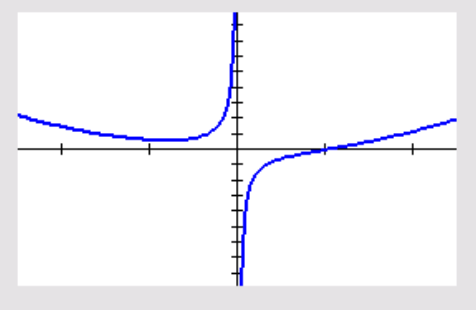
Sketch the graph by hand and check for intercepts, vertical asymptotes, horizontal asymptotes, and slant asymptotes.
(2x^2+7x+3)/(x+1)
Vertical Asymptote at x=-1
No horizontal Asymptote
Slant Asumptote at 2x+5