Reflux Revelations
Barrier Breakdown
Cells Gone Wild
Scope, Biopsy & Statistics
IDK, I'm Tired
100
This classic GERD symptom is a burning sensation behind the sternum, often occurring after a meal.
What is heartburn?
100
This high-pressure zone between the distal esophagus and stomach normally limits reflux.
What is the lower esophageal sphincter?
100
DNA replication occurs during this phase of the cell cycle.
What is the S phase?
100
This procedure allows direct visualization of Tony’s esophagus and collection of tissue.
What is an EGD, or esophagogastroduodenoscopy?
100
In this observational study design, investigators classify participants by exposure status and follow them over time to compare the incidence of an outcome between exposed and unexposed groups.
What is a cohort study?
200
Tony’s BMI of 33.5 contributes to reflux through this mechanical effect.
What is increased intra-abdominal pressure?
200
Put these changes in order: adenocarcinoma, dysplasia, chronic reflux injury, intestinal metaplasia.
What is chronic reflux injury → intestinal metaplasia → dysplasia → adenocarcinoma?
200
This checkpoint prevents a cell with damaged DNA from beginning replication.
What is the G1/S checkpoint?
200
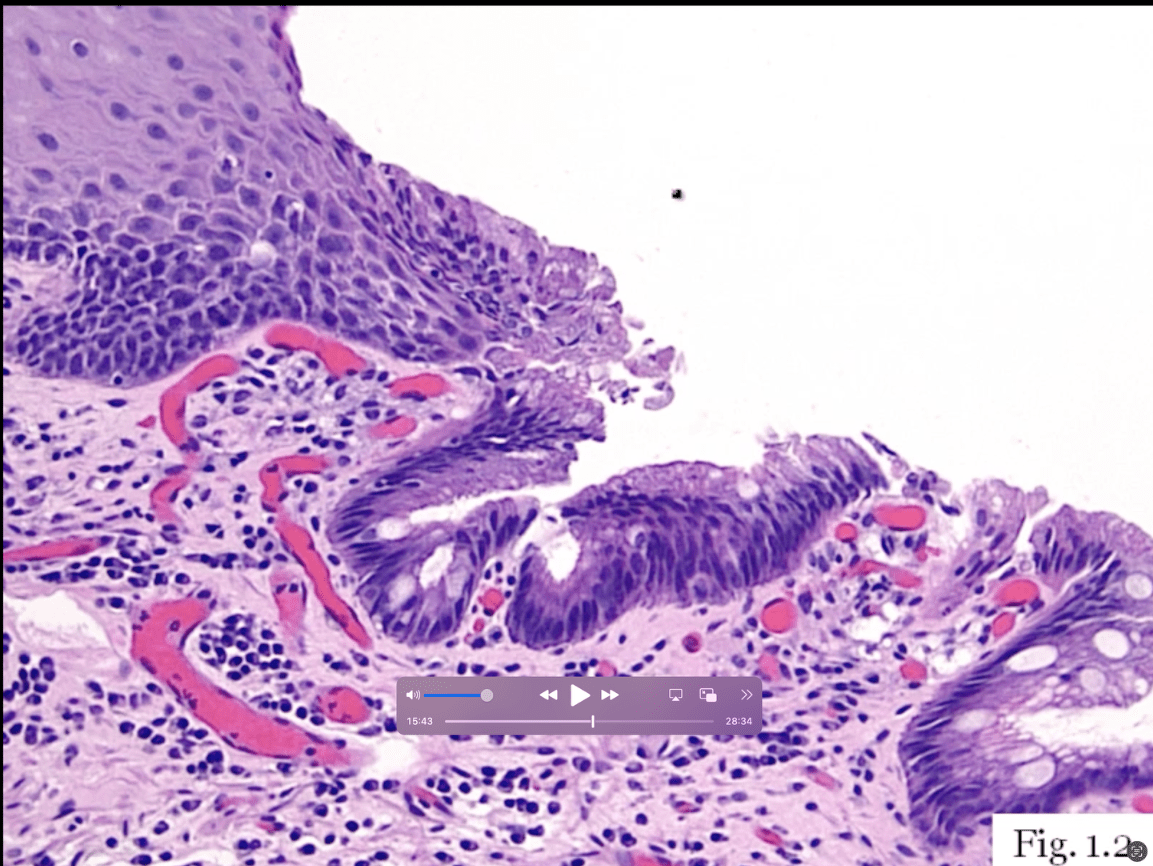
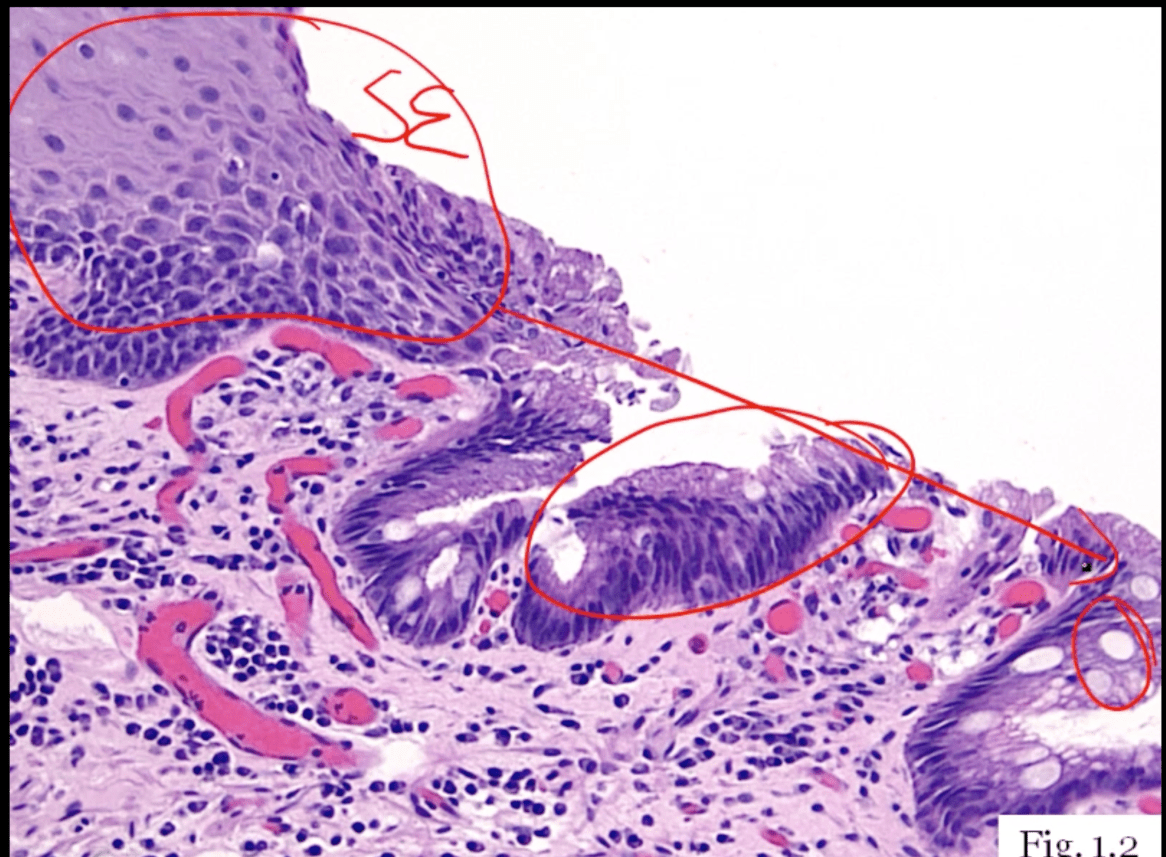
This histologic finding confirmed Tony’s Barrett’s esophagus.
What is intestinal metaplasia?
200
A distal esophageal biopsy shows columnar epithelium containing goblet cells but no nuclear atypia or architectural distortion. This finding represents which pathological process?
What is intestinal metaplasia without dysplasia?
300
Transient decreases in lower esophageal sphincter tone cause a disorder that commonly presents with heartburn, regurgitation, and dysphagia; may also cause chronic cough or hoarseness; is associated with asthma; and can lead to erosive esophagitis, strictures, and Barrett esophagus.
What is gastroesophageal reflux disease (GERD)?
300
In Barrett’s esophagus, normal stratified squamous epithelium is replaced by this type of epithelium.
What is specialized intestinal-type columnar epithelium with goblet cells?
300
This tumor suppressor responds to DNA damage by promoting repair, cell-cycle arrest, senescence, or apoptosis.
What is p53?
300
Tony’s biopsy did not show this precancerous alteration characterized by cytologic atypia and disordered tissue architecture.
What is dysplasia?
300
The histologic identification of these mucus-producing cells within columnar epithelium supports a diagnosis of specialized intestinal metaplasia.
What are goblet cells?
400
Name two possible extraesophageal manifestations of GERD.
What are chronic cough, hoarseness/laryngitis, asthma-like symptoms, or dental enamel erosion?
400
This premalignant change involving cellular atypia and disordered tissue architecture may regress if the injurious stimulus is removed, although it can also progress to cancer.
What is dysplasia?
Dysplasia is potentially reversible, but regression is not guaranteed especially with high-grade dysplasia.
400
Loss of this CDKN2A gene product removes inhibition of cyclin D–CDK4/6 and weakens the G1/S checkpoint.
What is p16?
Gene: CDKN2A, Gene Product:p16, blocks G1 p S phase
400
Investigators identify people with Barrett’s esophagus and follow them over time to measure new cancers. This is what type of study?
What is a cohort study?
400
This measure of association compares the probability of an outcome in an exposed group with the probability of that outcome in an unexposed group and is commonly calculated in cohort studies.
What is relative risk?
500
Discontinuing this exposure may improve GERD by restoring LES tone while also reducing irritation of the esophageal mucosa.
What is smoking
500
Which postprandial behavior decreases the likelihood that gastric contents will move proximally across an incompetent gastroesophageal barrier?
What is remaining upright after eating?
500
Loss of this tumor suppressor may activate Wnt/β-catenin signaling and promote cellular proliferation.
What is APC?
500
500
Match each tumor suppressor with its pathway: regulation of β-catenin/Wnt signaling; inhibition of cyclin D–CDK4/6; and DNA-damage-induced arrest or apoptosis.
What are APC, p16, and p53, respectively?