Chemical Reactions
Physical/Chemical Change
Atoms
Mixtures/Solutions
Chemistry
100
This law states that the total number of atoms (and mass) stays the same during a chemical reaction
Law of Conservation of Mass
100
A change that alters the form or appearance of a substance but does not make a new substance is called this.
Physical change.
100
The small particles found in the outermost shell that determine chemical bonding are called this.
Valence electrons.
100
A combination of substances that are together but not chemically combined and each keeps its own properties is called this.
Mixture.
100
As the temperature of a substance increases, the kinetic energy____________.
Increases
200
Name one piece of evidence that a chemical reaction has occurred.
Gas production, color change, new substance formed, light/heat energy
200
Give two physical properties that do NOT change during a physical change.
Examples: density, conductivity, malleability, melting point/freezing/boiling point.
200
If an element has fewer than half its valence shell electrons, it tends to do this when forming compounds.
It will give away electrons
200
Tell whether saltwater is a homogeneous or heterogeneous mixture and explain why.
Saltwater is homogeneous because the salt is dissolved evenly in water and the mixture looks the same throughout.
200
Name the physical property that can be used to identify the different substances in the image. 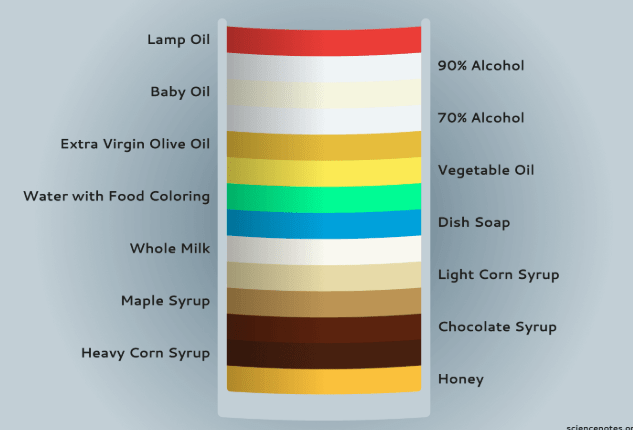
Density
300
Write the word used for the substances you start with in a chemical reaction and the word for the substances produced.
Reactants and Products
300
Identify one observable sign that indicates a chemical change (not a physical change).
Color change, gas production, or formation of a precipitate
300
Give the chemical formula for water and explain what the subscripts mean in this formula.
Water = H2O; the subscript 2 means there are two hydrogen atoms for every one oxygen atom
300
Name two methods that can be used to separate components of a mixture
Filter by size, use a magnet, heat to evaporate liquid components (evaporation), etc.
300
The density of an image is determined by which two other physical properties?
Mass and Volume
400
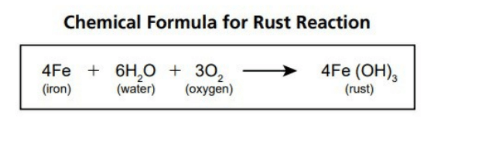 List the total number of atoms of Hydrogen on the Reactants side then the Products side.
Reactants: 12
Products:12
400
Describe the difference between melting point, freezing point, and boiling point in terms of particle motion and energy.
Melting point: temperature where particles gain energy, vibrate enough to move past each other (solid → liquid). Freezing point: particles lose energy, move less and form fixed positions (liquid → solid). Boiling point: particles have enough energy to overcome attractions and enter the gas phase (liquid → gas).
400
Describe, in terms of electrons and bonding, why oxygen typically needs two more electrons to be stable in common compounds.
Oxygen has six valence electrons (needs two more to reach eight), so it typically gains or shares two electrons to fill its outer shell, forming two bonds in many compounds.
400
Define solvent and solute and give the example used in the content (identify solvent and solute).
Solvent = the part usually present in largest amount that dissolves other substances; solute = substance dissolved. Example: Grape juice example: solvent = water; solutes = sugar and grape compounds.
400
Describe the difference between a natural substance and a synthetic material.
Natural = found in nature
Synthetic = man-made by combining natural resources
500
Explain, using particles/atoms, why the coefficients in a balanced chemical equation are necessary. Use H2 + O2 rightarrow H2O as an example and describe how to balance it.
Balancing ensures equal numbers of each atom on both sides.
500
Explain how adding thermal energy affects particle motion and phase for a solid becoming a gas; reference particle motion, temperature, and phase change in your answer.
Adding thermal energy increases particle motion and temperature; particles move faster, collisions are more energetic, bonds or attractions between particles weaken, causing phase changes (solid → liquid → gas). Example: as a solid is heated, particles vibrate more (temperature rises) until they break free to become a liquid; further heating increases motion until particles escape to gas.
500
Describe how atoms would be arranged in a solid, a liquid, and a gas.
(500) Solid- tightly packed, very little movement
Liquid- less compact, moves more
Gas- spread out, a lot of movement
500
Explain the difference between a mixture and a compound using examples from the content and particle-level reasoning (how are particles arranged and bonded).
A mixture is a physical combination (e.g., saltwater or sand) where components keep properties and are not bonded; a compound is chemically combined with definite ratios and bonds (e.g., H2O), where atoms are bonded and the compound has new properties. Particle-level: mixtures contain separate particles of each substance not bonded; compounds have atoms bonded into molecules with new arrangements.
500
Describe how you would separate a mixture of saltwater.
Boil/Evaporate the water and you will be left with salt crystals.