9.1 Area
9.2 Squares and Rectangles
9.3 Triangles
9.4 Trapezoids and Parallelograms
9.5 Pythagorean Theorem
100
What is the area postulate?
Every polygonal region has a postive number called its area such that
1) congruent triangles have equal areas
2) the area of the polygonal area is equal to the sum of the areas of its nonoverlapping parts
100
True or False. The area of a square with a side of 5m is 25m.
False, the area is 25 square meters. Units matter
100
True or false. The area of a triangle is half of the product of the length times the width.
False, though this definition would work for right triangles, for all triangles, the area is half the product of its base times its height.
100
True or False, the area of a parallelogram is the product of its base times its height.
True, but make sure it is the height and not the side.
100
True or False, the pythagorean theorem is applicable for all types of triangles.
False, it is applicable for only right triangles.
200
The pool has an area of 1050 square meters. For a leisure pool, each swimmer needs 2 square meters. How many swimmers can swim leisurely?
(1050 m^2)/(2m^2)=525" swimmers"
200
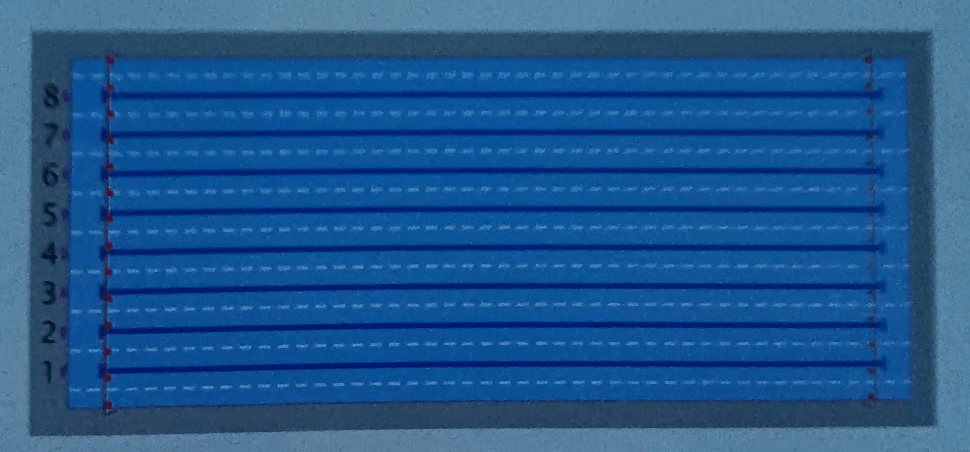
Olypic pools are 50m by 21 meters wide. It is divided into 8 lanes and each lane is 2.5 meters wide.
What is the area of each lane and do the eight lanes fill up the pool?

50*21=1050m^2 " -area of the whole pool"
2.5*50=125m^2" -area of a single lane"
8*125=1000m^2" - area of 8 lanes"
The 8 lanes do not fill the entire pool.
200
In the following figures AX and DY are the heights of △ABC and △DEF, respectively. AB=DE, BC=EF and ∠B and ∠DEF are supplementary.
Find a pair of triangles that are congruent. (hint find an angle that is equal to ∠B)
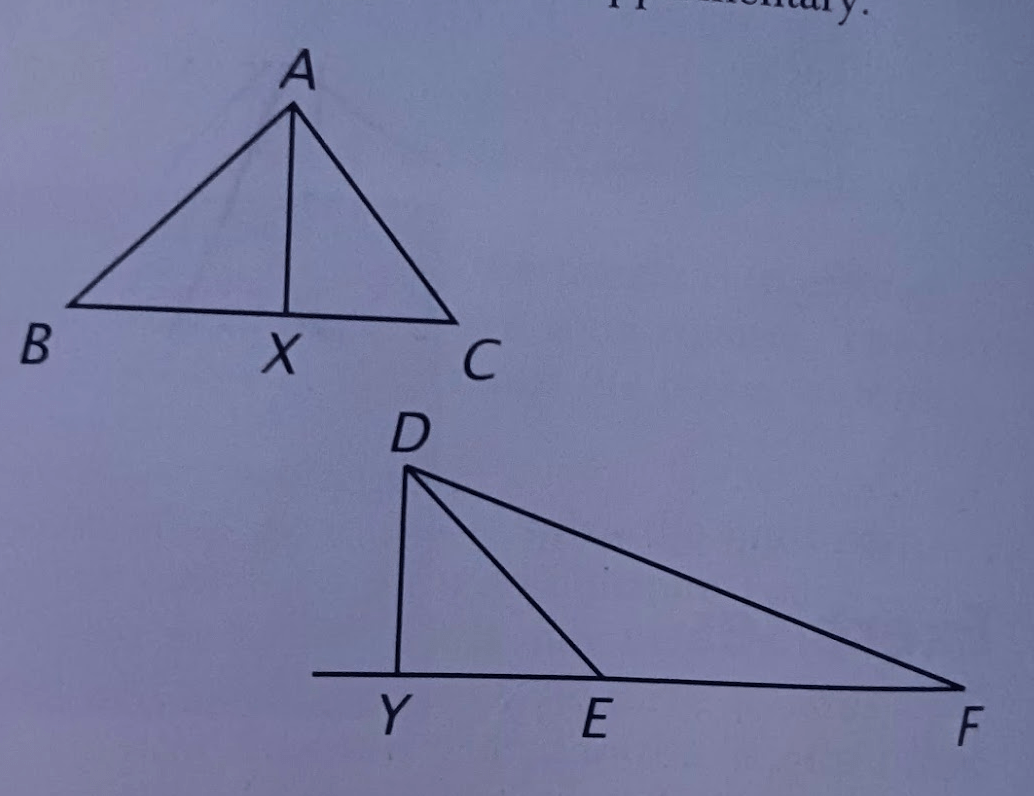
AB=DE - Given
∠AXB = ∠DYE = 90° - heights are perpendicular to bases
∠B+∠DEF=180 - given
∠DEY+∠DEF=180 - linear pair
∠DEY=∠B - Substitution
△ABX ⩭ △DEY - SAA
200
The square has a side of 2x. What is the area of the purple region?
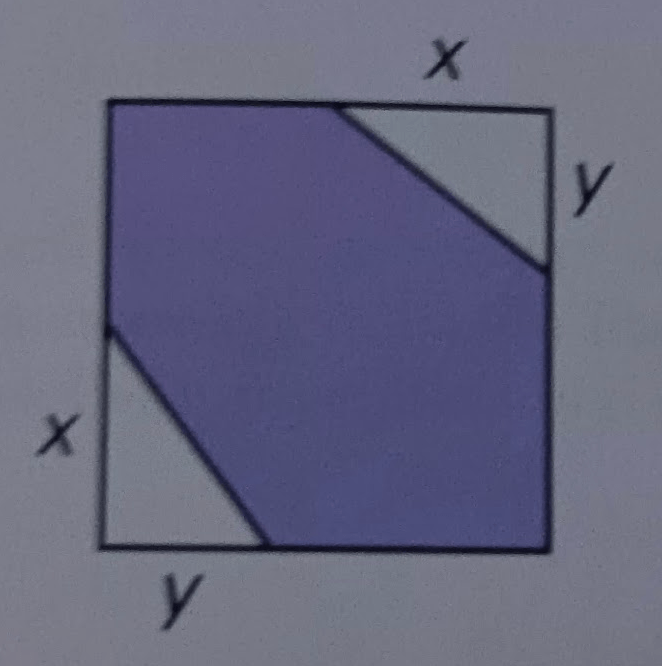
Area of the square is
4x^2
Area for each triangle is
1/2xy
Area of the purple region
4x^2-2(1/2xy)=4x^2-xy=4x(x-y)
200
BA = AE, AC=CF and CB=BD. Also, both BH and EG are perpendicular to the line AF.
Given that ⍺△ABC = x, express ⍺△AEF in terms of x
(Hint why is △EGA ⩭ △BHA)
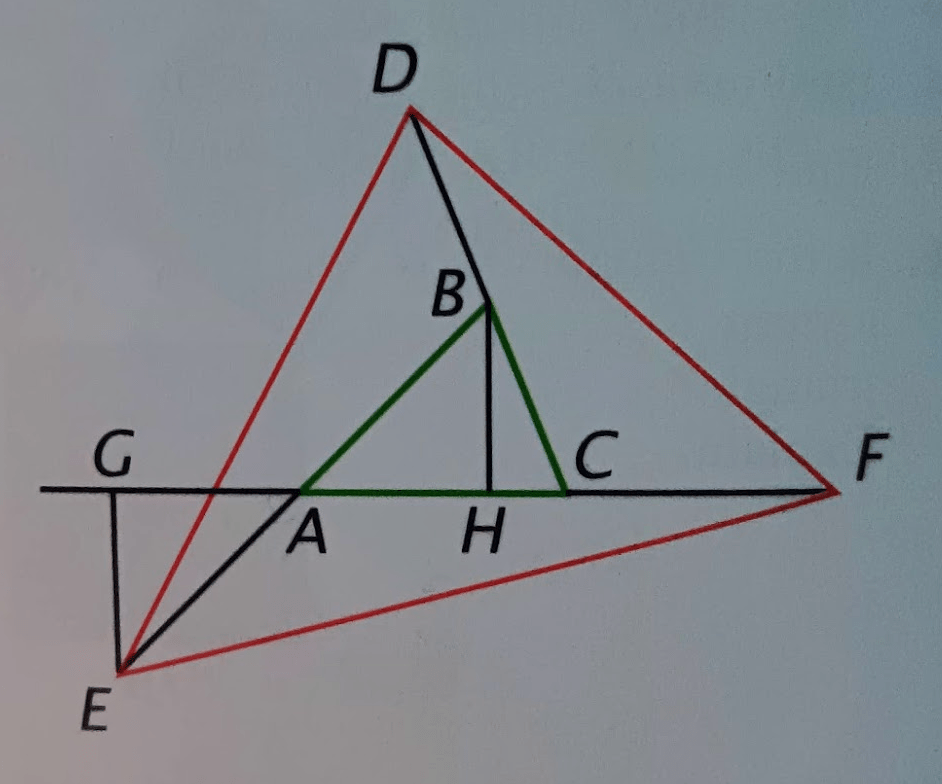
BA=AE - given
∠BAH=∠GAE - verticle angles
∠BHA=∠AGE=90° - given perpendicular
△EGA ⩭ △BHA - AAS
GE = BH - CPCT
⍺△ABC=(1/2)*AC*BH=x
⍺△AEF=(1/2)*AF*GE
AF=AC+CF
and AC=CF so
AF = 2AC
⍺△AEF=(1/2)*2AC*BH" -substitution"
⍺△AEF=2x
300
Given the area of one of the small squares is 1 unit. Find the area of each of the 7 pieces.
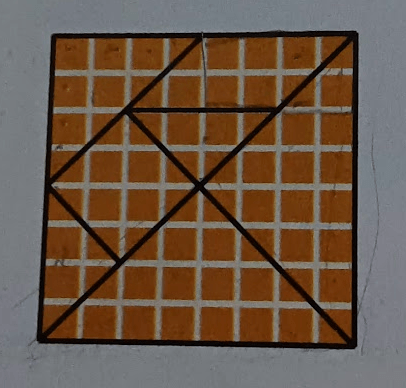
Big Triangles - 16 units
A=1/2bh=1/2*8*4=16
Medium Triangle - 8 units
A=1/2bh=1/2*4*4=8
Small Triangles - 4 Units
A=1/2bh=1/2*4*2=4
Parallelogram - 8 units
A=bh=4*2=8
Square = 8 units (2 small triangles)
300
In the Middle Ages, it was customary in designing a courtyard to make the central garden equal in area to the path surrounding it. The path around the garden is 3m wide. Based on the dimensions, does the design fit the description?
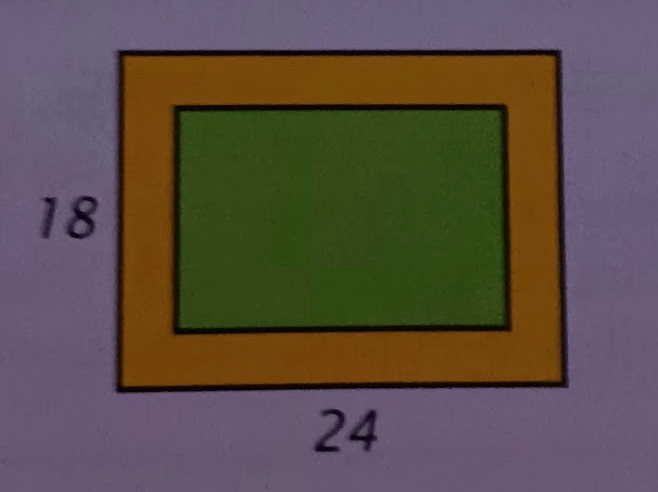
Full courtyard area is
18*24=432m^2
The area of the garden is
(24-6)(18-6)=18*12=216m^2
The area of the path is the difference between the area of total courtyard and the garden.
432-216=216m^2
The garden and the path have the same area, so it meets the conditions for the Middle Ages.
300
In the following figures AX and DY are the heights of △ABC and △DEF, respectively. AB=DE, BC=EF and ∠B and ∠DEF are supplementary. △ABX ⩭ △DEY
Find a pair of triangles that are not congruent but have the same area. (hint use the congruent triangles)
BC=EF - Given
AX=DY - CPCT
⍺△ABC=1/2*BC*AX
⍺△DEF=1/2*EF*DY
⍺△DEF=1/2*BC*AX " - substitution"
⍺△ABC=⍺△DEF
300
Write an expression for the area of the tract shown above in terms of a, b, c, d, e, and x
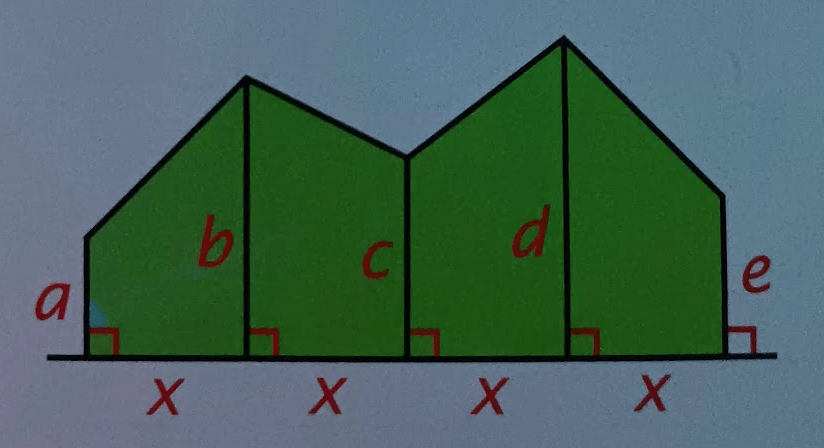
A_1=1/2x(a+b)
A_2=1/2x(b+c)
A_3=1/2x(c+d)
A_4=1/2x(d+e)
A_t=1/2x(a+2b+2c+2d+e)
300
Is the triangle a right triangle?
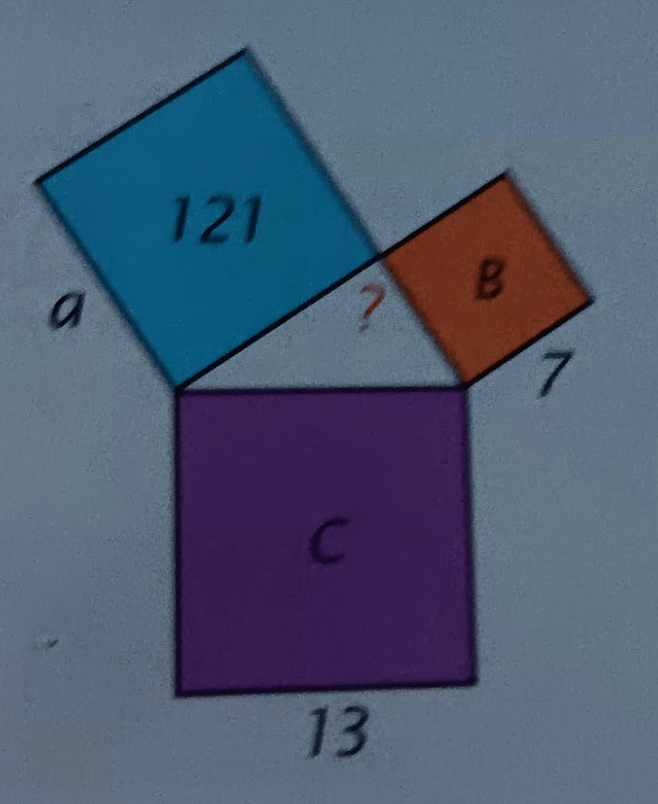
a^2+b^2=c^2
121+7^2=13^2
121+49=169
170=169
The triangle is not a right triangle because the pythagorean theorem does not apply.