7.1 Quadrilaterals
7.2/7.3 Parallelograms and Point Symmetry
7.4 Rectangles, rhombuses, and squares
7.5 Trapezoids
7.6 The Midsegment Theorem
Algebra Review
100
The sum of the interior angles of a quadrilateral equal what?
360 degrees
100
The diagonals of a parallelogram ______
Bisect each other, and a parallelogram has point symmetry at the intersection point.
100
What is an equilateral quadrilateral called?
Rhombus
100
Is a trapezoid a parallelogram? Why?
No because it has only one pair of parallel sides.
100
What is a midsegment?
A line segment that connects the midpoints of two sides of a triangle
100
Simplify
1/2+2/3
7/6
200
What is the diagonal of a polygon?
a line segment that connects any two nonconsecutive vertices.
200
What does OSAP stand for, and what is it used for?
Opposite sides and opposite angles of a parallelogram are equal. It is used to prove that quadrilaterals are parallelograms or that angles/sides are equal.
200
Fill in the blank with the following terms.
A ______ is a type of _______ which is a type of _______ which is a type of _______.
quadrilateral, rectangle, parallelogram, square.
A square is a type of rectangle, which is a type of parallelogram, which is a type of quadrilateral.
200
What are the sides of trapezoids called, and how are they significant?
Trapezoids have bases and legs. The bases are the parallel sides, and the legs are the other sides.
200
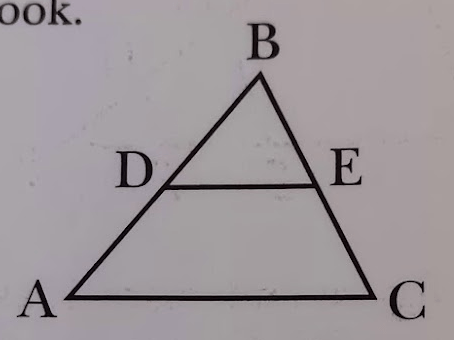 What is the midsegment in this image?
DE is the midsegment
200
Simplify
3/4*8/9
24/36=2/3
300
Which tile is convex?
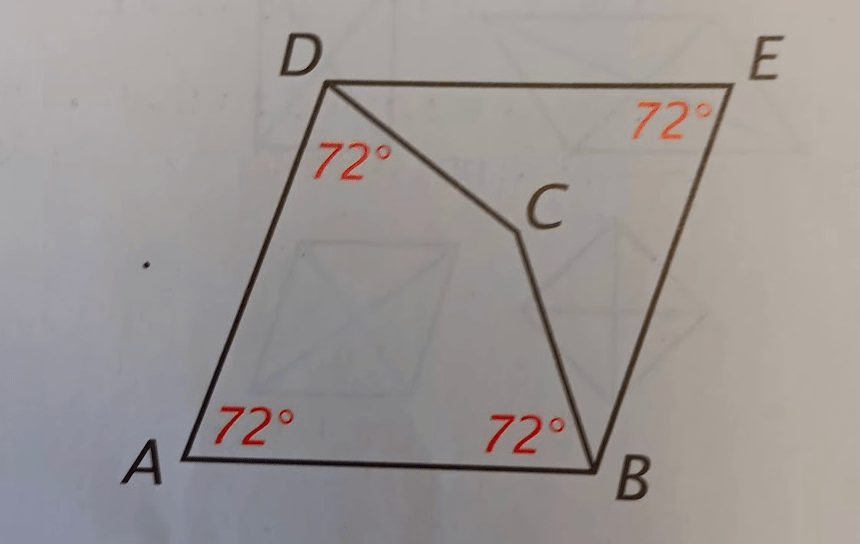
ABCD is convex
DCBE is concave
300
The marked line segments are all equal. Because of this the quadrilaterals will always be parallelograms. Why?
For ABCD, which angles will equal each other? Why?
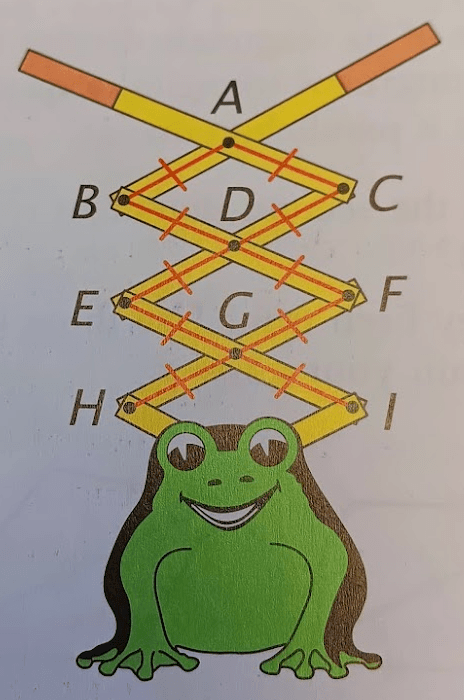
Because opposite sides are equal, the quadrilaterals will always be parallelograms. (OSAP)
Angle A = Angle D and Angle B = Angle C because opposite angles of a parallelogram are equal (OSAP)
300
A trapezium is a quadrilateral that has no parallel sides.
A rhomboid is a parallelogram that has no right angles.
1. Can a trapezoid be a trapezium? Why?
2. Can a rhombus be a rhomboid? Why?
3. Can a rectangle be a rhomboid or a trapezium? Why?
1. No because a trapezoid has one pair of parallel sides.
2. Yes because a rhombus does not need 90 angles
3. No because a rectangle has 2 sides of parallel lines and all right angles.
300
What is special about isosceles trapezoids?
They have equal legs and equal base angles.
300
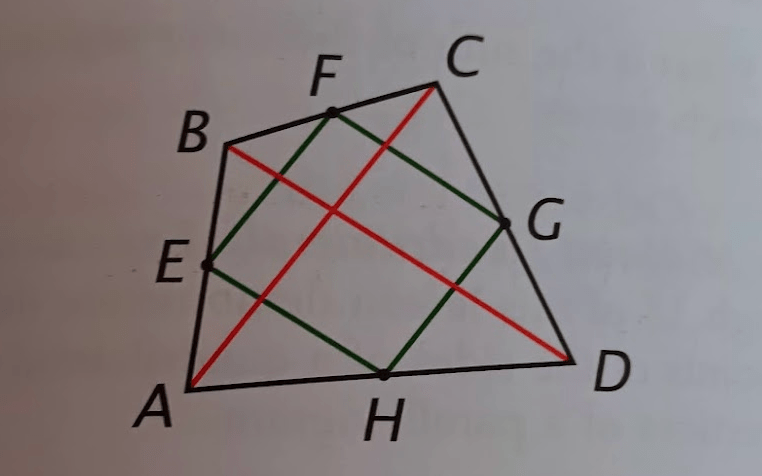 E, F, G, and H are midpoints for their corresponding sides. What four equations comes from knowing this?
2EF=AC
2FG=BD
2GH=AC
2HE=BD
300
Simplify
1/2div7/10
1/2*10/7=10/14=5/7
400
What is x+y=?
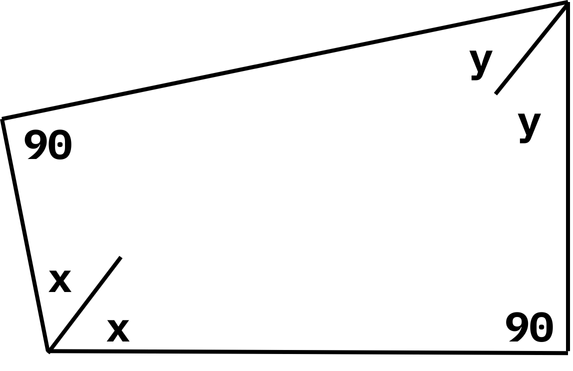
90+90+2x+2y=360 - Angles of a quadrilateral sum to 360
2x+2y=180 - subtraction property
x+y=90 division property
400
Which shapes are quadrilaterals? Why?
Which are parallelograms? Why?
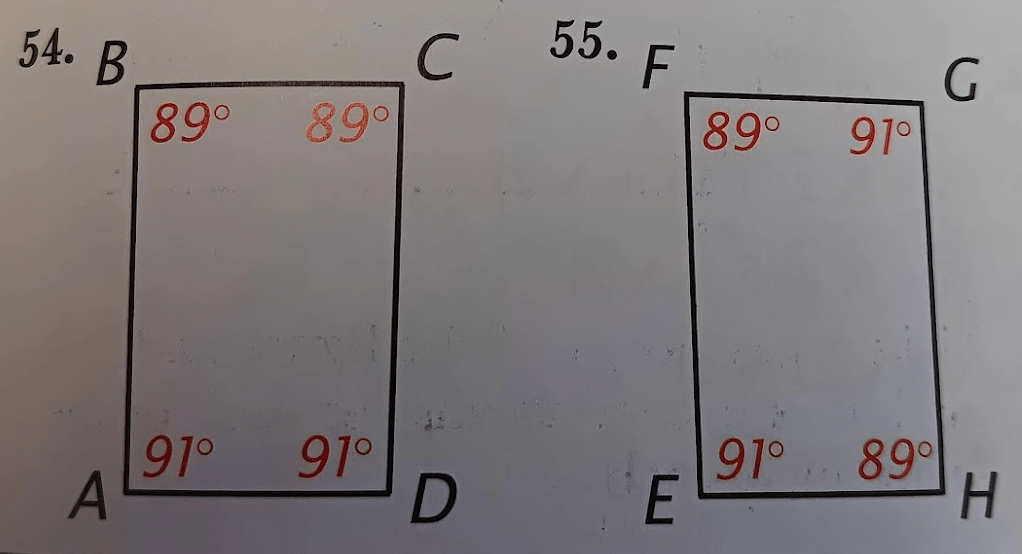
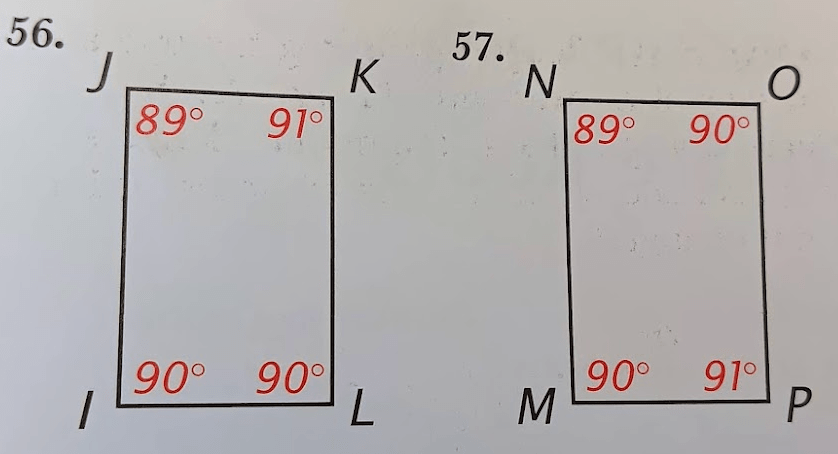
all are quadrilaterals because their angles add up to 360.
Only 55. is a parallelogram because its oposite angles are equal
400
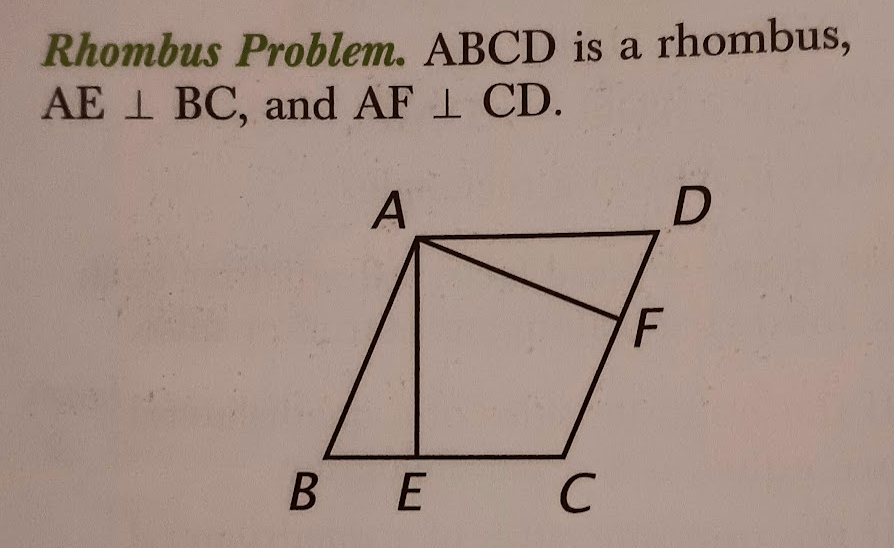 It looks like AE=AF. Is this true? Why? Write a proof.
AD = AB -> ABCD is a rhombus
∠D=∠B -> OSAP
∠AFD = ∠AEB -> Both are right angles
△AFD = △AEB -> AAS
AF=AE -> CPCT
400
What is true about the top two angles of an isosceles trapezoid? What about their diagonals?
The top two angles are congruent and the diagonals are equal.
400
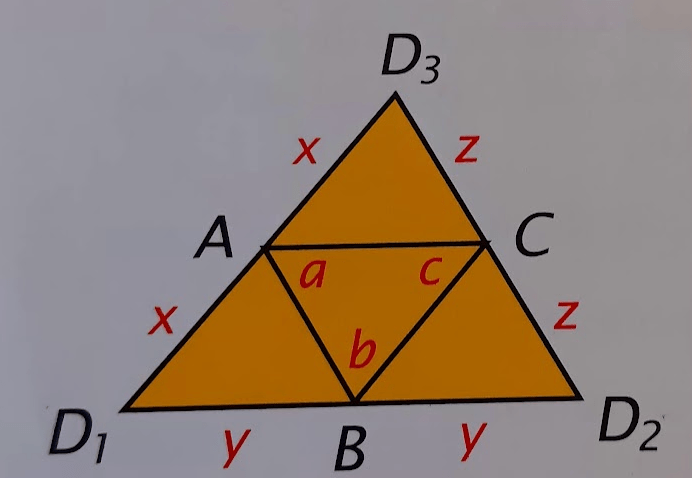 A, B, and C are the midpoints of their respective sides. What are the lengths of the sides of triangle ABC in terms of x,y, and z
AB = z
BC = x
AC = y
400
Simplify
6/(2x-3)*(x-3)/3
(6(x-3))/(3(2x-3))=(2(x-3))/(2x-3)=(2x-6)/(2x-3)
500
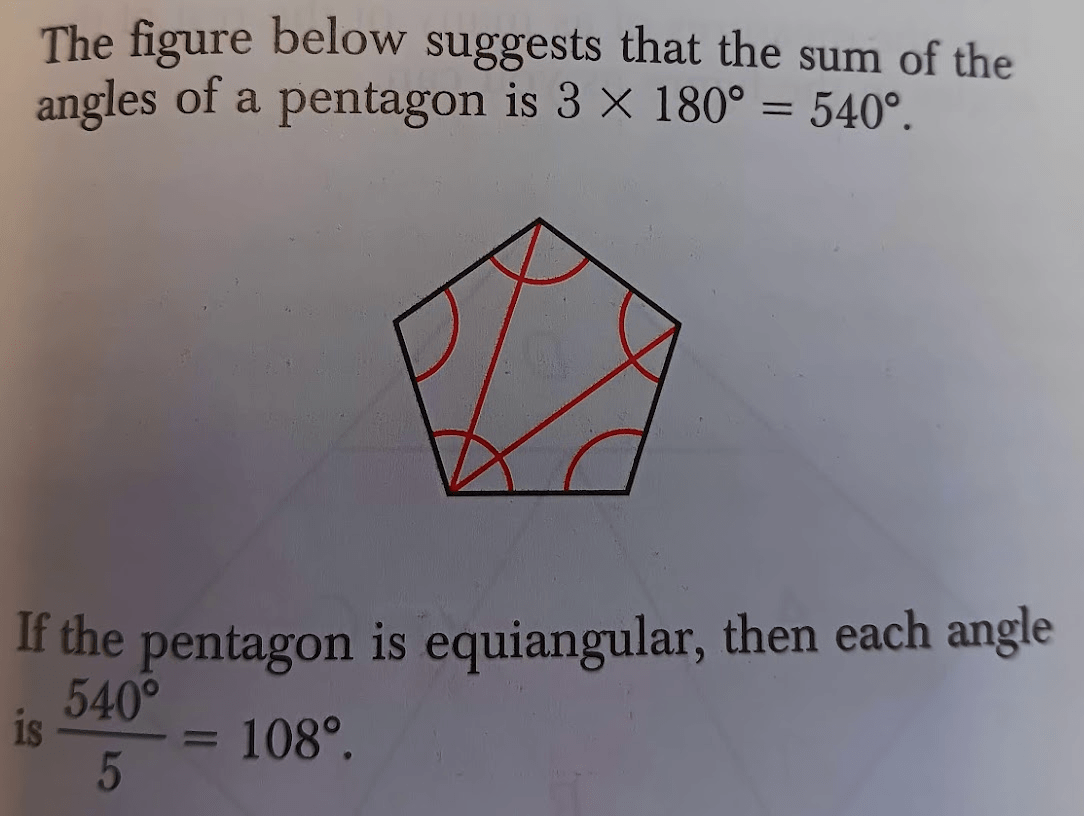
What is the sum of the angles of a hexagon?
What would they be if it was an equiangular hexagon?
If you break up a hexagon into triangles you get 4 triangles
a)4*180=720
b)720/6=120
500
AB||DC and AD||BC
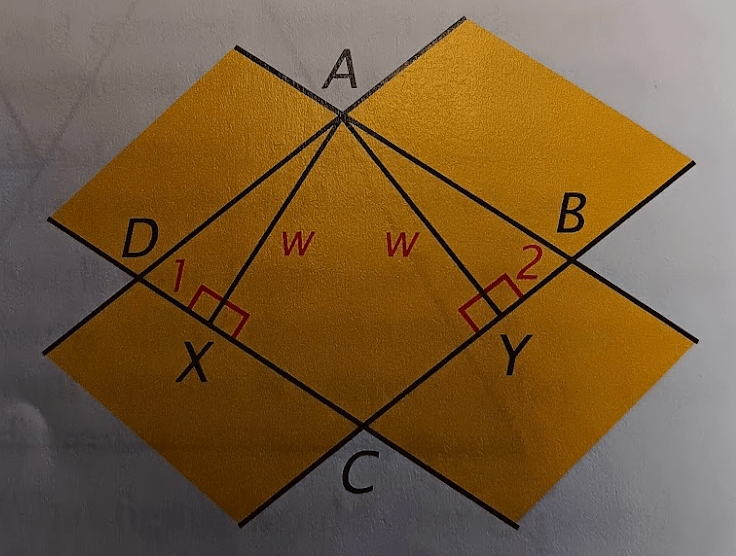
Why is ∠1=∠2? Why is AD=BC and AB=DC?
Why is △ADX = △ABY?
Why is AD=AB?
Why is BC=DC?
Why is ABCD a rhombus?
Why is ∠1=∠2? Why is AD=BC and AB=DC? OSAP
Why is △ADX = △ABY? AAS
Why is AD=AB? CPCT
Why is BC=DC? Substitution
Why is ABCD a rhombus? All sides are equal
500
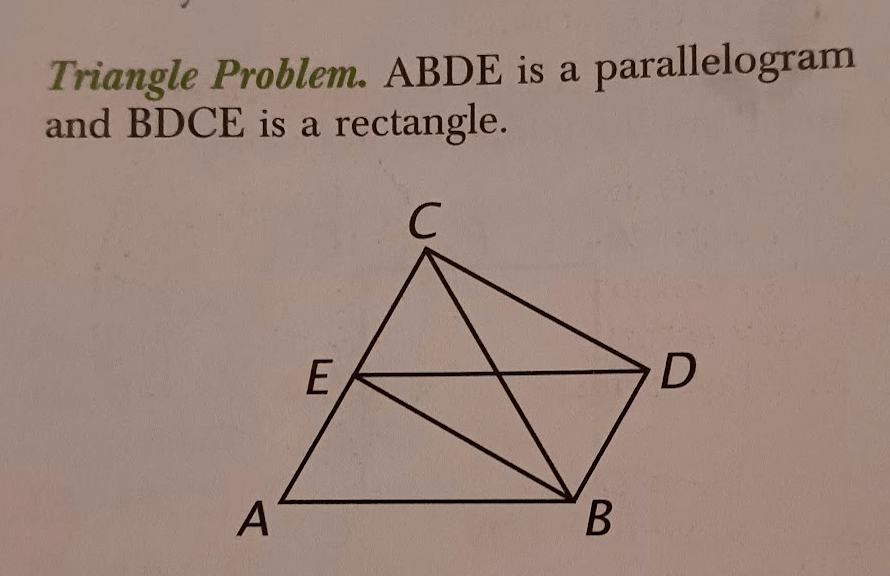 It looks like △ABC is isosceles. Is this true? Why? Write a proof.
AB=ED -> ABDE is parallelogram and OSAP
BC=ED-> BDCE is a rectangle and diagonals of a rectangle are equal
AB=BC -> Substitution
ABC is isosceles
500
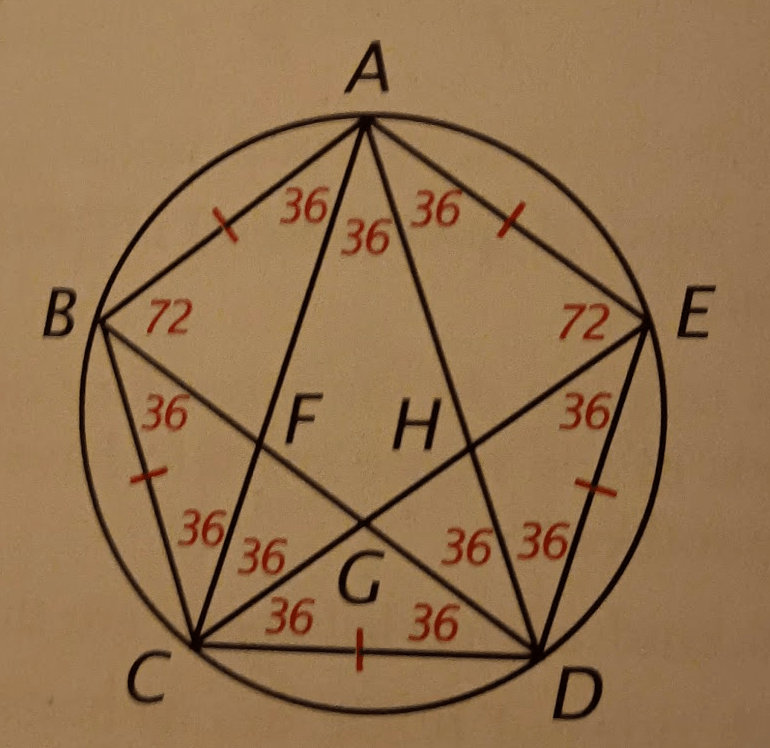
Find 3 isosceles trapezoids. How do you know they are isosceles trapezoids?
AEDB, EDCA, and BAEC
Their legs are equal and their base angles are equal
500
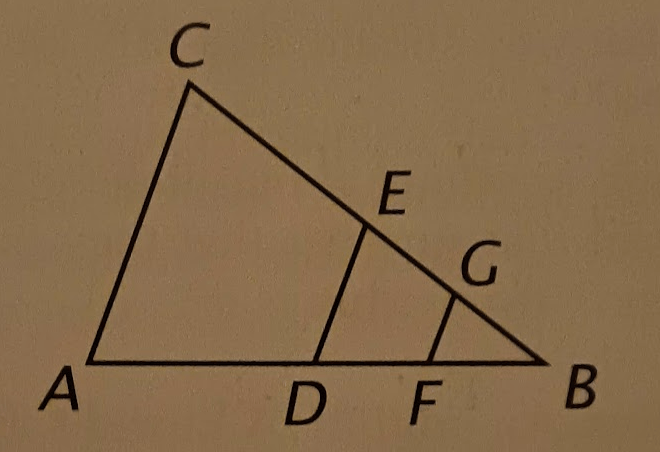 FG is the midsegment of triangle BED and ED is the midsegment of triangle ABC
What relation is FG to AC? Why?
4FG = AC
2FG=ED
2ED = AC
Substitution gives 4FG=AC
500
Simplify
(3x)/(x^2-1)-2/(x-1)
(3x)/(x^2-1)-(2(x+1))/((x-1)(x+1))=(3x-2x-2)/(x^2-1)=(x-2)/(x^2-1)