Limits
Continuity
Asymptotes
Velocity
Random
100
Limx→3-= 7
Limx→3+= 9
Limx→3 = ??
Limx→3=DNE
100
What are the 3 criteria for continuity?
1. f(a) is defined
2. Limx →a f(x) exists
2. f(a)=Limx →a f(x)
100
How do you find vertical asymptotes?
set the denominator equal to 0
100
What does instaneous velcoity mean? How do you find it using a graph?
1. the velocity at a specific point
2. sketch a tangent line and then find its slope
100
What is the average rate of change equation?
and also the average velocity ITS THE SAME!
f(a)-f(b)/a-b
200
Limx→5 (x-5)/(x2-3x-10)
1/7
200
What are the 3 types of discontinuties?
1. jump discontinuity
2. removable discontinuity
3. infinite discontinuity
200
What are the horizontal asymptote "shortcuts"?
1. if the highest exponents are equal in the numerator and denominator, the H.A is coefficient/coefficent.
2. if the exponent in the numerator is higher than the denominator, there is no H.A.
3. if the exponent in the denominator is higher than the numerator, the H.A.=0.
EXTRA: if the exponent in the numerator is one more than the denominator, there is a slant asymptote.
200
How do you find when the instantaneous velocity is equal to 0?
Where the tangent line=0
in other words, where the function is not decreasing or increasing
200
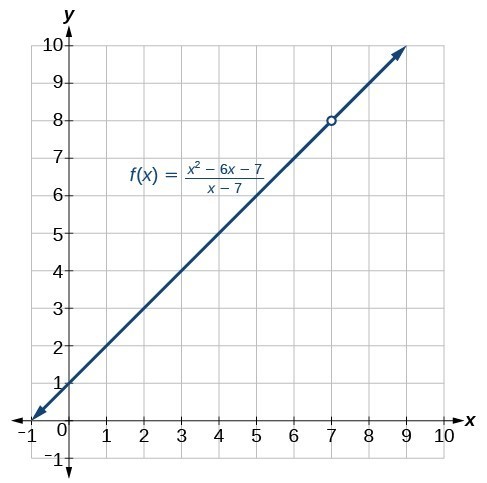
Does Limx→7 exist?
Is f(7) defined?
1. Yes
2. No
300
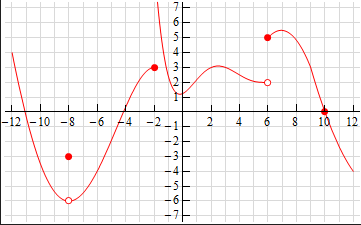
What is the Limx→-8?
What is the Limx→-2?
Limx→-8=-6
Limx→-2= DNE because Limx→-2+=∞ and Limx→-2-=3
300
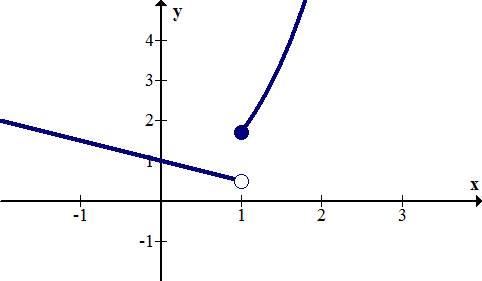
What kind of discontinuity is this? Prove that it is discontinuous using the 3 criteria of continuity.
- jump discontinuity
1. f(1)=2
2. Limx→1=DNE
3. Limx→1 ⧣ f(1)
300
Find the vertical asymptotes of this function.
1+x5/x2-9
How would you prove that using limits?
x=-3
x=3
Evaluate the limits from the left and the right to find positive and/or negative infinity.
300
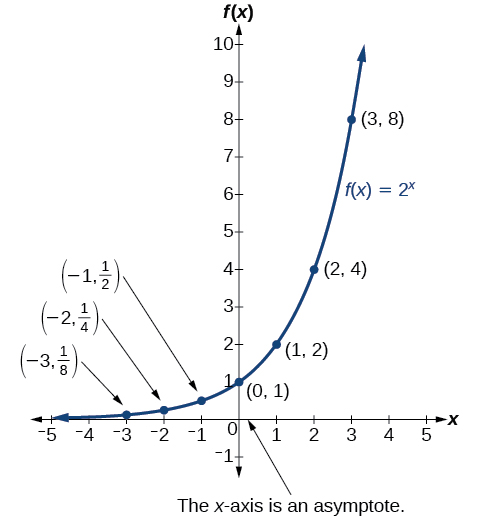 What is the average velocity over the interval [0,2]?
f(0)-f(2)/0-2
1-4/-2
-3/-2
3/2
300
f(4)=16
f(-6)=36
True or False: f(2)=c for some value c between 16 and 36.
What theorem is this?
True
400
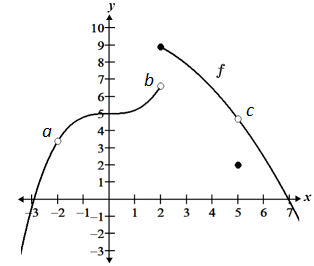
Where is this graph discontinous?
Name 3 points and why.
1. x=-2
f(-2)=DNE
2. x=2
Limx→2+⧣Limx→2-
3. x=5
Limx→5⧣f(5)
400
Find the horizontal asymptote using a shortcut.
8x6-2x2+3/8x7-9
y=0
400
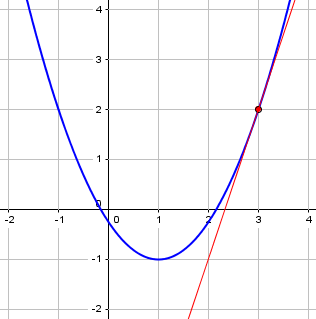
What is the instantaneous velocity at x=3?
3
400
f(x)= x3 x>4
x2-1 x≤4
Is this function continuous?
1. f(4)=15
2.Limx→4+=64
Limx→4-=15
Limx→4=DNE
3.Limx→4=f(4)
NO!
500
Limx→∞ (1/8ex)sin(x)
HINT: Apply the Squeeze Theorem.
-1≥sin(x)≥1
-1/8ex≥(1/8)sin(x)≥1/8ex
Limx→∞(-1/8ex)=0
Limx→∞(1/8ex)=0
Limx→∞(-1/8ex)sin(x)=0
500
Show that f(x)=x3-3x-1 has one root on the interval [1,2].
has at least one real root in the interval
Show that f(X)=x3-3x-1 has at least one root on the interval [1,2].
f(1)≤0≤f(2)
500
Find the horizontal asymptote using limits.
8x4-2x+3/2x4-9
y=4
500

What is the instantaneous velocity at x=2.
1
500
x+11/2≥f(x)≥x2-2
Show that Limx→3f(x)=7.
Limx→3(x+11/2)=7
Limx→3(x2-2)=7