Trivia and puns
Partial Derivatives
Gradients and Tangent Planes
Extrema
Potpourri
100
The result of differentiating a cow
prime rib
100
the partial derivative with respect to X of (6xy + x4)
6y + 4x3
100
∇f(x, y), where
f(x, y) = 10x5y
<50x4y, 10x5>
100
True or false: the gradient of
f(x, y) = lny is 1/y
False
100
Show that the limit below does not exist
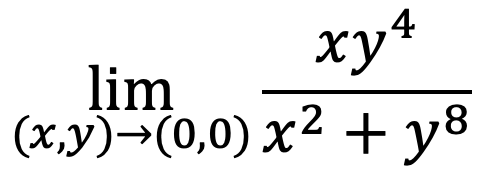
Along y = 0 the limit is 0
Along x = y4 the limit is 1/2
Therefore the limit does not exist
200
Why pirates good at calculus
A true pirate never forgets the C
200
the partial derivative with respect to x of
(2x3 + y2)1/2
3x2 / (2x3+y2)1/2
200
the directional derivative of f at the point (0, 1) in the direction 𝜃 = 𝜋/3 if
f(x, y) = y cos(xy)
sqrt(3)/2
200
The local max and min values and saddle points of the function f(x,y)=3xy - x2y - xy2
(Write max/min values as z-values and saddle points as ordered triples)
loc max of 1
saddle points at (0,0, 0), (0,3,0), and (3,0,0)
200
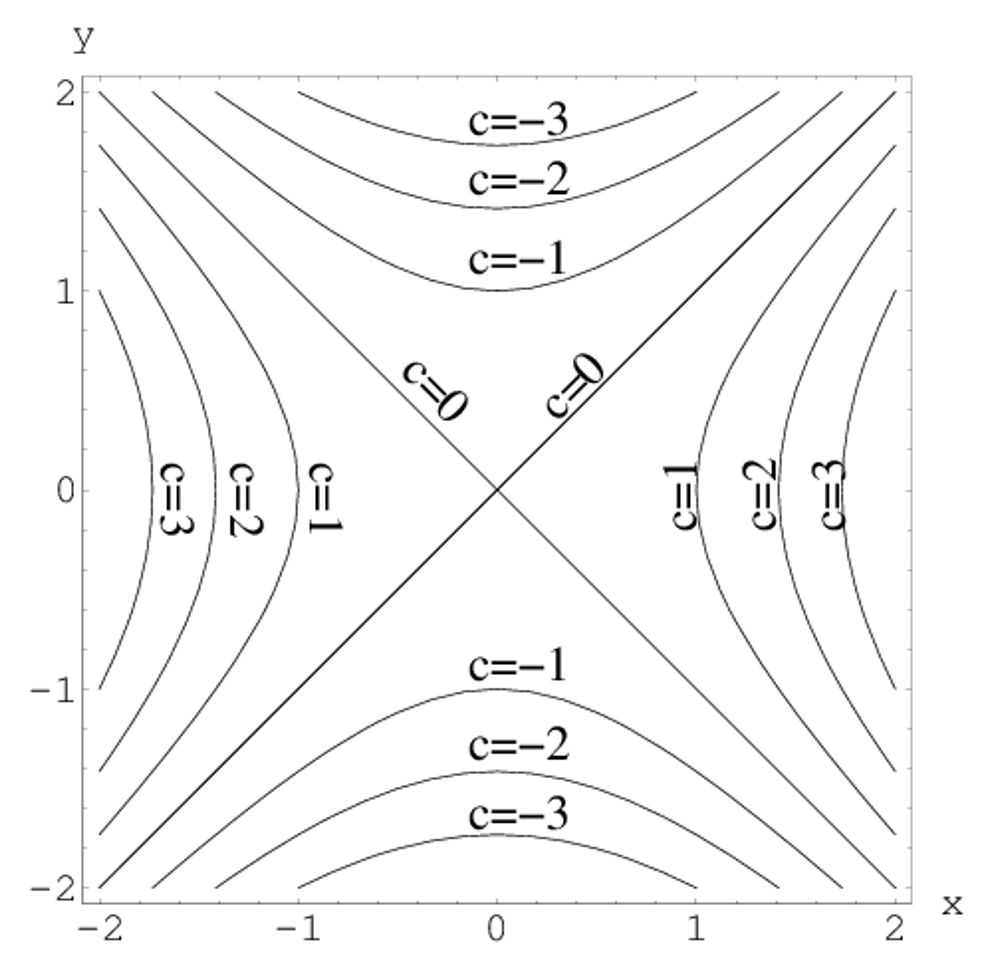
For the level curve above, determine if dx/dt and dy/dt are >0, =0, or <0 at the point (1, 0)
dx/dt>0, dy/dt = 0
300
What you call a recycled calculus pun
derivative humor
300
fxyzyzzyyxx given
f(x, y, z) = x30y26z
0
300
The equation of the plane tangent to
f(x,y) = ex cos y at the point (0,0,1)
z = x + 1
300
The absolute extrema (z-values) if
f(x, y) = 2x3 + y4 + 2
over the region bounded by x2 + y2 = 1
max = 4
min = 0
300
dz/dt if z = x2 + 3xy, x = e5st and y = s2 + t2
when s = 1 and t = 2
10e20 + 87e10
400
The landmark on which the founder of partial derivatives (Adrien-Marie Legendre) has a plaque of commendation
The Eiffel Tower
400
the partial derivative with respect to Y
of (sin((x2)(y2)))
cos(x2y2) * (2x2)y
400
The maximum rate of change of f at the point (4, 1) AND the direction vector in which it occurs if
f(x,y)=4ysqrtx
max rate of change =
sqrt(65)
direction vector =
(1/sqrt(65))<1, 8>
400
Find the shortest distance from the point
(3, 0, −2) to the plane
x + y + z = 2.
1/sqrt3
400
A tin can is supposed to have a radius of 1.5 inches and a height of 4 inches. Use differentials to estimate the propagated error in the surface area of the can if the radius has a max error of 0.2 inches and the height has a max error of 0.3 inches.
3.7 square inches
500
A wizard who is good at calculus
a mathemagician
500
the partial derivative with respect to x of (2yx4e(2xy+1))
8yx3e2xy+1 + 4y2x4e2xy+1
500
Let f be a function of two variables that has continuous partial derivatives and consider the points A(7, 1), B(8, 1), C(7, 11), and D(16, 13). The directional derivative of f at A in the direction of the vector AB is 4 and the directional derivative at A in the direction of AC is 2. Find the directional derivative of f at A in the direction of the vector AD.
4
500
The extreme values (z-values) of f subject to both constraints (use Lagrange multipliers).
f(x, y, z) = x + 2y
x + y + z = 2, y2 + z2 = 4
max =
2+2sqrt2
min =
500
Name all three of Mrs. Price's pets
Chief, Cobbler and Captain Awesome