Derivative Rules
Differentiability
PVA
Other Calculus
100
Find the derivative of:
f(x)=5x^3-4/x
f'(x)=15x^2+4/x^2
100
Where does this function appear to be non differential?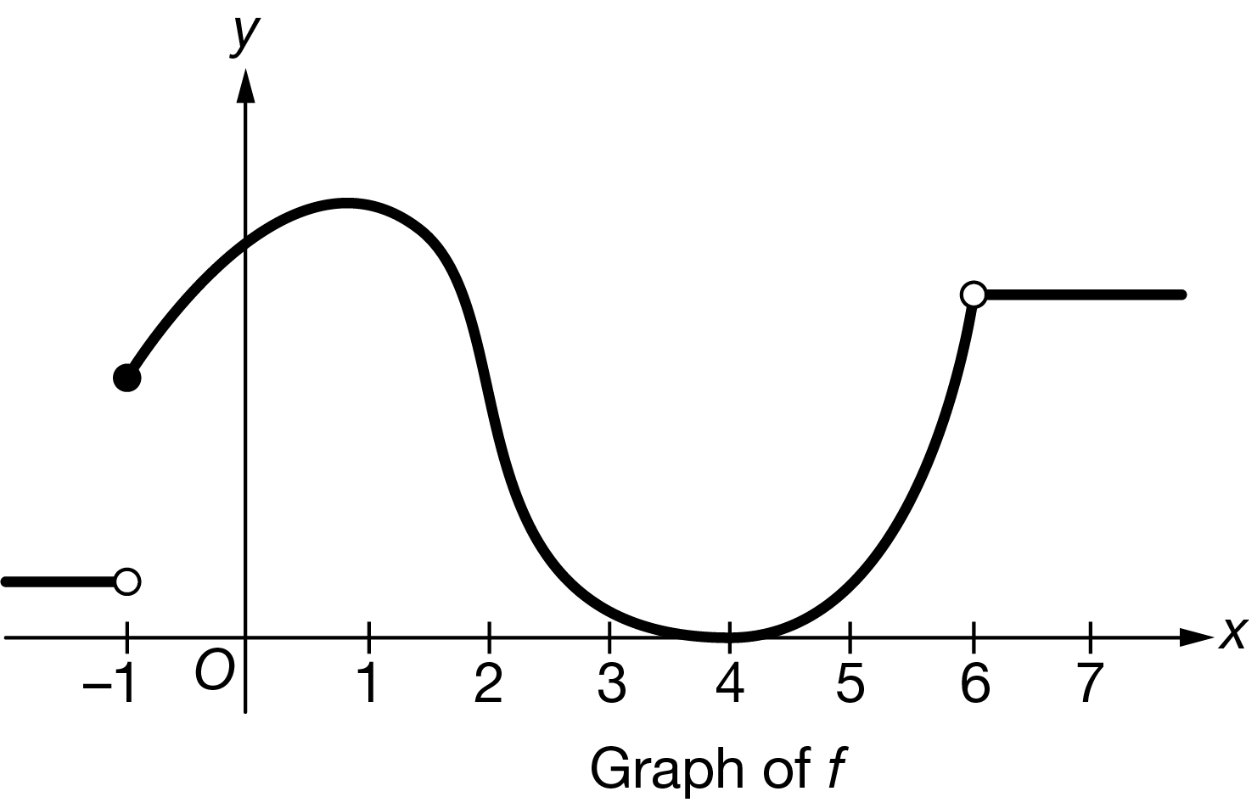
x= -1 and x = 6
100
Find the average velocity of the function below from t = 0 to t = 4.
-1/2
100
Write the equation of the tangent line at x = 9 for
y=5sqrtx
y-15=5/6(x-9)
200
Given f(2)=3, f'(2)=1, g(2)=-2, and g'(2)=-5. Determine the value of p'(2)
p(x)=3f(x)g(x)
p'(2)=-51
200
For what values of x is the function not differentiable?
y=|2x-9|
x = 9/2
200
Given the velocity graph, when does the object change directions?
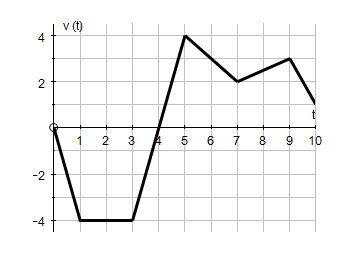
t = 4
Becuase velocity changes signs.
200
What is the average rate of change of the function below from t = 1 to t = 3?
g(x)=4x^2-pi
16
300
Find the derivative of
y=(7x^4+3x^2-4)/x^2
y'=14x+8/x^3
300
Determine if the function is differentiable at x = -1.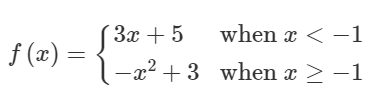
It is not, because it is not smooth.
300
The function below models the position of a particle for time greater than or equal to zero. When is the velocity zero?
x(t)=t^3/3+t^2/2-6t+1
t=2
300
What is the derivative of the function below?
k(x)=1/f(x)
k'(x)=-(f'(x))/f^2(x)
400
Find the second derivative of
y=2/x+6sqrt(x)
y''=4/x^4-3/(2x^(3/2))
400
For what value of a and b will this function be differentiable at x = 1
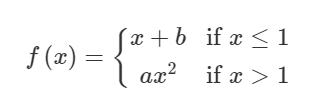
a = 1/2 and b = -1/2
400
Given the velocity graph, when is the particle speeding up?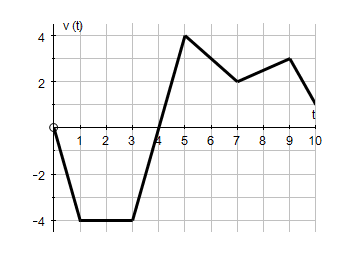
(0, 1), (4,5), and (7,9) because velocity and acceleration have the same signs on those intervals
400
For what value(s) of x would the function below have an instantaneous rate of change of -2?
y=x/(x-2)
x = 1 and x = 3