Basic Derivatives
Chain Rule
Product and Quotient Rule
Implicit & Log Differentiation
Related Rates
100
This is the meaning/interpretation of a derivative
Slope of the Tangent Line to a function at a point/
The Instantaneous Rate of Change
100
Define the Chain Rule for f(g(x))
d/dx(f(g(x)))=f′(g(x))g′(x)
100
Define the Product Rule using f(x)g(x)
and
Define the Quotient Rule using f(x)/g(x)
d/dx(f(x)g(x))=f′(x)g(x)+ g′(x)f(x)
d/dx(f(x)/g(x))=(g(x)f'(x)-f(x)g'(x))/(g(x))^2
100
Find y' given x^3y^5 + 3x = 8y^3+1
y'=(-3x^2y^5-3)/(x^3(5y^4)-24y^2)
100
The side length of a square is increasing at a rate of 3 cm/sec. At what rate is the square's perimeter changing when the side length is 10cm?
include units!
(dP)/dt=12(\cm)/sec
200
d/dx \pi^2
0
200
d/dx (3x+1)^4
4(3x+1)^3 3
200
Find f'(x) given f(x)=x²cos(x)
f'(x)=2xcos(x)-x^2sin(x)
200
Provide the equation of the tangent line to
x^2+y^2=9
at the point (2,\sqrt 5)
y-\sqrt(5)=-2/\sqrt(5)(x-2)
200
The side length of a square is increasing at a rate of 3 cm/sec. At what rate is the square's area changing when the side length is 10cm?
include units!
(dA)/dt=60(cm^2)/sec
300
d/dx x^2
2x
300
d/dx sin(4x²)
cos(4x²)8x
300
Find f'(x) given f(x)= ((x²-1)³)/ (x²+1)
f'(x)=((x^2+1)(3(x^2-1)^2(2x))-(x^2-1)^3(2x))/(x^2+1)^2
300
Find dy/dx given
y=x^(x^3)
*Requires log differentiation
dy/dx = x^(x^3) (3x^2ln(x)+x^3 1/x)
300
A ladder 13 feet long is leaning against a high wall. If the base of the ladder is pushed toward the wall at the rate of 2 ft/sec, at what rate is the top of the ladder moving up the wall when the base of the ladder is 5 ft from the wall?
include units!
(dy)/dt = 5/6 (ft)/sec
400
d/dx (3x²-x+3)
6x-1
400
Differentiate
y=\sqrt(13x²-5x+8)
y'=1/2(13x²-5x+8)^(-1/2)(26x-5)
400
Differentiate
y=e^(3x)ln(5x+1)
y′ =3e^(3x)ln(5x) +e^(3x)(1/(5x+1))5
400
Find dy/dx given
e^(2x+3y)=x^2−ln(xy^3)
dy/dx= (2x −1/(xy^3)(y^3)-2e^(2x + 3y))/(3e^(2x + 3y)+1/(xy^3)3xy^2)
400
Leg 1 of a right triangle is decreasing at the rate of 5 in/sec and leg 2 of the right triangle is increasing at the rate of 7 in/sec. At what rate is the triangle's area changing when Leg 1 is 8in and Leg 2 is 6in?
include units!
(dA)/dt=13 (\text(in)^2)/sec
500
The position (in ft) of a particle at time t seconds is given by:
s(t) = 2t^3 + 3t - 1
Find the acceleration of the particle at t=1. Include units in your answer.
Recall that
a(t)=v'(t)=s''(t)
So
a(t)=s''(t)=12t
a(1)=12 (ft)/(sec^2)
500
Differentiate y=3tan(1/x)
y'=3sec^2(1/x)(-x^-2)
500
Compute
d/dx (3^xsec(x))/arcsin(x)
d/dx (3^xsec(x))/arcsin(x) = (arcsin(x)(3^xln(3)sec(x)+3^xsec(x)tan(x))-3^xsec(x)(1/\sqrt(1-x^2)))/(arcsin(x))^2
500
Find dy/dx given y=(xe^x)/(x-1) using log differentiation (not quotient & product rule).
Do not simplify
dy/dx= (xe^x)/(x-1)(1/x+1-1/(x-1))
500
Consider the given right triangle with legs of length x cm and y cm and angle θ radians. 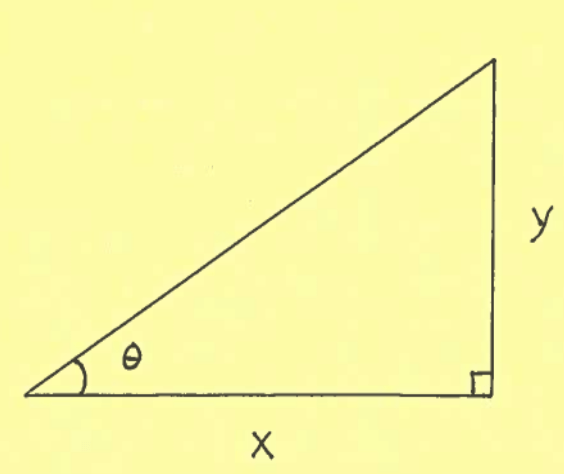
If x is decreasing at the rate of 3 cm/min and y is increasing at the rate of 4 cm/min, at what rate is angle θ changing when x=5 cm and y=2 cm?
(d\theta)/dt=26/29 (rad)/min