Differentiation
Stationary points
Integration
Area under the curve
Equation of tangent/normal
100
The derivative of y=cos(3x)
-3sin(3x)
100
What is the value of the gradient at a stationary point and how do we find it?
Gradient = 0
Find by differentiating and letting y'=0
100
Find
∫ 6x^2 dx
2x^3 + C
100
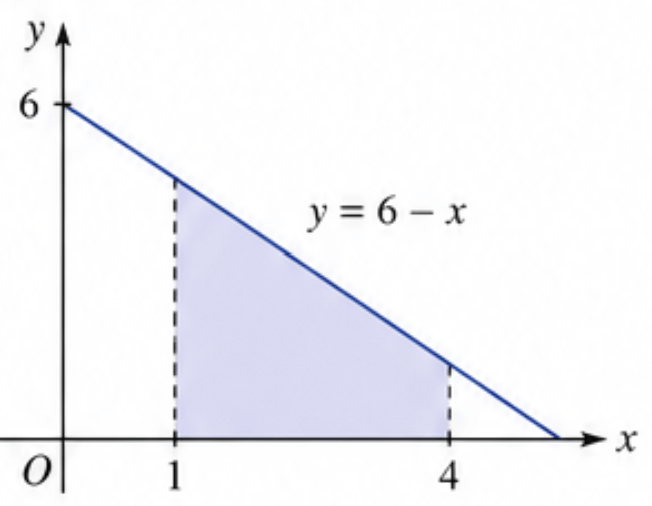
The diagram shows the curve y = 6 - x and a shaded region between x = 1 and x = 4.
Write the definite integral that represents the area of the shaded region.
int_1^4 (6 - x) dx
100
The curve has equation:
y = x2+ 3x - 2
Find the gradient of the curve when x = 2.
dy/dx = 2x + 3
When x = 2:
m = 2(2) + 3
m = 7
200
Differentiate
y = (3x^2 - 4x + 1)^5
y' = 5(6x - 4)(3x^2 - 4x + 1)^4
200
The curve has equation: y = x2 - 4x + 7
Find the coordinates of the stationary point.
dy/dx = 2x - 4
At a stationary point:
2x - 4 = 0 -> x = 2
Substitute x = 2 into the original equation:
y = (2)^2 - 4(2) + 7
y = 3
Stationary point = (2, 3)
200
int_1^3(2x^2 - 4x + 3) dx
26/3
200
A region is bounded by the curve y = x2, the x-axis, x = 0 and x = 2.
Find the exact area of the shaded region.
int_0^2 x^2 dx
= [x^3/3]_0^2
= 8/3
200
The curve has equation:
y = x2 - 4x + 7
Find the gradient of:
a) the tangent at x = 3
b) the normal at x = 3
dy/dx = 2x - 4
At x = 3:
m_tangent = 2(3) - 4
m_tangent = 2
Therefore:
m_normal = -1/2
a) 2
b) -1/2
300
Differentiate
y=(x^2+3)(2x^3−5)
y' = 10x^4 + 18x^2 - 10x
300
y = x^2 - 4x + 7
The curve has a stationary point at (2, 3).
Determine the nature of this stationary point.
(d^2y)/dx^2 = 2
Since this is > 0:
The stationary point is a local minimum.
300
∫ 3e^(3x) dx
e^(3x) + C
300
The curves y = 4x and y = x2 intersect at x = 0 and x = 4.
Find the exact area enclosed between the two curves.
Area = int_0^4 (4x - x^2) dx
= [2x^2 - x^3/3]_0^4
Area = 32/3 units^2
300
The curve has equation: y = x2 + 2x + 1
Find the equation of the tangent to the curve at x = 1.
dy/dx = 2x + 2
At x = 1: m = 4
Find the y-coordinate:
y = (1)2 + 2(1) + 1 = 4
The tangent passes through (1, 4).
Using:
y - y1 = m(x - x1)
y - 4 = 4(x - 1)
y = 4x
400
Differentiate
y = ln(3x^2 + 5)
y' = (6x)/(3x^2 + 5)
400
The curve has equation:
y = x3 - 3x2 - 9x + 5
The stationary points are:
(-1, 10) and (3, -22)
Determine the nature of each stationary point.
(d^2y)/dx^2 = 6x - 6
At x = -1: (d^2y)/dx^2 = -12
Therefore:
(-1, 10) is a local maximum.
At x = 3:
(d^2y)/dx^2 = 12
Therefore:
(3, -22) is a local minimum.
400
∫ 3x^2 + 4/x^2 dx
x^3 - 4/x + C
400
Find the area enclosed between the curves
y=x^2
and
y=2x+3
Points of intersection: -1, 3
Area = ∫_(-1)^3 ((2x+3)-x^2) dx
= [(2x+3)-x^2]_(-1)^3
Area = 32/3 units^2
400
The curve has equation: y = x2 + 1
Find the equation of the normal to the curve at x = 1.
dy/dx = 2x
At x = 1: m_tangent = 2
Therefore: m_normal = -1/2
The point on the curve is: y = (1)2 + 1 = 2
So the point is (1, 2).
y - 2 = -1/2(x - 1)
y = -1/2x + 5/2
500
Find
d/dx(2xsinx+x^2cosx)
4xcosx+2sinx-x^2sinx
500
The curve has equation:
y = x3 - 3x2
Find the stationary points and determine the nature of each stationary point.
dy/dx = 3x^2 - 6x
3x(x - 2) = 0
x = 0 or x = 2
Stationary points:
(0, 0) and (2, -4)
(d^2y)/dx^2 =6x-6
At x = 0:
(d^2y)/dx^2 = -6
Local maximum at (0, 0)
At x = 2:
(d^2y)/dx^2 = 6
Local minimum at (2, -4)
500
∫ 6x(x^2 + 4)^3 dx
3/4(x^2 + 4)^4 + C
500
The curve is given by the equation of y = x2 - 5x + 6 .
Find the exact area enclosed between the curve and the x-axis.
X intercepts at 2, 3
Area = -int2_3 (x^2 - 5x + 6) dx
Area = 1/6 units^2
500
The curve has equation: y = e2x
Find the equation of the tangent to the curve at x = 0.
dy/dx = 2e2x
At x = 0: mtangent = 2e0 = 2
The point on the curve is: y = e0 = 1
Point = (0, 1)
y - 1 = 2(x - 0)
y = 2x + 1