Limits
Rational Functions
Continuity
Derivatives
100
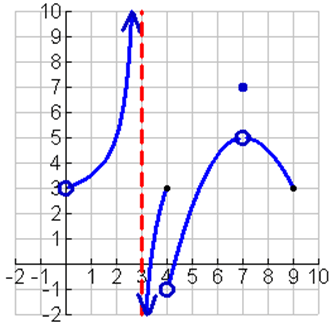
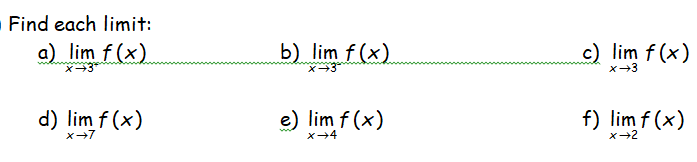
a) -inf
b) inf
c) DNE
d) 5
e) DNE
f) 5
100
Simplify (x^2+16x+64)/(x^2-2x-80)
(x+8)/(x-10)
100
List the three pieces we need to determine if a function is continuous.
1) f(a) exists
2) lim as x approaches a exists
3) lim as x approaches a = f(a)
100
What is the derivative of 3x5+4x+7
15x4+4
200
Evaluate the limit as x approaches 2 if f(x)= (x^2-2x)/2 .
0
200
Simplify (21x^3)/(7x^4+35x^3)
3/(x+5)
200
Given f(x)= {19-4x^2,x>2 and 9-2x, x<2 , is f(x) continuous at 2? Explain.
No, 2 is not included in either function
200
What is the derivative of 6ln(x)
6/x
300
Find the limit as x approaches 0 if f(x)= (sqrt(x+3) -sqrt3)/x
1/2sqrt(3)
300
Find all values that make the expression undefined:
(x^2-81)/(8x+16)
When x = -2
300
List all values for which the graph is discontinuous on (-9,9). State the type of discontinuity.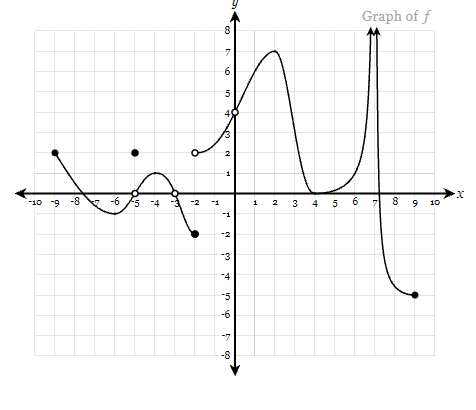
x=-5 (removable)
x=-3 (removable)
x=-2 (jump)
x=0 (removable)
x=7 (infinite)
300
What is the derivative of (3x)(5x)
3(5x)+3x(5x)ln5
400
Find the limit as x approaches 0 if f(x)= ((x-6)^2-36)/x
-12
400
Find k that makes the function continuous.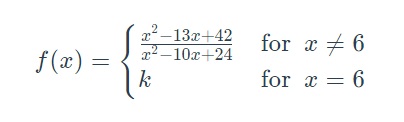
k=-1/2
400
What is the derivative of (7x2)/(3x+4)
(14x(3x+4)-21x2)/(3x+4)2