ECGs
Pharmacology
Murmurs
Anatomy
Physiology
100
A 22-year-old healthy man has an ECG showing a regular rhythm at 75 beats/min. Each QRS complex is preceded by a P wave, and the PR interval is constant
What is the rhythm?
Normal sinus rhythm
100
A 62-year-old man with hypertension is started on lisinopril. Two weeks later, he develops a persistent dry cough.
Which mechanism best explains this adverse effect?
Increased bradykinin
100
A 58-year-old man has a murmur described as a high-pitched, blowing, early diastolic decrescendo murmur along the left sternal border.
what is causing the murmur?
Aortic regurgitation
Teaching point: Aortic regurgitation causes blood to flow backward from the aorta into the LV during diastole. Common causes include aortic root dilation, bicuspid aortic valve, endocarditis, and connective tissue disease. The increased stroke volume and rapid diastolic runoff produce bounding pulses and widened pulse pressure.
100
This anatomical feature on the internal wall of the right atrium separates the smooth-walled sinus venarum from the rough, pectinate-lined atrium proper and serves as a key landmark during catheter placement.
What is the crista terminalis?
The SA node lies near the superior end of the crista terminalis. Externally, it corresponds to the sulcus terminalis.
100
A wide, fixed-splitting of the S2 is a classic symptom of this congenital heart defect.
Atrial Septal Defect.
200
A 58-year-old man develops crushing substernal chest pain. ECG shows ST-segment elevation in leads II, III, and aVF.
Which coronary artery is most likely occluded?
Right coronary artery
200
A patient with stable angina takes a medication under the tongue for acute chest pain. The drug increases nitric oxide and causes venodilation, reducing preload.
nitroglycerin
Teaching point: Nitrates increase NO → cGMP, relaxing vascular smooth muscle. Venodilation decreases preload and myocardial oxygen demand. Never combine nitrates with PDE-5 inhibitors such as sildenafil because severe hypotension can occur.
200
A 64-year-old woman develops dyspnea after a myocardial infarction. A blowing holosystolic murmur is heard best at the apex and radiates to the left axilla.
mitral regurgitation
Teaching point: Mitral regurgitation causes a holosystolic murmur at the apex that radiates to the axilla. Acute MR after MI can result from papillary muscle dysfunction or rupture, especially involving the posteromedial papillary muscle. Chronic causes include mitral valve prolapse and ventricular dilation.
200
A penetrating injury damages a vessel running in the coronary sulcus between the left atrium and left ventricle. This vessel supplies the lateral wall of the left ventricle.
Left circumflex artery
200
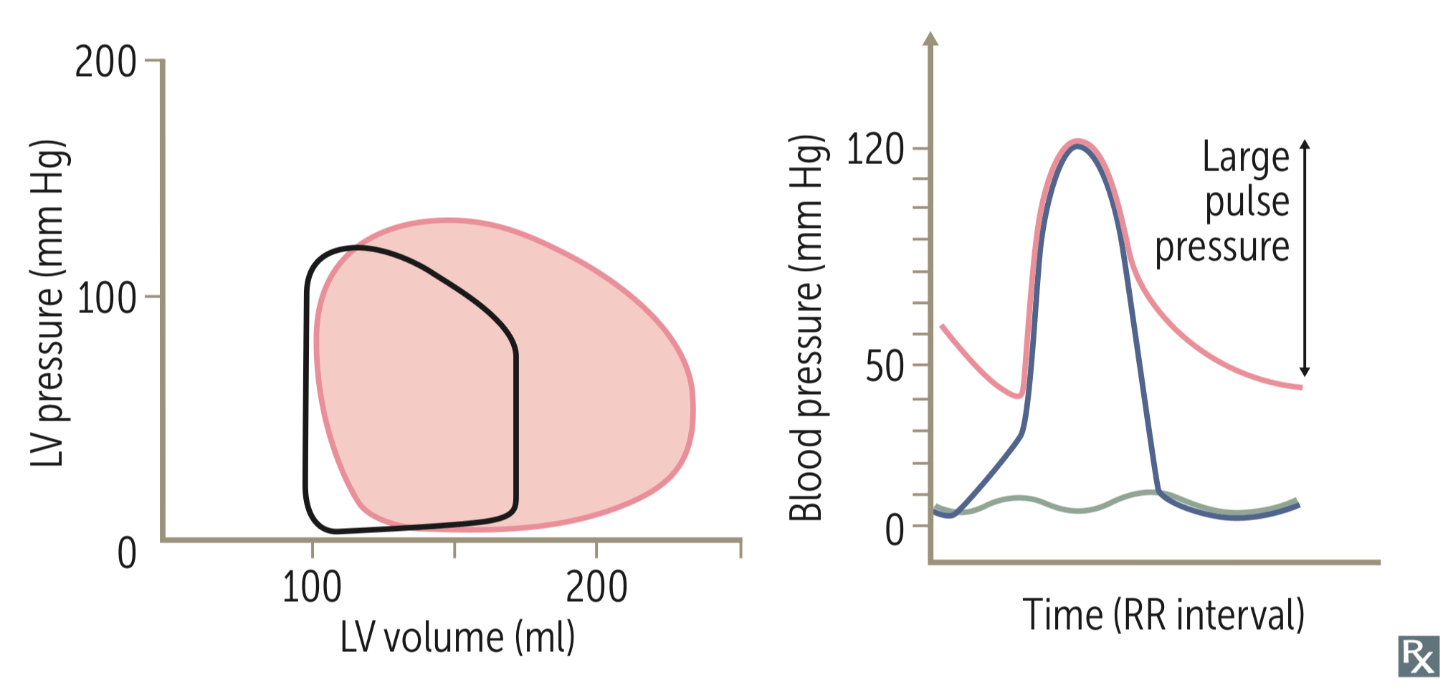
Aortic Regurgitation.
300
A 70-year-old man has dizziness. ECG shows progressively lengthening PR intervals followed by a dropped QRS complex.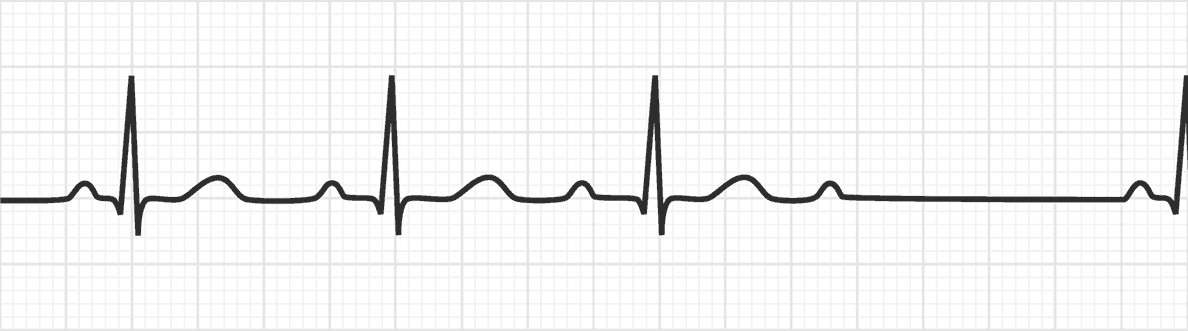
Second-degree AV block, Mobitz type I (Wenckebach)
Teaching point: The block is usually located at the AV node and may occur with increased vagal tone, inferior MI, or AV nodal-blocking drugs. It is generally less dangerous than Mobitz II.
300
A patient with supraventricular tachycardia is given a drug that briefly blocks AV nodal conduction. The drug has an extremely short half-life, and you have a sense of impending doom.
Adenosine
Teaching point: Adenosine activates A1 receptors, causing AV nodal hyperpolarization and briefly blocking conduction. The sudden transient bradycardia/asystole, chest pressure, and dyspnea can produce a sense of impending doom.
300
76-year-old man has exertional chest pain and syncope. Cardiac exam reveals a harsh systolic murmur at the right upper sternal border that radiates to the neck.
Aortic stenosis
Teaching point: In older adults, the most common cause is age-related calcification of the aortic valve; severe disease classically causes angina, syncope, and dyspnea.
300
Cardiac dominance is defined by whichever coronary artery gives rise to this vessel, which supplies the inferior wall of the ventricles and the posterior third of the interventricular septum.
Posterior descending artery (PDA) / posterior interventricular artery
In ~85% of individuals, the heart is right-dominant (PDA branches off the Right Coronary Artery). In ~8%, it branches off the Left Circumflex Artery (left-dominant).
300
Standing and Valsalva maneuver cause a drop in preload and cause these murmurs to increase.
Mitral Valve Prolase and Hypertropic Cardiomyopathy.
400
A patient has an ECG with a PR interval of 240 ms. Every P wave is followed by a QRS complex.

What is the most likely diagnosis?
First-degree AV block
Teaching point: It represents delayed AV conduction rather than a true interruption of conduction. It is often benign and can occur with increased vagal tone or AV nodal-blocking medications
400
A patient with atrial fibrillation is treated with a drug that blocks potassium channels and prolongs the action potential duration. Months later, he develops pulmonary fibrosis and thyroid dysfunction.
Amiodarone
Teaching point: Amiodarone is primarily a Class III antiarrhythmic that blocks potassium channels. High-yield toxicities include pulmonary fibrosis, thyroid dysfunction, hepatotoxicity, corneal deposits, and skin discoloration
400
A 25-year-old athlete has exertional syncope. A crescendo-decrescendo systolic murmur becomes louder with Valsalva and softer with squatting.
Hypertrophic obstructive cardiomyopathy (HOCM)
Teaching point: HOCM gets louder when preload falls because the LV outflow obstruction worsens.
400
A patient has an infarction affecting the posterior third of the interventricular septum and the AV node. Which coronary artery is most likely occluded, assuming right-dominant coronary circulation?
Right coronary artery (RCA)
400
What is the equation for Stroke Volume and Cardiac Output?
SV = EDV - ESV / CO = SV x HR
500
An ECG shows a broad, notched R wave in leads I, aVL, V5, and V6 with a deep S wave in V1.
Left bundle branch block
Teaching point: LBBB causes delayed left ventricular depolarization and is more likely than RBBB to indicate underlying structural heart disease, including hypertension, cardiomyopathy, or ischemic disease. The abnormal ventricular depolarization also produces secondary ST-T changes.
500
A 72-year-old patient with heart failure and atrial fibrillation develops nausea, confusion, and yellow-green vision. ECG shows an arrhythmia after treatment with a drug that inhibits the Na⁺/K⁺ ATPase.
Digoxin toxicity
Teaching point: Digoxin inhibits Na⁺/K⁺ ATPase, indirectly increasing intracellular calcium and cardiac contractility. It also increases vagal tone and slows AV conduction. Toxicity can cause almost any arrhythmia, GI symptoms, confusion, and yellow-green vision. Hypokalemia increases the risk of toxicity
500
A 52-year-old man with IV drug use has fever and a holosystolic murmur at the left lower sternal border that becomes louder with inspiration.
Tricuspid regurgitation.
Teaching point: Right-sided murmurs generally become louder with inspiration because inspiration increases venous return to the right heart. In IV drug users, tricuspid regurgitation often results from infective endocarditis, classically Staphylococcus aureus.
500
This triangular region in the right atrium—bordered by the tendon of Todaro, the ostium of the coronary sinus, and the septal leaflet of the tricuspid valve—contains the AV node.
What is the Triangle of Koch?
Crucial landmark during electrophysiology studies and ablation procedures to avoid damaging the AV node and causing heart block.
500
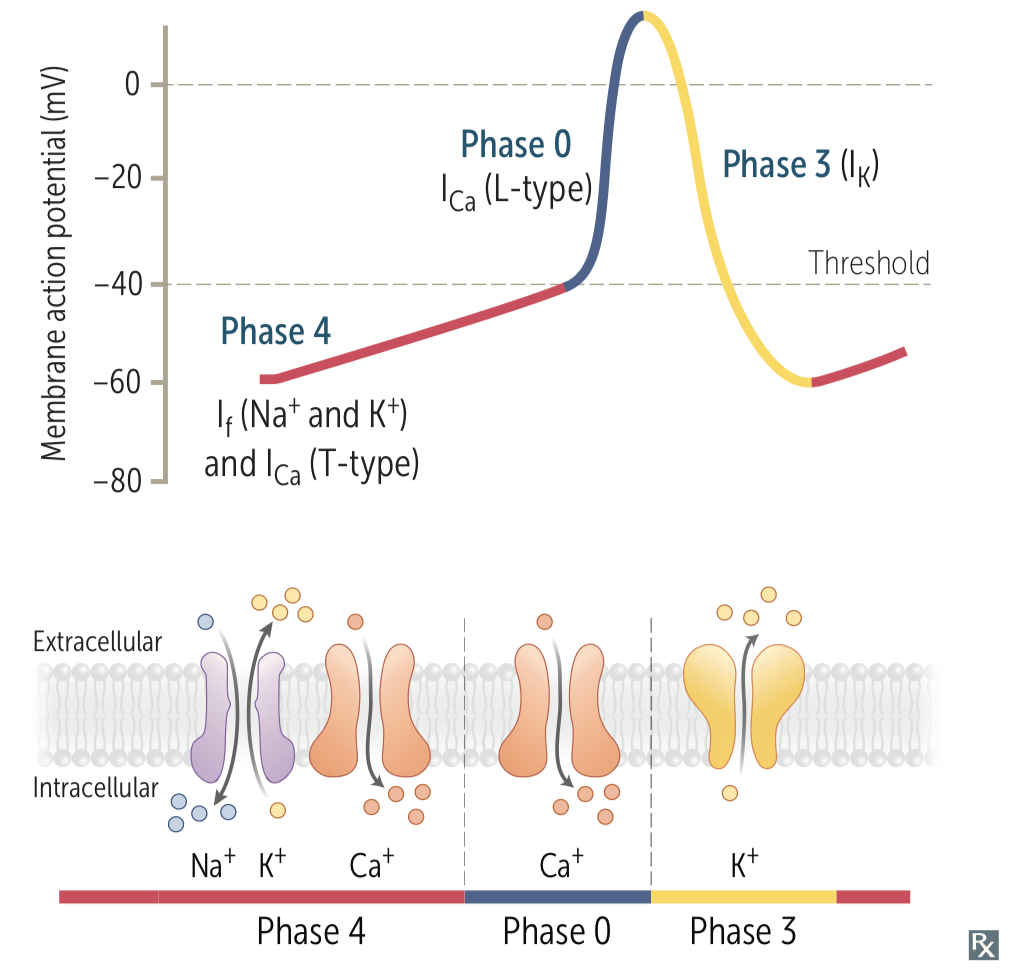
In pacemaker action potential, what phase determines the heart rate?
Slope of Phase 4 or B1 receptor stimulation.