Enter Category Name
Enter Category Name
Enter Category Name
Enter Category Name
Enter Category Name
100
________phase starts with the nuclear division, corresponding to the karyokinesis, and usually ends with cytokinesis.
M phase
100
The nuclear membrane and nucleolus reappear, cytokinesis follows and this is called as dyad of cells.
identify the phase
Telophase 1
100
In which stage do cells in adult animals do not appear to exhibit division and give example
G0 or quiescent stage
Heart cells
200
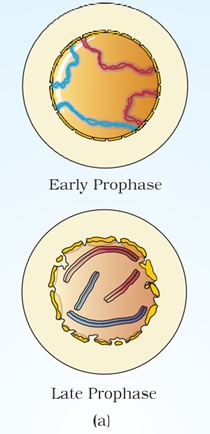
In the above phase diagram, each centrosome radiates out microtubules called ___________.
Asters
200
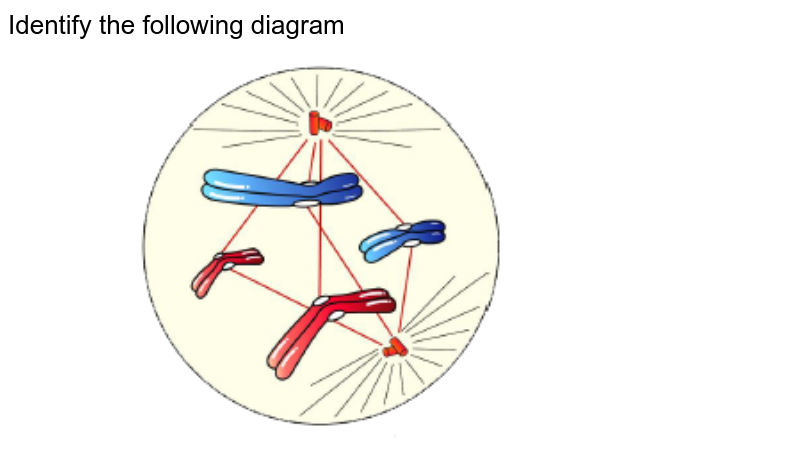
Mention one key feature of this phase
Spindle fibers attach to kinetochores of chromosomes.
Chromosomes are moved to the spindle equator and get aligned along with the metaphase plate through spindle fibers to both poles.
300
Identify the stage given below and answer the following questions
A. During this stage chromosomes start pairing together and this process of association is called synapsis
B. This stage is characterized by the appearance of recombination nodules.
C. The beginning of this stage is recognized by the dissolution of the synaptonemal complex and the tendency of the recombined homologous chromosomes

A. Zygotene
B. Pachytene
C. Diplotene
300
identify the phase
During this phase, the chromosomes are fully condensed and the meiotic spindle is assembled to prepare the homologous chromosomes for separation
X shaped structures formed in diplotene are called______
Diakinesis
chiasmata
400
Write the phases of the cell cycle against each of the events
a) The disintegration of the nuclear membrane
b) The appearance of the nucleolus
c) Division of centromere
d) Replication of DNA
A. Prophase.
B. Telophase.
C. Anaphase.
C. S-phase.
500
Meiosis and Mitosis are called ________ and _______divisions respectively.
What will be the DNA content of a cell at G1, after S and G2, If the content after the M phase is 2C
Mention 3 difference between mitosis and meiosis
Reductional and equational divisions
G1 -2C
S - 4C
G2-4C
1. before mitotic division, the cell is in the interphase. there are three phases in interphases G1, S, and G2.daughter cell grows in size and produces enzyme required for replication in the G1 phase
2. In the S phase, DNA replicates, and the content of the chromosome gets double. In the G2 phase, cells grow in size and prepare to move in mitosis.
3.WhenDNA content becomes 4C as DNA replication has the DNA content will remain 4C
4. When this cell finishes mitosis, the DNA content gets reduced to half i.e, 2C
mitosis
occus in somatic cell
process is completed in one sequence
No crossing over or formation of chiasmata
end product-two diploid cells
meiosis
occurs in reproductive or germ cells
process is completed in 2 successive divisions
both crossing over and formation of chiasmata occurs
end product - 4 haploid cells