Cell Respiration
Photosynthesis
Fermentation
Cell Transport
Cell Theory Scientists & Random
100
What organelle does cell respiration happen in?
mitochondria
100
What organelle does photosynthesis happen in?
What absorbs the sunlight?
chloroplast and chlorophyll
100
Which type of respiration requires oxygen and which type of respiration does not require oxygen?
aerobic respiration & anaerobic respiration
100
What is the image representing?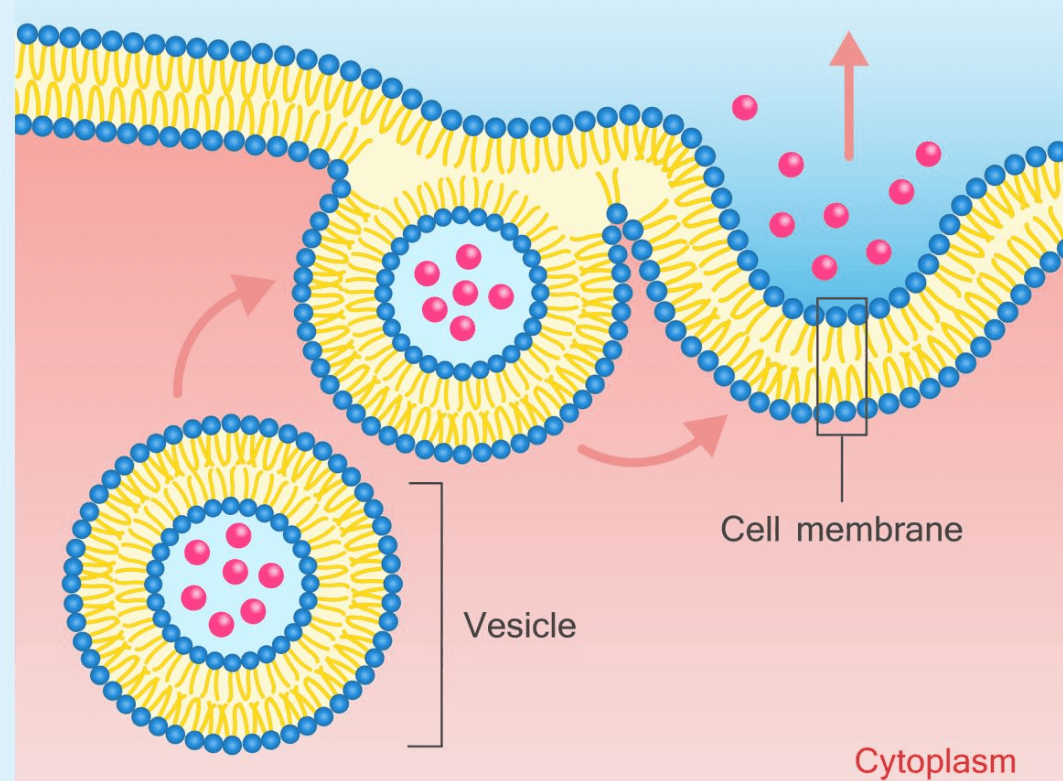
It represents exocytosis.
100
The father of microbiology?
Leeuwenhoek
200
What are the reactants of cellular respiration?
glucose & oxygen
200
Sunlight splits water into protons, electrons and oxygen.
The light-dependent phase of photosynthesis.
200
Which type of fermentation is used by bacteria and animal muscle cells to make yogurt, cheese and kraut?
It is lactic acid fermentation.
200
The movement of substances using a protein without energy and the movement of substances using a protein and with ATP.
It is facilitated diffusion and protein pump.
200
Plants are made of cells and animals are made of cells.
Schleiden & Schwann
300
What are the products of cellular respiration?
carbon dioxide, water, & ATP
300
What are the reactants of photosynthesis?
water & carbon dioxide
300
How many ATP does fermentation make?
2 ATPs
300
What do the pictures represent?
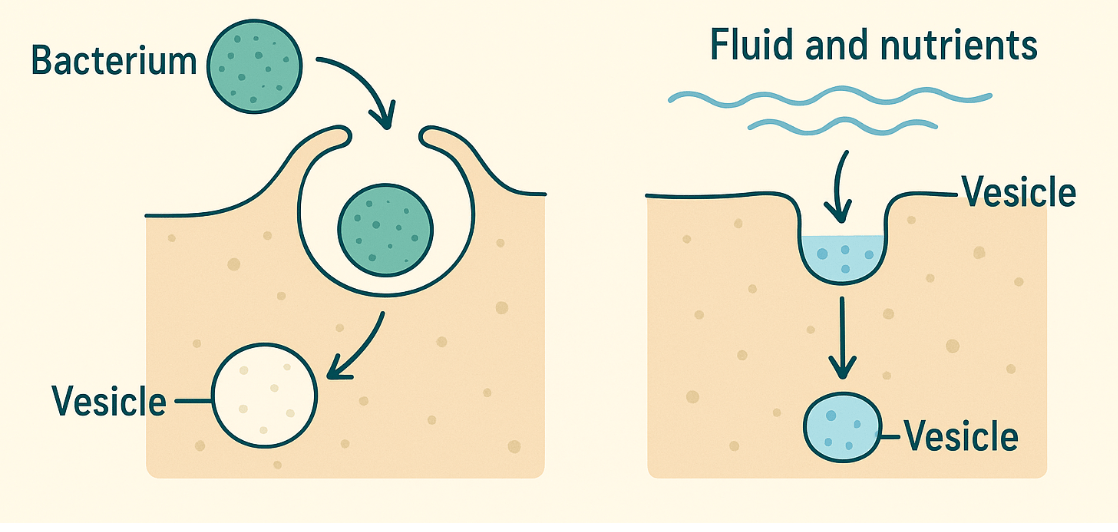
Left to right: Phagocytosis and Pinocytosis
300
What is a heterotroph (consumer)? What is an autotroph (producer)?
An organism that cannot make their own food and must get their food from other sources. An organism that makes its own food.
400
Cellular respiration occurs to make ATP for cells to perform their functions. How many ATP are produced?
ATP that is produced is 36.
400
What are the products of photosynthesis?
oxygen & glucose
400
Which type of fermentation is used to make bread, wine, and beer? (The by-product is carbon dioxide)
C6H12O6 > 2C2H5OH + 2 CO2 + ATP
alcoholic fermentation
400
What is osmosis and diffusion?
The movement of water across a semi-permeable membrane until equilibrium is reached. The movement of particles until equilibrium is reached.
400
Cells come from preexisting cells and cells divide to make new ones.
Virchow & Remak
500
What is the equation for aerobic cellular respiration?
glucose + oxygen --> carbon dioxide + water + ATP
C6H12O6 + 6O2 → 6CO2 + 6H2O + ATP
500
What is the chemical equation for photosynthesis?
carbon dioxide + water --> glucose + oxygen
6CO2 + 6H2O + sunlight→ 6O2 + C6H12O6
500
Which type of fermentation causes muscle soreness when exercising? C6H12O6 > 2C3H6O3 + ATP
lactic acid fermentation
500
Identify the containers and describe water flow for each of the following. What is isotonic?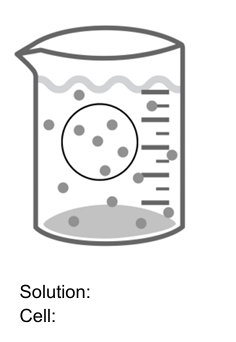
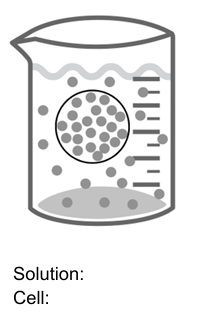
Top container: Cell is hypotonic, solution hypertonic. Water will flow out of the cell until equilibrium is reached.
Bottom container: Cell is hypertonic, solution is hypotonic. Water will flow into the cell until equilibrium is reached.
Isotonic is an equal flow of water between the cell and solution.
500
Glucose is made from protons, electrons and carbon dioxide.
When glucose is broken down into pyruvates.
The light-independent phase of photosynthesis.
The process is glycolysis.