Cell Transport #1
Cell Transport #2
Cell Transport #3
Cell Transport #4
Cell Transport #5
Cell transport #6
100
Molecules moving against a concentration gradient from [L] to [H] is this kind of cell transport
Active Transport
100
The function of the cell membrane is ________________
To control what comes in and out of a cell (maintain homeostasis)
100
What is the term for the Phospholipid bilayer that refers to it letting somethings pass through, but not everything.
Semi-permeable or Selectively permeable
100
The molecule that active transport uses to move large molecules against the concentration gradient [L] - [H]
ATP
100
Inside of cell : 80% salt, 20%water
Outside of cell: 50% salt, 50% water
What type of solution is the cell in?
Hypotonic
100
What is the difference between active and passive transport? (2 differences)
Active requires energy (ATP)/ Passive does not
and
Active goes against the concentration gradient [L] to [H]
Passive goes with the gradient [H] to [L]
200
What type of cell transport is represented by moving molecules from [H] to [L] with the concentration gradient?
Passive Transport
200
Molecules stop Passive Transport when both sides of the membrane reach ________________
Equilibrium
200
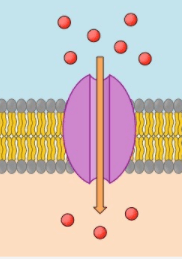
What type or transport is shown in this image?
Facilitated Diffusion
200
When there is a higher solute concentration inside in the solution, than in the cell, what type of solution is the cell in?
Hypertonic
200
The type of transport is shown in the picture
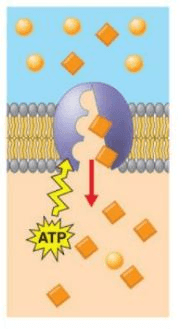
Active Transport
200
What part of the membrane is Hydrophobic?
Phospholipid Tails
300
The heads of a phospholipid are ___________
hydrophilic
300
Osmosis can happen both through the bilayer and proteins. What are the specialized proteins used for osmosis called?
Aquaporins
300
What 4 structures make up the cell membrane?
Phospholipids, Proteins, Carbohydrates, Cholesterol
300
What are the 3 types of Active Transport?
Protein Pumps, Exocytosis & Endocytosis
300
A large substance (bacteria) is engulfed by the cell and a vesicle is formed to bring it to the lysosome for digestion. What type of transport is is this an example of?
Endocytosis
300
What are the three types of passive transport?
Diffusion
Facilitated diffusion
Osmosis
400
What does Hydrophilic mean?
Water loving.
400
Your teacher sprays an air freshener, and it slowly spread throughout the classroom. This was an example of what type of transport?
Diffusion - passive transport
400
The movement of water across the membrane from [H] to [L] is known as....
Osmosis
400
During osmosis water will move in what direction?
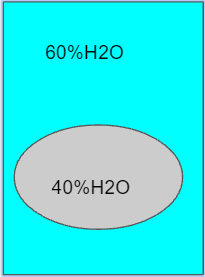
INTO the cell
400
Glucose is a large nonpolar molecule. After eating, glucose needs to go form the blood stream into cells. What type of transport allows this?
Facilitated Diffusion
400
Carbon dioxide moving out of cells into the blood cells is an example of what type of transport?
Diffusion
500
The structure used that makes facilitated diffusion different from other types of passive transport
protein channel
500
A difference in concentrations on both sides of the membrane is known as
Concentration gradient
500
The process by which a cell releases a substance from a vesicle to the outside of the cell
Exocytosis
500
What happens to a cell placed in a Hypotonic Solution?
It will swell.
500
The solvent and solute are evenly distributed throughout the solution. what type of solution is this?
Isotonic
500
The brackets around the [H] and [L] represent what vocabulary term?
Concentration