Cell Junctions & Misc
Protein Sorting & Targeting
DNA
DNA Replication
Mitosis
100
What are cell to cell junctions and their functions?
Cell to cell junctions: protein complexes found outside of cells that help keep them together
Functions:
- Anchor cells together and or to their environment
- Helps cells communicate with each other
- Anchor to the cytoskeleton
100
What is the difference between free and bound ribosomes? Where do the products of bound and free ribosomes usually go?
Free: found floating in the cytosol and produces proteins that will go to other organelles or remain in the cytoplasm
Bound: ribosomes found on the rough ER and produces proteins that will be used in the endomembrane system, will be secreted, or will go to the cell membrane
100
What makes up the structure of DNA nucleotides?
What are purines and pyrimidines?
What are the complimentary base pairs in DNA and how many bonds are within each pair?
Nucleotides: 1) Deoxyribose sugar 2) Phosphate group 3) Nitrogenous base
Purines: bases with a 2 ring structure (A & G)
Pyrimidines: bases with a 1 ring structure (C, U, T)
A + T (2 H bonds); G + C (3 H bonds)
100
What does it mean that DNA replication is semi-conservative and bidirectional?
Semi-conservative: DNA replication involves using one old strand as a template and produces one new strand, resulting a product that conserved half / semi of the parent strand (half old half new)
Bidirectional: it occurs in both directions
100
Somatic cells undergo _______ for cell division.
Mitosis
200
What are adhesive, tight, and gap junctions?
Adhesive: junctions that mechanically attach cells to neighboring cells or the extracellular matrix
Tight: keeps cells together in epithelial tissues and acts as a barrier to prevent movement of molecules between cells
Gap: junctions that allow for communication between cells through connexion proteins forming channels
200
What are the function of chaperone proteins? Name at least three.
1. Help polypeptides fold properly and prevent them from interacting inappropriately
2. Block hydrophobic interactions with other proteins
3. Help fold misfolded proteins correctly
4. Unfold proteins before they enter an organelle
5. Heat shock proteins can protect other proteins from harsh environmental conditions (like high temp. or pH)
200
What are the minor and major grooves found in DNA? Describe the function of the major groove.
Major: wide distance / space within the DNA backbone - the wide space allows for proteins and enzymes to interact with the DNA without having to unwind it
Minor: smaller distance / space within the DNA backbone
200
What are the functions of DNA polymerase I and III?
DNA pol. III: adds nucleotides onto the 3' OH end of the strand
DNA pol. I: removes the RNA primer and replaces it with DNA nucleotides
200
What are the 3 kinds of microtubules found within the mitotic spindle and what are their functions?
1. Kinetochore microtubules: binds to the kinetochores on the chromosomes and separates the sister chromatids
2. Polar microtubules: overlap with each other (doesn't bind to chromosomes) and lengthen the cell by connecting the cell poles
3. Aster microtubules: short microtubules that extend from the centrioles and stabilize the centrosome / spindle orientation
300
List the strands from highest to lowest melting points.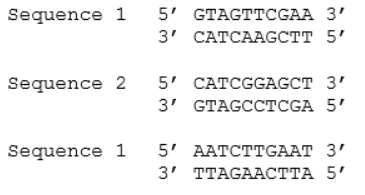
Highest to lowest: sequence 2, 1, and 3
300
Describe the structure of the ribosome and explain any differences between prokaryotic and eukaryotic ribosomes.
Structure: large and small subunit and is made of ribosomal RNA and proteins
Prokaryotic ribosomes are smaller (70S) and less complex than eukaryotic ribosomes, which are larger (80S) and more complex.
300
What is base stacking, what interactions are involved in base stacking, and why is it helpful for DNA?
Base stacking: the stacked bases will have weak interactions with each other through Van der Waals and hydrophobic interactions
They're helpful since they stabilize DNA and also keep out water so that it doesn't degrade from the water
300
(Double Jeopardy)
What are the functions of DNA helicase, topoisomerase, single stranded binding proteins (SSB), primase, and DNA ligase?
1. DNA helicase: unwinds/separates the parent strands
2. Topoisomerase: relieves supercoiling ahead of the replication fork
3. SSB: bind to the unwound DNA strands to keep them stable
4. Primase: adds RNA primers
5. DNA ligase: seals Okazaki fragments together and links any remaining gaps
300
What's the difference between mitosis in plant cells vs. animal cells?
Animal cells form a contractile ring that pinches the cytoplasm and cell into two.
Plant cells form a cell plate in the middle of the cell, which eventually fuses with the cell wall. This occurs since the cell wall is too rigid so it can't break.
400
What are the 3 types of adhesive junctions?
Adherens Junctions
Desmosomes
Hemidesmosomes
400
What is the difference between heterochromatin and euchromatin? Which one is used for transcription?
Heterochromatin: highly compacted chromatin
Euchromatin: loosely coiled / compacted chromatin - used for transcription since the proteins have easier access to the DNA
400
What is proofreading and how does it take place?
Proofreading is the ability for DNA pol. III to correct any mistakes it made by moving in the 3' to 5' direction, using its exonuclease activity to remove incorrectly added bases, and then continues adding bases in the 5' to 3' direction.
400
(Double Jeopardy)
List the steps of mitosis and describes what happens in each step briefly.
Prophase: DNA condenses
Prometaphase: Nuclear envelope fragments, spindle attaches to chromosomes
Metaphase: Chromosomes align on metaphase plate
Anaphase: A) Chromatids separate and move to the poles B) Centrosomes move to the poles of the cell and cell elongates
Telophase: (Reverse prophase) Chromosomes decondense, nuclear envelope reforms
500
What 2 proteins are found in Adheren junctions?
Cadherin: transmembrane protein
Catenins: link cadeherin to actin cytoskeleton
500
Explain this figure.
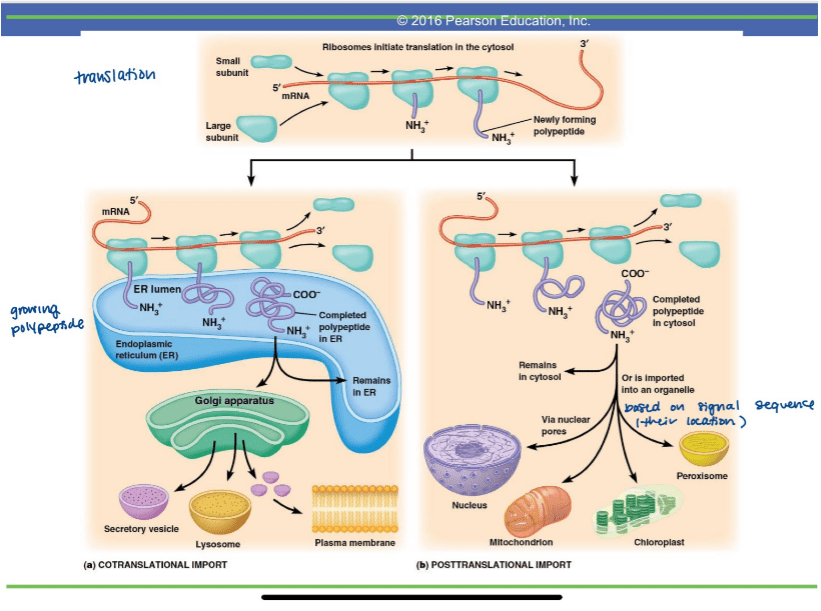
1. Protein synthesis begins on free ribosomes
2. Presence of a signal sequence determines where the growing polypeptide will go. If it needs to go to the ER, a receptor will recognize the sequence and pick it up to take it to the ER. If it needs to go to another organelle, it will finish translating in the cytoplasm and then be picked up and transported to its final destination.
3. ER -> Cotranslational import: once it has reached the ER, the polypeptide enters the ER lumen as TL is still happening (hence co-translational). Once TL is finished, it gets released into the ER, gets folded by chaperone proteins, gets transported to the Golgi where it will become glycosylated, and transported to its final destination (vesicle, membrane, lysozyme)
Post-translation Import: TL finishes in the cytoplasm and the sequence/signal determines whether the protein will go to the nucleus, mitochondria, or chloroplast
500
(Double Jeopardy)
Describe the steps or levels of DNA packaging.
1. DNA wraps around histone proteins, making nucleosomes
2. Beads on a string/chromatin forms, so nucleosomes connect
3. 30 nm Chromatic fiber forms with the help of H1 histone
4. DNA loops
5. Heterochromatin
6. Chromosome
500
What is the difference between the leading and lagging strand? Why does the lagging strand take place at all?
Leading: continuous DNA synthesis with no gaps
Lagging: discontinuous DNA synthesis filled with Okazaki fragments and RNA primers
The lagging strand is usually going in the 3' to 5' direction, but DNA pol. III can only add nucleotides on the 3' OH end, which results in those Okazaki fragments.
500
When is cyclin produced and is the most available? Which events in the mitotic cycle are regulated by cyclin and cyclin-dependent kinases (Cdk)?
Cyclin is produced throughout interphase and reaches a threshold at the end of G2. Since there's more cyclin, there is a higher chance it will bind to Cdks and allow mitosis to begin.
Cdks play a role in:
- Nuclear envelope breakdown
- Chromosome condensation
- Spindle formation