More
Cell Theory
Cell Structures
Levels of Organization
Diagrams and Graphs
100
Which statement best describes why cells need to reproduce?
A. to increase their size
B. to maintain genetic diversity
C. to create waste products
D. to replace damaged or dead cells
D. to replace damaged or dead cells
100
What is the smallest unit of an organism that is classified as living?
A. an atom
B. a molecule
C. an organ
D. a cell
D. a cell
100
A student observes a cell under a microscope and notices a rigid outer structure surrounding the cell. Which cell part is the student most likely observing?
A. cell membrane
B. cell wall
C. cytoplasm
D. nuclear membrane
B. cell wall
100
1. _______: the smallest unit of MATTER.
2. __________: a group of atoms bonded together.
1. ATOM
2. MOLECULE
100
Look at the diagram of a plant cell below:
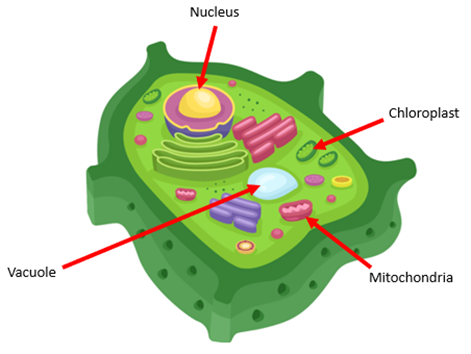
Which organelle is responsible for storing water and maintaining cell pressure?
A. mitochondria
B. vacuole
C. nucleus
D. chloroplast
B. vacuole
200
How are cells in multicellular organisms different from those in a single-celled organism?
A. Cells in multicellular organisms are specialized to perform certain functions.
B. Cells in multicellular organisms do not have nuclei.
C. Cells in multicellular organisms are smaller than cells in single-celled organisms.
D. Cells in multicellular organisms do not move.
A. Cells in multicellular organisms are specialized to perform certain functions.
200
A student observes that when a plant stem is cut, new cells form at the site of the cut. What principle of cell theory does this observation support?
A. Cells contain genetic material.
B. All organisms are made of cells.
C. Cells are the basic unit of life.
D. Cells come from existing cells.
D. Cells come from existing cells.
200
Which of the following best describes the main function of the cell membrane?
A. controls what enters and exits the cell
B. stores genetic material
C. produces energy for the cell
D. creates proteins for the cell
A. controls what enters and exits the cell
200
1. ______: the basic unit of LIFE.
2. ________: specialized structure within a cell (example - nucleus, mitochondria, vacuole, etc)
1. CELL
2. ORGANELLE
200
The graph below shows the amount of energy produced by mitochondria in plant and animal cells.
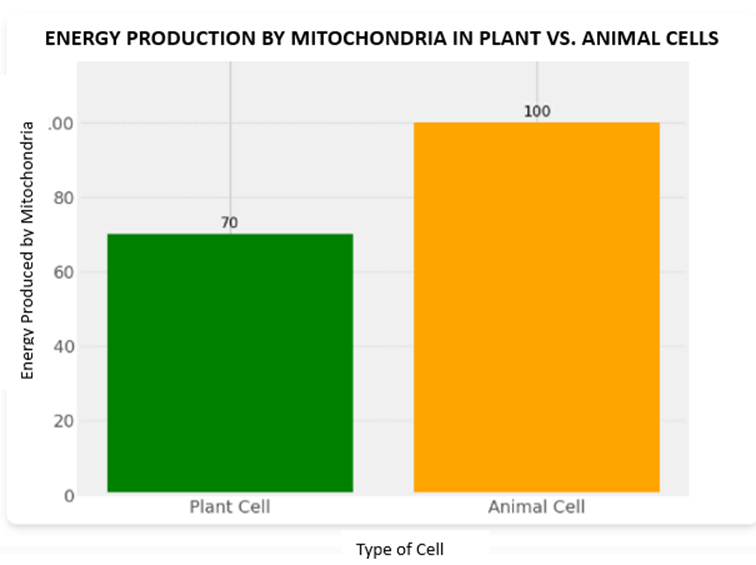
What conclusion can be made from the graph?
A. Mitochondria in animal cells produce more energy than plant cells.
B. Mitochondria in plant cells produce more energy than animal cells.
C. Mitochondria in both plant and animal cells produce the same amount of energy.
D. Mitochondria produce energy only in animal cells.
A. Mitochondria in animal cells produce more energy than plant cells.
300
Why is it important for cells to maintain homeostasis?
A. to stay balanced and healthy
B. to keep their shape
C. to grow bigger than other cells
D. to produce waste
A. to stay balanced and healthy
300
A scientist claims to have discovered a new life form that is not made of cells. Based on cell theory, which explanation shows why this claim is unlikely to be accepted?
A. The organism could be a crystal, with a structure that supports life.
B. All living things are made of cells.
C. The organism might be too small to see without advanced equipment.
D. The scientist needs a more precise microscope to verify the claim.
B. All living things are made of cells.
300
How do cells move waste from the inside the cell to outside the cell?
A. Waste passes through the cell membrane into surrounding fluids.
B. Waste is stored in the cell’s nucleus in the cell’s DNA.
C. Waste is changed into water that is carried out of the cell by the endoplasmic reticulum.
D. Waste is used to build cell walls.
A. Waste passes through the cell membrane into surrounding fluids.
300
Compare and contrast tissues and organs. Which statement is correct?
A. Tissues and organs are the same thing.
B. Tissues are made of organs.
C. Organs are made of multiple types of tissues working together.
D. Both tissues and organs do not contain cells.
C. Organs are made of multiple types of tissues working together.
300
A scientist recorded the number of cells in a growing culture over time in the graph below.
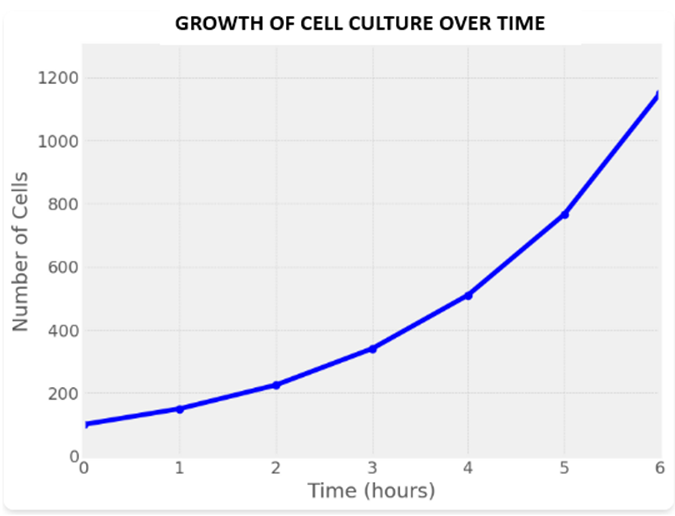
What does the graph tell us about how cells come from other cells?
A. The number of cells stays the same over time.
B. The number of cells decreases over time.
C. The number of cells increases over time.
D. The cells disappear over time.
C. The number of cells increases over time.
400
1. ___________ (powerhouse of the cell) produces energy (ATP) for the cell.
2. ___________ (the command center of the cell) contains DNA and controls cell activities.
Word Bank: nucleus, mitochondria, chloroplast, cytoplasm, cell membrane, cell wall, vacuole
1. MITOCHONDRIA
2. NUCLEUS
400
Allison has a sealed petri dish each with a single cell in it. Every 6 hours for the next 2 days she counts the number of cells in her petri dish. Her data is listed in the table below.
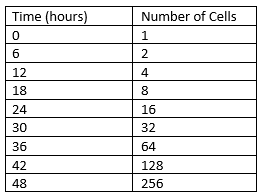
What part of cell theory was Allison’s experiment most likely about?
A. The number of cells grown in a petri dish doubles every 6 hours.
B. The cells grown in a petri dish all come from preexisting cells.
C. Single-celled organisms can grow in a petri dish.
D. The cells grown in a petri dish will only survive for 48 hours.
B. The cells grown in a petri dish all come from preexisting cells.
400
A student creates a model showing how plants make their own food. Which cell organelles must be included to accurately represent this process?
A. nucleus and ribosomes
B. chloroplasts and mitochondria
C. mitochondria and cell wall
D. Golgi body and cell membrane
B. chloroplasts and mitochondria
400
A student is studying how different levels of organization work together in the human body. Which sequence correctly shows the progression from simplest to most complex?
A. cells → tissues → organs → organ systems
B. tissues → cells → organs → organ systems
C. organs → tissues → cells → organ systems
D. organ systems → organs → tissues → cells
A. cells → tissues → organs → organ systems
400
Refer to the graph below showing the rate of waste removal and energy production in cells over time.
WASTE REMOVAL VS. ENERGY PRODUCTION IN CELLS
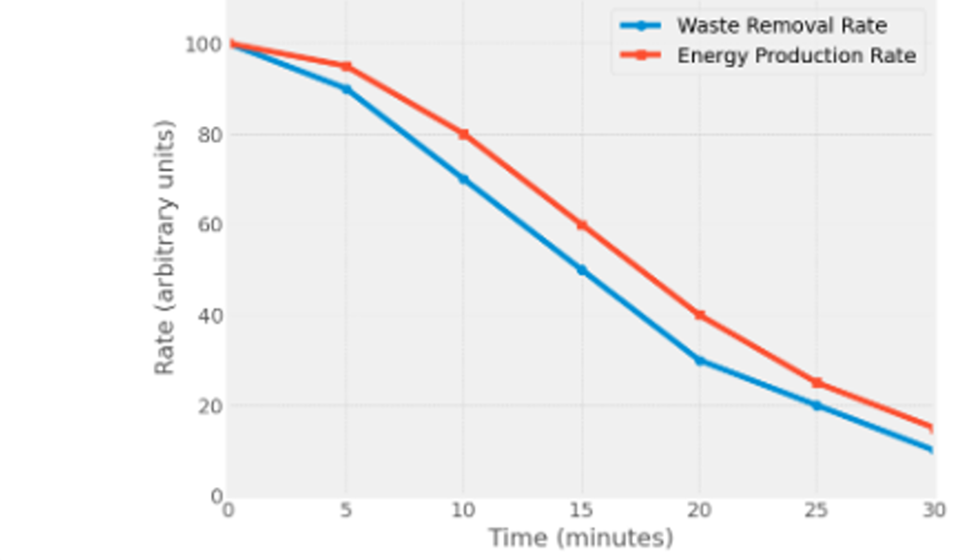
What happens to energy production when waste removal decreases?
A. Energy production increases.
B. Energy production stays the same.
C. Energy production decreases.
D. Energy production stops immediately.
C. Energy production decreases.
500
1. ____________: (supermarket and water tower of the cell) stores water, nutrients, or waste.
2. __________: gel-like fluid that fills cells.
Word Bank: nucleus, mitochondria, chloroplast, cytoplasm, cell membrane, cell wall, vacuole
1. VACUOLES
2. CYTOPLASM
500
A scientist discovered a new microscopic organism. What evidence would be necessary to classify it as a living thing according to cell theory?
A. It moves independently.
B. It contains cell structures and can reproduce through cell division.
C. It responds to environmental changes.
D. It grows larger over time.
B. It contains cell structures and can reproduce through cell division.
500
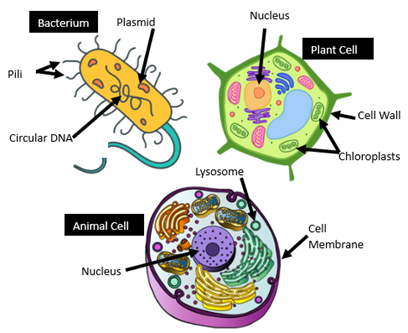
Study the diagram below of various organisms and their cellular structure. Which statement best explains what these organisms have in common?
A. They all contain a nucleus.
B. They are all composed of one or more cells.
C. They all have cell walls.
D. They all perform photosynthesis.
B. They are all composed of one or more cells.
500
What TWO organelles do plant cells have that animal cells do not?
Word Bank: nucleus, mitochondria, chloroplast, cytoplasm, cell membrane, cell wall, vacuole
CELL WALL and CHLOROPLAST
500
Look at the diagram of a cell membrane. The cell membrane is a thin, flexible barrier that surrounds all cells.
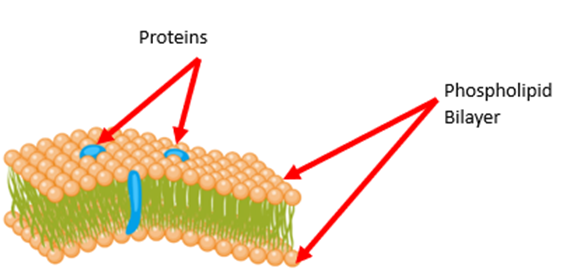
What would happen to the cell if the membrane became more rigid?
A. The cell would divide faster.
B. Transport of materials would be hindered.
C. The cell would produce more energy.
D. Protein production would increase.
B. Transport of materials would be hindered.