Biomolecules
Organelles
Diffusion and Facilitated Diffusion
Osmosis
Active Transport
100
Polymers are made of ___.
Monomers
100
Which kind of cells have membrane-bound organelles?
Eukaryotic cells
100
What do active transport processes need that passive transport processes do not need?
Energy
100
Give an example of a solute, solvent, and solution.
Solute is what is dissolved, solvent does the dissolving, solution is solute and solvent together.
100
In active transport, things move from __ to __ concentration
low, high
200
What biomolecule do mitochondria break down and turn into energy?
carbohydrates
200
Describe the role of the nucleus
It holds all the cell's genetic information
200
Describe what happens when something diffuses across the cell membrane.
Molecules move from an area of high to low concentration through the cell membrane without the input of energy.
200
What is it called when water molecules move from high concentration to low concentration
Osmosis
200
Cells use this kind of energy to power active transport
ATP
300
What biomolecule do ribosomes create?
Protein
300
Describe the role of the mitochondria
Mitochondria break down sugars and convert them to energy in the form of ATP
300
What is facilitated diffusion?
A transport protein provides a tube-like opening in the plasma membrane through which particles can diffuse
300
What kind of solution does not change the size or shape of a cell?
An isotonic solution, or when the concentration inside and outside of the cell is the same.
300
When a package of material exits the cell using active transport it is called
Exocytosis
400
What biomolecule are cellular membranes made of?
Lipids
400
Describe the structure and function of the ribosome
Made of RNA and protein, serves as the site for protein production in the cell
400

Is this process using energy? Explain why or why not.
No, because the particles are moving from high to low concentration down their concentration gradient and no ATP is required.
400
Draw a picture of a cell in a hypotonic solution.
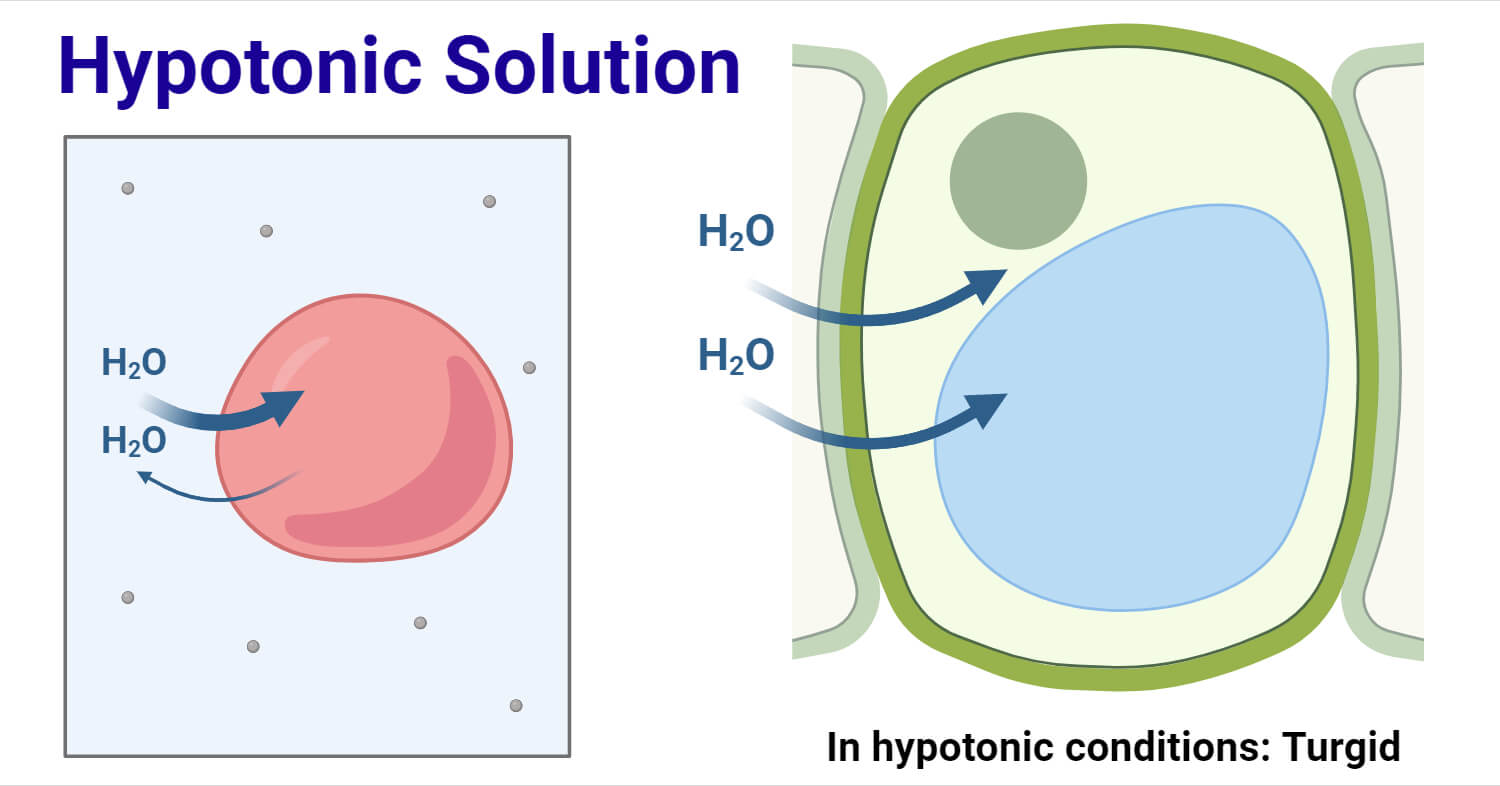
400
Describe the action of the sodium-potassium pump.
The sodium-potassium pump moves sodium and potassium ions against their concentration gradient across the cell membrane using ATP.
500
Describe the function of each biomolecule.
Carbohydrates: Short term energy
Lipid: Long term energy, protection, insulation
Protein: Cell structure, cell transport and signaling, metabolism, enzymes
Nucleic acids: Store and transmit genetic information
500
Describe the role of the cytoskeleton
Helps maintain the shape and organization of a eukaryotic cell.
500
Explain how diffusion, facilitated diffusion and osmosis related to maintaining cell homeostasis.
These processes are related to homeostasis because they allow things to pass in and out of the cell freely without the use of energy. For example, oxygen is able to diffuse in and carbon dioxide is able to diffuse out. In this way, oxygen is available for cellular respiration and carbon dioxide, a waste product, is removed.
500
A cell is 95% water and 5% salt. When it is placed in a solution of unknown concentration, it shrinks. What is the concentration of the solution?
The solution has to be more than 5% salt.
500
Explain how endocytosis, exocytosis and the sodium-potassium ion pump related are related to maintaining cell homeostasis.
These active transport processes are essential for healthy cell functioning. For example, through endocytosis, cells can "eat" pathogens to keep the body healthy. Cells can release enzymes or waste products through exocytosis. And finally, the sodium-potassium pump creates a concentration gradient of ions that is essential for nerve signaling, muscle contraction, and other processes.