Mitosis
Chromosomes
Cellular Respiration
Cell Size
Other
100
Describe what is happening in Interphase.
G1 phase, Sphase, and G2 phase. The cell is preparing for mitosis in this phase.
100
How is a chromosome in a prokaryotic cell shaped?
Chromosomes in Prokaryotic cells form a ring.
100
What are calories? What about Calories?
A calorie is the amount of energy needed to raise the temperature of 1 gram of water 1 degree Celsius. A Calorie is 1000 calories.
100
What two factors are taken into account for cell size?
Surface area and volume.
100
What is cell division called in Prokaryotes?
Binary Fission
200
Describe what is happening in Prophase.
The nucleus condenses and chromosomes become visible. The spindle begins to form.
200
Illustrate a eukaryotic chromosome, identify the sister chromatids, and the centromere
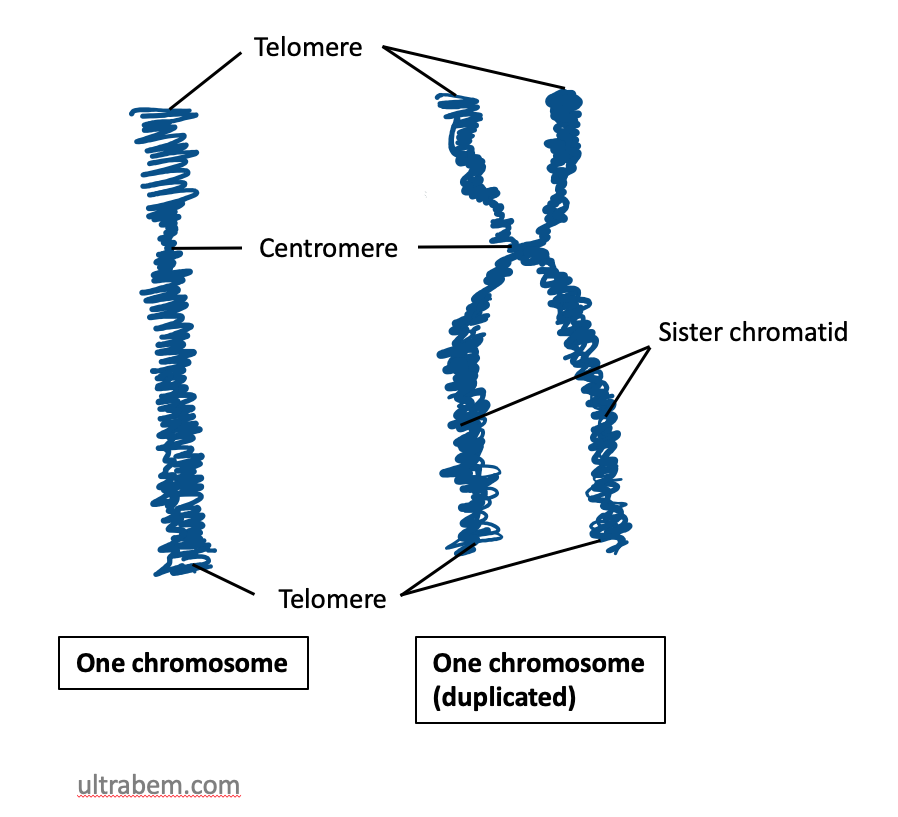
200
What are the two reactants in cellular respiration? What do they form after the chemical process?
Oxygen and Glucose are the reactants, they form carbon dioxide, water, and usable energy after the chemical process.
200
Do the volume and surface area of a cell increase at the same rate as a cell grows? Why not?
No, the volume increases at a greater rate than the surface area does.
200
If cellular respiration requires O2, then why doesn’t the planet run out of O2?
Photosynthesis removes carbon dioxide from the atmosphere, and cellular respiration puts it back.
300
Describe what is happening in Metaphase.
Chromosomes line up at the center of the cell.
300
What are the role of Histone proteins? (not on daily sheet!)
Organize DNA in to compact structures.
300
The Krebs cycle is what kind of process? Aerobic or anaerobic?
The Krebs cycle is an Aerobic cycle.
300
Considering the problem of surface-area-to volume ratio, how could cell growth create a problem that is similar to the traffic jam in the growing town?
There is only so much space (surface area) to exchange nutrients and genetic material. The more volume something has, the more surface area is needed for nutrient and genetic material to move.
Much like how cities with a larger volume require more roads (surface area) to allow materials, goods, and people to transit across that city.
300
M phase contains what two phases?
Mitosis, and Cytokinesis.
400
Describe what is happening in Anaphase.
Chromosomes move toward opposite poles.
400
What is a Nucleosome? (not on daily sheet!)
A group of histones wrapped by DNA.
400
Glycolysis is what kind of process? Aerobic or anaerobic?
Glycolysis is an anaerobic cycle.
400
How does cell division benefit the cell when it comes to surface area to volume ratio?
Smaller cells mean a greater surface area to volume ratio.
400
What is the role of chromosomes in cell division?
To provide structure and order for DNA (genetic material) to exchange between daughter cells equally.
500
Describe what is happening in Telophase.
The cell begins to divide into daughter cells.
500
Explain Supercoils -> Nucleosomes, and everything they are made of. (not on Daily sheet!)
Supercoils are made of many/ multiple coils.
Coils are made up of many/multiple Nucleosomes
Nucleosomes are made up of many/ multiple bundled histones that are wrapped in DNA
500
What does it mean for a process to be anaerobic?
What does it mean for a process to be aerobic?
Anaerobic processes requires no oxygen.
Aerobic processes requires oxygen.
500
Describe the three stages of interphase and what happens in each.
G1 Phase: Cell growth
Sphase: DNA replication
G2 Phase: Preparation for mitosis