Cells/Viruses
Mitosis/Meiosis
Nucleic Acids
Biomolecules
Miscellaneous
100
An abnormal mass of cancer cells is called a ?
Tumor
100
What is the difference between a diploid and haploid cells.
Haploid cells have only ONE copy of each chromosome, while diploid cells have TWO copies.
100
What is this called?

DNA Replication
100
List the 4 Biomolecules.
Carbohydrates, Lipids, Proteins, Nucleic Acids
(Cows Like Playing Nice)
100
What is homeostasis?
Internal Balance (allows the organism to survive)
200
When stage does DNA replicate in the cell cycle?
S Phase (Synthesis Phase)
200
During which process does the cell divide only ONCE?
A. Mitosis
B. Meiosis
Mitosis
200
What is the purpose of DNA replication?
A. So that the cells can have ATP
B. So that two new cells can be genetically identical to parent.
C. So that two new cells can be genetically different than the parent.
D. So that the parent cell can absorb the DNA Strand.
B. So that two new cells can be genetically identical to parent.
200
Which biomolecule stores the MOST energy?
Lipids
200
What does the vacuole of a cell do?
Stores Food, Water, and Waste. (Hint: Vacuum bag)
300
What is the purpose of the cell cycle?
To divide and produce more cells.
300
Which process produces 2 cells? Which process produces 4 cells?
2 Cells= Mitosis
4 Cells= Meiosis
300
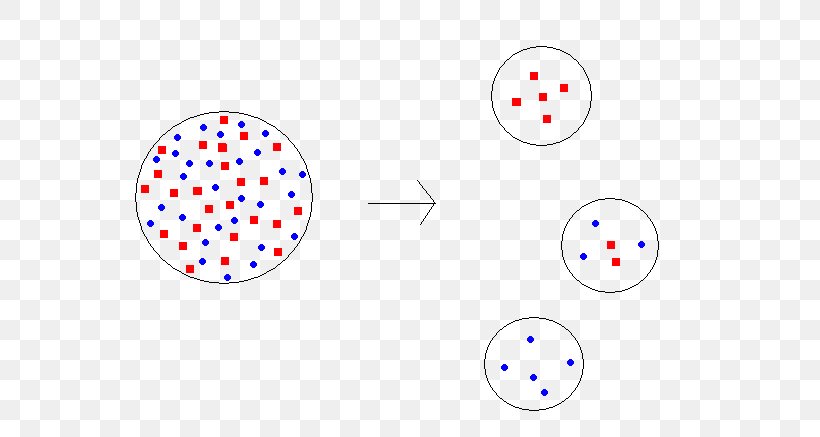
The picture above are cells. By looking at this picture What can you determine is TRUE.
A. The even takes place in RNA inside the Mitochondria of cells
B. This takes place in bacterial cells.
C. This produces genetically identical daughter cells.
D. This provides genetic diversity in cells.
D. This provides genetic diversity in cells.
300
What is the difference between a monosaccharide and a polysaccharide?
A monosaccharide is one and a polysaccharide is many.
(So, a monosaccharide is a SIMPLE sugar and polysaccharide is a COMPLEX sugar.
300
True or False.
This picture is considered active transport.

False. It is passive transport because it requires NO ENERGY (ATP). It is the "lazy" type of transport.
400
 Label the cell cycle.
A.__________
B.__________
C. __________
D.___________
A. G1 Phase
B. S (Synthesis) Phase
C. G2 Phase
D. Mitosis
400
A cell has 10 chromosomes. It then undergoes MITOSIS. How many chromosomes will each of the new cells have?
A. 5
B. 10
C. 15
D. 20
B. 10
400
Which nucleic acid includes the following nucleic bases?
Guanine, Cytosine, Uracil, and Adenine
RNA because of URACIL
400
Which 2 biomolecules are NOT USED FOR ENERGY.
Proteins and Nucleic Acids. (Carbs and Lipids are the ones we use for energy)
400
True or false.
Homeostasis plays a role in cellular transport.
True. Cellular transport helps cells maintain homeostasis by keeping conditions within normal ranges inside all of an organism's cells.
500
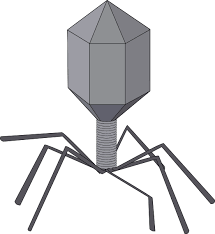
What are the 2 reproductive cycles that Viruses undergo? (Hint: one is longer than the other)
Lytic and Lysogenic Cycle
500
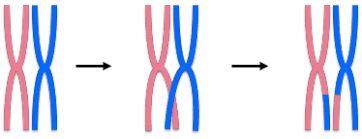
What is this process called in Meiosis? (Look at the pictures carefully)
Crossing-over
500
A nucleotide is the building blocks of ________?
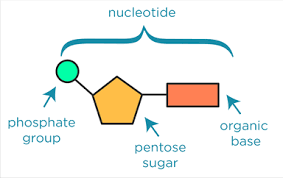
DNA
500
Which biomolecule functions include enzymes which speeds the rate of chemical reactions, structural components in cells, mechanical functions in muscles and cytoskeleton, cell signaling, and immune response; provides structure and helps with chemical reactions
Proteins
500
Put the following biological levels in order from simplest to most complex. You must get all of them correct to get the points.
organism, ecosystem, community, organ systems, organ, organelles, cell, atom, tissue, molecules, and population.
Atom
Molecule
Organelles
Cell
Tissue
Organ
Organ System
Organism
Population
Community
Ecosystem