Equilibrium concepts
Acid/base concepts
Conjugate pairs
pH
Problem solving
100
If reaction quotient Q is greater than K, in which direction will the reaction proceed to reach equilibrium?
The reaction will proceed to the left until Q = K.
100
What is the definition of an Arrhenius acid?
An Arrhenius acid forms H3O+ in water.
100
Identify the Bronsted-Lowry acid/base conjugate pairs in the following reaction:
HSO4- (aq) + H2O (l) ⇌ OH- (aq) + H2SO4 (aq)
HSO4- (base) and H2SO4 (acid) are a conjugate pair, H2O (acid) and OH- (base) are a pair.
100
A solution with a high pOH will be: (acidic/neutral/basic)
Acidic
100
What mass of Ca(OH)2 is required to neutralize 2 L of strong acid solution with a pH = 1.2?
4.67 g Ca(OH)2
200
According to Le Chatelier’s principle, if heat is added to a system with an exothermic reaction, in which direction will the reaction shift?
The reaction will shift to the left to consume the heat added.
200
What is the definition of a Lewis acid?
A Lewis acid accepts an electron pair to form a new bond.
200
Given the Ka value for a weak acid, how would the Kb value for its conjugate base be calculated?
Kb = Kw / Ka Kw = 1.0 x 10⁻¹⁴
200
The following pictures represent aqueous solutions of binary acid HA (water molecules have been omitted for clarity). In each figure, 7 molecules of HA are originally present. Arrange in order of increasing acid strength.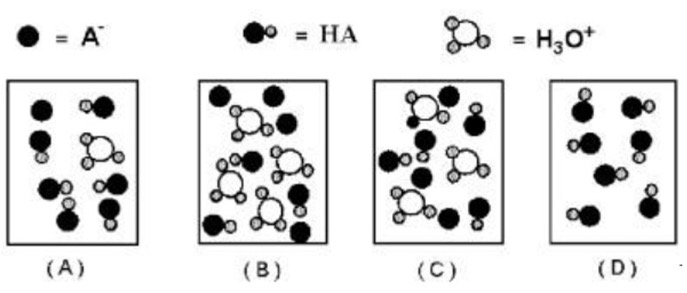
D < A < C < B
200
What volume of 6.15 M HCl(aq) is required to exactly neutralize 1.25 L of 0.265 M NH3(aq)? Kb = 1.8 x 10⁻⁵
53.87 mL HCl
300
According to Le Chatelier’s principle, which way will a reaction involving gases shift when pressure is decreased?
The reaction will shift to the side with a higher number of moles of gas.
300
Write a balanced equation for the dissociation of the Bronsted-Lowry acid HCO3- in water:
HCO3- (aq) + H2O (l) ⇌ CO32- (aq) + H3O+ (aq)
300
Consider acids 1 and 2. If acid 2 is stronger than acid 1, is the conjugate base of acid 2 stronger or weaker than the conjugate base of acid 1?
The conjugate base of acid 2 is weaker than that of acid 1.
300
What is the trend of binary acid strength on the periodic table?
Acid strength increases down a group and across a period.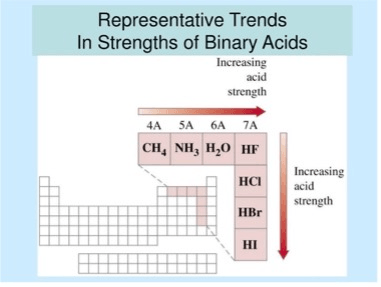
300
What is the equilibrium concentration of H3O+ if the initial concentration of a weak acid HA is 0.100 M? Ka = 1.8 x 10⁻⁵
[H3O+] = 1.3 x 10⁻³ M
400
In what situation can the small x approximation be used?/What is the ‘threshold’?
When a dissociation is small relative to initial concentration, threshold of x < 5%
400
How is [H+] calculated from pH?
[H+] = 10-pH
400
A salt including the anion NO3- and the cation Ca2+ will result in what type of solution? (acidic/neutral/basic)
The resulting solution will be neutral.
400
Arrange the following 0.20 M aqueous solutions in order of decreasing pH:
KOH, HBr, NaCH3COO, KBr, NH4Br
KOH, NaCH3COO, KBr, NH4Br, HBr
400
A weak monoprotic acid has molar mass = 204.2 g/mol and Ka = 3.91 x 10⁻⁶. Calculate the pH of the solution when 0.60 g of the acid is dissociated 50.0 mL of water.
pH = 3.32
500
Consider two reactions, 1 and 2, with equilibrium constants of Ka1 and Ka2. What is the equilibrium constant for a reaction that is the net result of reversing reaction 1, doubling reaction 2, and adding them together?
((K_(a2))^2)/K_(a1)
500
When can the second dissociation of a polyprotic acid be considered negligible?
A good rule of thumb is when Ka1 is at least 103 larger than Ka2, generally when the second dissociation does not result in a noticeable pH difference.
500
Consider the following Bronsted-Lowry acids: HCl, H2SO4, HNO3, CH3COOH (acetic acid), and HBr. Which acid’s conjugate base will produce the highest concentration of OH- ions in water?
CH3COOH
500
What is the pH of a 0.040 M Ca(OH)2 solution at 25 ᵒC?
pH = 12.90
500
What mass of benzoic acid, C6H5COOH, needs to be dissolved in 350.0 mL of water to produce a solution with a pH of 2.85? Ka = 6.3 x 10⁻⁵
1.39 g C6H5COOH