Ch 26 Soft Tissue
Ch 27 Face and Neck
Ch 28 Head and Spine
Ch 29 Chest Injuries
Ch 30 Abdominal Injuries
100
The adult has partial thickness burn to his entire left leg and left arm. Using the rule of 9's, what is the estimated burn percentage?
27%
100
What are the major vessels found in the neck?
Carotid artery and jugular vein
100
What is largest part of the brain?
Cerebrum
100
Hemoptysis is defined as:
Coughing up blood
100
Which of the organs would most likely bleed profusely when injured?
The liver and spleen.
200
What is the difference between a bruise and a hematoma?
A bruise occurs when the small veins and capillaries under the skin break. A hematoma is a collection (or pooling) of blood outside the blood vessel.
200
What is the bone above the teeth called and what type of la forte fracture is this?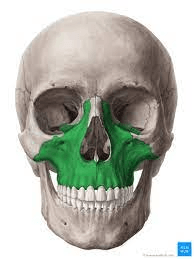
Maxilla, La forte II
200
Where is an epidural bleed located?
Between the dura mater and the skull
200
What is the difference between a pneumothorax and a tension pneumothorax?
A pneumothorax is an accumulation of air in the pleural space, a tension pneumothorax is when the air has built up enough to cause obstructive shock.
200
Peritonitis usually occurs when:
Hollow abdominal organs are damaged and spill their contents.
300
An injury that separates various layers of soft tissue, resulting in complete detachment or a flap of skin, is called a(n):
An avulsion.
300
What is the medical term for naturally occurring unequal pupil size?
Anisocoria
300
Describe Cheyne-stokes breathing, why does this happen?
Progressively deeper and faster breathing followed by a gradual decrease that results in apnea. The pattern repeats, with each cycle usually taking 30 seconds to 2 minutes. This is usually indicating brainstem herniation.
300
During your assessment of a patient with blunt chest trauma, you note that the patient has shallow breathing and a small area of paradoxical movement of the left chest wall. This injury is called:
Flail chest
300
What is the best treatment regarding abdominal eviscerations?
The protruding organs should be kept warm and moist.
400
Explain compartment syndrome. What is it, how can it be caused and what are the symptoms?
A painful condition that occurs when pressure within the muscles builds to dangerous levels. This pressure can decrease blood flow resulting in tissue death. the S/S are pain out of proportion, paresthesia, pallor, paralysis, and pulselessness.
400
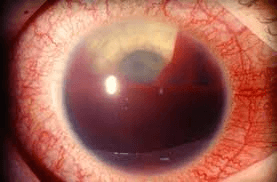
What is this injury called?
Hyphema
400
Racoon eyes and Battle's signs indicate what kind of skull fracture?
Basilar skull fracture
400
Immediate death from blunt chest trauma following a motor vehicle crash is most often the result of:
Traumatic aortic rupture.
400
Bruising to the left upper quadrant of the abdomen after blunt trauma is most suggestive of injury to the:
Spleen
500
Tension pneumothorax and cardiac tamponade result in what type of shock? Explain the mechanism
Obstructive. Air or blood/fluid gets in the way of the functioning of the heart so it lowers CO.
500
What is the difference between aqueous and vitreous humor?
Aqueous humor is a clear liquid found in the anterior chamber of the eye, whereas vitreous humor is a clear gelatinous mass found in the rear part of the eyeball between the lens and retina. Vitreous humor is not easily replaced while aqueous humor is.
500
What is Cushing's triad?
- Hypertension
- Bradycardia
- Irregular respirations – primarily Cheyne-Stokes breathing
This often signals impending danger of brain herniation.
500
A 19-year-old male is unresponsive, apneic, and pulseless after being struck in the center of the chest with a softball. Based on the mechanism of injury, what most likely occurred? What is this called?
Ventricular fibrillation when the impact occurred during a critical portion of the cardiac cycle. It is called commotio cordis.
500
Which organs/structures are retroperitoneal?
The retroperitoneal space contains the kidneys, adrenal glands, pancreas, lymph nodes, abdominal aorta, and inferior vena cava.