3-1:
Population
Population
What is population?
What branch of science studies how populations change and grow over time?
Population is the total number of people in any given place.
Demography is a science that tries to explain how and why populations change over time.
Define migration.
What do we call people who migrate from their home country?
Migration is the movement of people from one place or region of the world to another.
People who move to a new country from their homeland are called immigrants.
What is an economy?
What are the two key groups of people in an economy?
An economy is a system in which people make, exchange and use things that have value.
This system lets people get the items they need or want to live their lives, but can’t create themselves.
There are two groups of people in an economy:
-Producers - the owners and workers of a company that makes a product
-Consumers – the people who buy and use those products
Define a government.
A government is the organization of a country that sets up and enforces laws.
Where in the world were people most likely to settle for most of human history?
Where do most people live today?
For most of human history, people tended to live where they could grow the most food – in places where the climate was warm enough and wet enough to support farms.
Today, most people live in cities – close to services and jobs that make life easy.
What do demographers call the reasons people move out of a country and into a new one? Give an example of each type.
Demographers call these push factors – things that push you OUT of your home country – and pull factors – things that pull you IN to a new country.
Push factors: lack of job opportunities, few services, war, hunger
Pull factors: better job opportunities, safe living conditions, adequate resources and services
What three types of economies exist?
Free Market (also called capitalism), Command (also called communism), and mixed-market
What is an oligarchy?
Give an example.
An oligarchy is a government run by a small group of people, whether it is a single family, a small group of families, or even a group of business owners.
One example is Saudi Arabia, which is ruled by members of an extended family.
Define population density.
What formula do demographers use to find population density?
Population density is the average number of people per square mile.
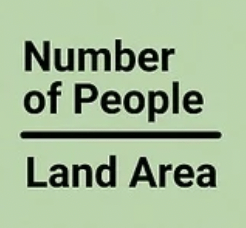
What is the difference between voluntary migration and involuntary migration?
Which is more common today?
Voluntary immigration is movement of people by their own choice – people who decide to move based on the push factors in their homeland and the pull factors in their new home.
Involuntary immigration is when people are forced to move against their will, because of war, exile or enslavement.
Voluntary immigration is much more common today.
What are the three economic questions?
1) What will be produced?
2) How will it be produced?
3) For whom will it be produced?
What is an anarchy?
Anarchy is the lack of a government - everyone looks out for themselves, with no rules, no order, and no government binding together.
If Old Bridge, NJ has 65,898 people and 38 square miles of land, what is Old Bridge’s population density?
65,375 people ÷ 38 square miles =
1,734 people per square mile
What does an urban area look like? What does a rural area look like?
Where are people more likely to live today?
Urban areas are areas in or near cities. Rural areas are areas in the countryside used for farming.
People today tend to live in urban areas.
What is a free-market economy? How does it work?
In a free-market economy, all businesses are owned by private citizens.
Anyone can start a business and try to make and sell a product.
If a product is well made and people want to purchase it, the business will be successful, but if the product isn’t high-quality or isn’t popular, the business will fail.
What is a theocracy? Give an example.
Theocracies are governments run based on religious doctrine, with the leader being not a ruler (like a king, queen or president) but instead a religious leader.
One example is Vatican City, which is led by the Pope, who is the leader of the Roman Catholic Church.
Is Earth’s population growing or shrinking?
What two statistics do demographers look at to determine a country’s rate of population growth?
The Earth’s population is growing.
Demographers use birth rate – how many babies are born each year – and death rate – how many people die each year – to determine how fast a country is growing or shrinking.
What is a suburb? Give an example of a suburb.
What is suburbanization?
Suburbs are towns just outside of major cities. These towns are close enough to the cities to allow people to commute to work in the city, but far enough away that they allow people to own homes and property. Edison is an example of a suburb.
As urbanization has made cities crowded, expensive and congested, people have started to spread outside the cities. This process is called suburbanization.
What is a command economy? How does it work?
In a command economy, every business is owned by the community and controlled by the government.
The government has complete control over what is produced, how it’s produced, and who will receive those products. It also decides how much workers are paid.
What is an autocracy? What are the two types of autocracy? Describe each one and give an example of each.
An autocracy is a government where one person is in charge.
The two types of autocracies are monarchies - where a king or queen inherits their power and position through their family line - and dictatorships, where a single ruler holds all power and often oppresses their people.
One example of a dictatorship is North Korea, which is led by the dictator Kim Jong-un.
One example of a monarchy is Great Britain, which is led by King Charles III.
When did Earth’s population start growing so quickly? What two things made it possible?
The population of the Earth started growing much faster in the 1800s, when the world started to industrialize.
Two things changed the rate of growth:
-Better agriculture increased the world’s food supply, which helps people live longer, healthier lives and care for more children
-Better medicine helps people get sick less often and prevents disease, letting people live longer
What is a megacity?
What does the development of megacities tell us about how life on Earth is changing in the 21st century?
A megacity is a city with more than 10 million people living it.
The growth of megacities - from just 3 in 1975 to more than 21 of them today! - demonstrates that life is shifting to one centered around an urban lifestyle.
What is a mixed-market economy? How does it work?
Mixed markets are a system where some industries are owned by private businesses, while others are controlled by the government.
In a mixed-market economy, most business are open to anyone. However, some things – like roads, tolls and schools – are considered important enough to be run by the government.
What is an democracy?
What are the two types of democracy? Describe each one and give an example of each.
A democracy is a government run by the people.
The two types of democracy are direct democracy, where every single citizen receives an equal vote on each law, and representative democracy, where citizens elect lawmakers to represent them to create laws.
An example of a representative democracy is the United States!