Ch. 3 Sec. 2.7
Ch. 3 Sec. 2.8
Ch. 3 Sec. 2.8
Newsela: The Crusades
Academic Voc.
100
Cause & Effect:
not many artifacts and historical writings survived from this time
so....
historians are actually sure what happened
100
I.)....
A.)....
1.) The Catholic Church grew....
1.) The Catholic Church grew in power
100
I.)....
A.)....
2.) Catholic Europe came into conflict with
the ...The Catholic Church grew....
2.) Catholic Europe came into conflict with the ... Islamic/Muslim world
100
At the time, there was lots of fighting going on in the Middle East. On one side was the Byzantine Empire. This was a Christian Empire covering parts of eastern Europe and Turkey. It was also called Eastern Roman Empire because it had continued the Roman Empire after Rome fell.
On the other side were the Turks. The Turks were Muslims, or followers of Islam. Islam is one of the world's main religions. Arab Muslims took over Jerusalem in the 600s. In 1071, the Turks attacked the Byzantine Empire. They also took over Jerusalem from the Arabs. The Turks would not allow Christians to visit the holy city.
Which sentence explains one reason why the Crusades happened?
A. Several things led to the Crusades.
B. On one side was the Byzantine Empire.
C. Islam is one of the world's main religions.
D. The Turks would not allow Christians to visit the holy city.
D. The Turks would not allow Christians to visit the holy city.
100
This is when something shares a border or edge with something else.
contiguous
200
Cause & Effect:
government & rulers were picked by their kinship groups
so....
someone's family was more important than someone's education
200
II.)....
A.)....
#.) the Byzatine Empire ..... many of its
lands
...
#.) the Byzatine Empire lost many of its lands
200
II.)....
A.)....
#.) the Seljuks even threathen to take over
.....
#.) the Seljuks even threathen to take over
Byzantium
200
Select the paragraph that explains how the Second Crusade ended.
The spread of Muslim power led to the Second Crusade. It lasted from 1147 to 1149. The rulers of Germany and France led the Crusade. But it did not succeed. Instead, it hurt the relationship between the Christians and the Byzantine Empire.
In the 1180s a new Muslim leader came to power. His name was Saladin. He took over Egypt and Syria. In 1187, he won two big victories against the Christians. Saladin defeated a Christian army and took control of Jerusalem.
World History
The Crusades: War in the Holy Land
By Encyclopaedia Britannica, adapted by Newsela staff
Text Level 3
07/17/2017
Word Count 657
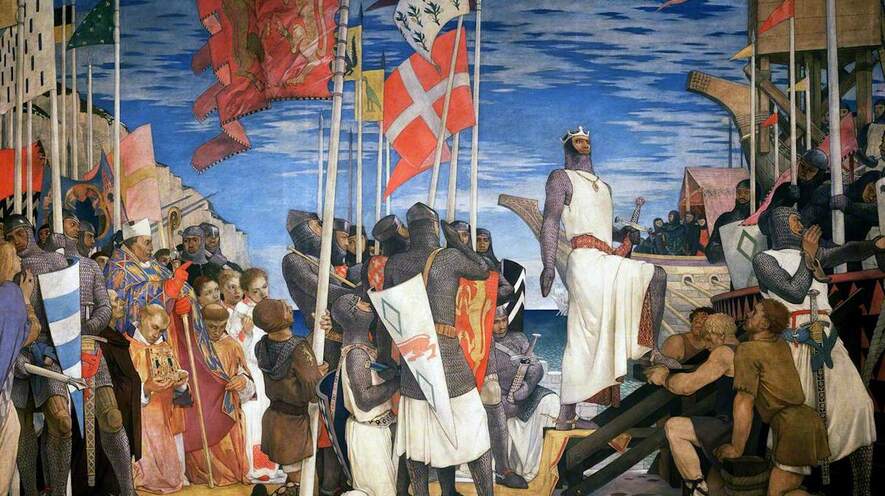 Richard I leaving England for the Crusades in 1189. Painted by Glyn Warren Philpot between 1925 and 1927.
The Crusades were wars over religion. Europeans fought the Crusades between the 1000s and the 1400s. They wanted to take back the Holy Land from the Muslims. The Holy Land was an area in the Middle East. It included the holy city of Jerusalem. Today it is in the country of Israel.
Origins of the Crusades
Several things led to the Crusades. First, European countries were becoming very strong by the end of the 1000s. The countries were much bigger than they were before. European leaders could finally put together large armies.
The biggest cause of the Crusades was religion. At the time, many Christians believed in holy war. They thought it was their duty to fight for the church. Christians wanted to take back Jerusalem so they could worship there. The city is one of the holiest places in the Christian religion.
At the time, there was lots of fighting going on in the Middle East. On one side was the Byzantine Empire. This was a Christian Empire covering parts of eastern Europe and Turkey. It was also called Eastern Roman Empire because it had continued the Roman Empire after Rome fell.
On the other side were the Turks. The Turks were Muslims, or followers of Islam. Islam is one of the world's main religions. Arab Muslims took over Jerusalem in the 600s. In 1071, the Turks attacked the Byzantine Empire. They also took over Jerusalem from the Arabs. The Turks would not allow Christians to visit the holy city.
Soon the Turks began to gain more power. The Byzantine emperor became worried. He sent a call for help to Pope Urban II, the leader of the Catholic Church. The pope called a meeting in 1095. He told Christians to start a Crusade to take back the Holy Land.
The First Crusade
The pope's speech led to the First Crusade. It lasted from 1096 to 1099. The Christians went first to Constantinople, the capital of the Byzantine Empire. Then they marched across Turkey to a city called Antioch. They spent seven months attacking the city before they captured it.
The Christians went to Jerusalem in 1099. They captured the city on July 15. Then the Christians killed all the people in the city. After the killing, they went to pray at the Church of the Holy Sepulchre.
Many Christians returned home. But others decided to stay in Jerusalem. They built castles to protect the Holy Land.
Second and Third Crusades
The spread of Muslim power led to the Second Crusade. It lasted from 1147 to 1149. The rulers of Germany and France led the Crusade. But it did not succeed. Instead, it hurt the relationship between the Christians and the Byzantine Empire.
In the 1180s a new Muslim leader came to power. His name was Saladin. He took over Egypt and Syria. In 1187, he won two big victories against the Christians. Saladin defeated a Christian army and took control of Jerusalem.
Saladin's victory led to the Third Crusade. It lasted from 1189 to 1191. King Richard I of England tried to take back Jerusalem but did not succeed. But the king made a treaty with Saladin. It allowed Christians to visit Jerusalem.
The spread of Muslim power led to the Second Crusade. It lasted from 1147 to 1149. The rulers of Germany and France led the Crusade. But it did not succeed. Instead, it hurt the relationship between the Christians and the Byzantine Empire.
200
This is the ability to spread sickness or infections.
contagious
300
Cause & Effect:
the Caliphate of Cordoba was leader by Islamic leaders
so....
it came into conflict with European Christian kingdoms
300
II.)....
B.)....
#.) the Pope declared that there should be
holy-war to take back....
#.) the Pope declared that there should be a
holy-war to take back the Seljuk/Holyland
300
I.)....
B.)....
#.) the Byzantines sent a messenger to ....
#.) the Byzantines sent a messanger to Rome
300
The Crusades were wars over religion. Europeans fought the Crusades between the 1000s and the 1400s. They wanted to take back the Holy Land from the Muslims. The Holy Land was an area in the Middle East. It included the holy city of Jerusalem. Today it is in the country of Israel.
Fill in the blank.
A Crusade is ____.
A. a war that Christians fought to protect Muslims
B. a war that Europeans fought to stop religion in Jerusalem
C. a war that Christians fought to try to take over the Holy Land
D. a war that Europeans fought to bring peace to the Holy Land
C. a war that Christians fought to try to take over the Holy Land
300
This is when a straight line touches only one point on a curved line. When someone becomes distracted and goes off topic.
tangent
400
Cause & Effect:
the Catholic Church filled in the power vacuum of the Western Roman Empire
so....
it became the only source for art & education in Europe
400
IV.)....
B.)....
#.) In total, there were .... wars called
Crusades
#.) In total, there were 9 wars called
Crusades
400
IV.)....
C.)....
#.) During the 1st Crusade, crusaders
massacred the population of ...
#.) During the 1st Crusade, crusaders
massacred the population of Jerusalem
400
On the other side were the Turks. The Turks were Muslims, or followers of Islam. Islam is one of the world's main religions. Arab Muslims took over Jerusalem in the 600s. In 1071, the Turks attacked the Byzantine Empire. They also took over Jerusalem from the Arabs. The Turks would not allow Christians to visit the holy city.
Which word is CLOSEST in meaning to the word "Empire" in the selection?
A. ruler
B. area
C. kingdom
D. commander
C. kingdom
400
This is your mind which is below your level of awareness: thoughts that you're unaware of.
subconscious
500
Cause & Effect:
Islamic rulers of the Caliphate of Cordoba allowed people to keep their religion and langauges
so....
it became very diverse
500
V.)....
B.)....
#.) Crusaders returned home with the ....
numeral system
#.) Crusaders returned home with the Arabic
numeral system
500
V.)....
C.)....
#.) Brought new things from the Silk Road
to Europe, like .....
#.) Brought new things from the Silk Road
to Europe, like (spice/clothing/food/technologies)
500
Which sentence from the article BEST supports the conclusion that even though not all the Crusades were won, they had a major effect on history?
A. They were designed to take back control of the Holy Land from the Muslims.
B. However, the Crusades played an important role in the growth of Europe.
C. But after 1000, more and more Christians began visiting the city of Jerusalem in the Holy Land.
D. They built castles and established Crusader states to protect the Holy Land.
B. However, the Crusades played an important role in the growth of Europe.
500
This is keeping a clean environment.
sanitation