Vocab
More Vocab
Vocab+Questions
Questions
More Questions
100
The sum of the different forms of living things in a given area or population
Biodiversity
100
Removal of a forest or stand of trees, which are then used for nonforest purposes
Deforestation
100
What is a producer?
organisms that are capable of performing photosynthesis, or transforming energy from sunlight and using carbon dioxide and water to make food
100
Invasive species: a species that is not native to the ecosystem, usually brought to an area by humans, and competes for resources and causes problems for the native species within the ecosystem.
Based on the definition, what impacts can invasive species have on ecosystems?
use up resources, increase competition, alter habitat physically, introduce diseases, etc.
100
Decomposers: organisms such as bacteria and fungi that _ _ the remains of dead plants and animals without the need for internal digestion
break down
200
A force of nature that results in catastrophic consequences
Natural Disaster
200
An increase in the average temperature of Earth's atmosphere, especially a sustained increase great enough to cause changes in the global climate
Global Warming
200
What is species diversity?
The number of species within a community.
200
The larger the variety of organisms, the more _ the ecosystem.
stable
200
What is an effect of a warmer ocean?
Coral expel their algae due to shock and die. This decreases the homes/hiding spots available for marine life that uses coral reefs as shelter. Also, the animals that eat the algae on coral would have less and less food.
300
An alien (non-native to the ecosystem) species, usually brought to an area by humans, that competes for resources and causes problems for the native species within an ecosystem
Invasive Species
300
What is the meaning of human activities?
Things that people do or cause to happen.
300
What is the meaning of keystone species?
A species that, if removed from an ecosystem, would cause a major change in that ecosystem.
300
What is ecological diversity?
Variation within an ecosystem.
300
How do the seasons affect ecosystems?
Seasons affect feeding and breeding patterns in an ecosystem.
Summer: Food and abiotic resources tend to be more available
Winter: Less direct sunlight, colder temperatures, shorter days. Animals will migrate, hibernate or change their physical characteristics to better survive.
Rainy Season: greater food availability, increased fertility, flood risk
Dry Season: Drop in activity, drought risk
400
A long-term change in the temperature range and related environmental variables for regions of Earth
Climate-Change
400
What is genetic diversity?
The total number of genetic characteristics within a species that allows the species to adapt and survive in its environment.
400
The ______ the biodiversity, the more chances an ecosystem has to survive and bounce back from a catastrophic event such as a hurricane, drought, or flood or from human activities such as the introduction of invasive species or deforestation.
greater
400
 Based on the image above, what is climax community?
the dynamically stable ecological community representing the final stage of ecological succession
400
What are ways that invasive species become invasive.
- If the new species doesn't have natural predators and throws off the balance of the ecosystem, then it is invasive.
- People accidentally bring them from another place.
- They are purposefully brought as pets, pest control, or aesthetics.
500
The process that decreases the pH of the ocean due to an increase in the absorption of carbon dioxide
Ocean Acidification
500
What is a change in the type of species present in a community over time?
succession
500
What are some effects fire can have in a forest? (Hint: both positive and negative)
Positive: get rid of pests, remove layers of dead trees, leave behind a nutrient rich soil, etc.
Negative: destroy the homes of animals, wipe out many plants and animals that are crucial to the balanced food chain, etc.
500
What is the difference between primary succession and secondary succession?
Primary succession is the process of a once uninhabited place to become a thriving ecosystem. However secondary succession is the rebuilding of a broken ecosystem that was once inhabited before a disaster.
500
What biotic and abiotic factors can be seen in the image?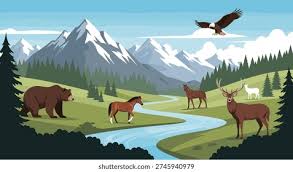
Biotic: trees, animals, grass, etc.
Abiotic: mountains, water, etc.