Introduction to PSYC
Research Methods
Bonus
100
What is the definition of psychology?
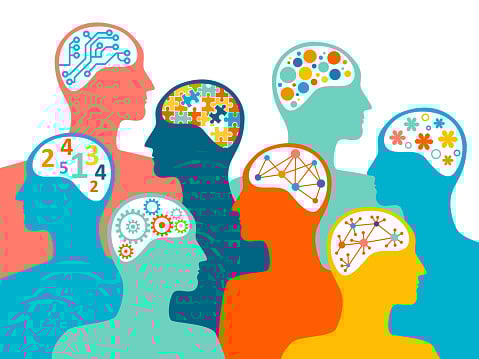
The scientific study of behavior and mental processes.
100
Explain what a case study is or give an example.
A descriptive research method where a researcher gathers detailed, qualitative, information about a single individual
Example: Studying the behavior and mind of a serial killer
:max_bytes(150000):strip_icc()/how-to-write-a-psychology-case-study-2795722-final-f90b37ae2de34cc29b53e303fc0eef5d.png)
100
Give an example of naturalistic observation.
Descriptive research method used to systematically observe "real life" behavior in a naturalistic setting
Example: Studying chimpanzees in the wild
:max_bytes(150000):strip_icc()/what-is-naturalistic-observation-2795391-5c2cfe704cedfd0001583331.png)
200
Who is the founder of psychology?

Willhelm Wundt
200
A descriptive research method used to obtain self-report data about people's experiences, attitudes, or feelings.
Survey

200
Fill in the blank:
In the scientific method, after making an observation about the world, you then form a __________.
BONUS: Correlation does not equal ___________.
Hypothesis/Testable Hypothesis
Hypothesis: Testable prediction about what will happen.
B: Correlation does not equal causation.
300
The idea that knowledge should be obtained through personal experience.
Empirical
300
Give an example of
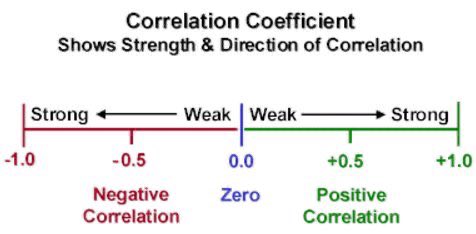
1. A strong correlation coefficient (CC)
2. A weak CC
3. A perfect CC
1. -.91
2. .21
3. 1.0 or -1.0
300
What are the 3 types of research methods AND how can you distinguish the 3?
BONUS:
True or False: Correlation equals causation
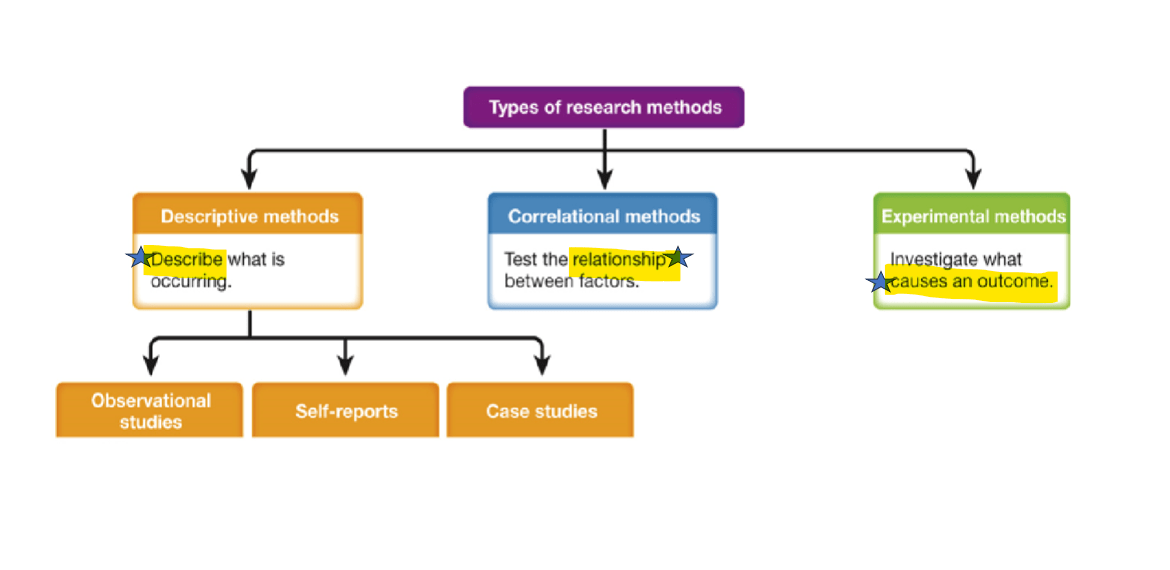
descriptive - describe
correlational - relationship
experimental - causation and IV, DV, E and C
Bonus - False
400
What is a meta-analysis?
"Study of studies."
Summary of a large body of evidence on a particular topic, that allows the researcher to assess the strength and relationship between two variables.
Can better allow for determining "high" consistency.
400
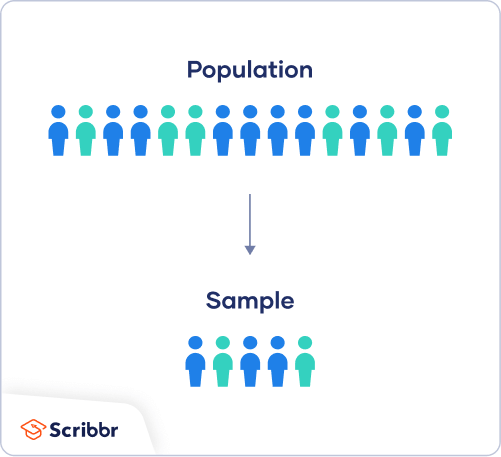
In a research experiment, what is a sample supposed to be representative of?
The population
400
What are the three aspects that make up a true experiment?
1. Random assignment to conditions
2. Use of control conditions (manipulation)
3. Control over confounding variables
500
Why do we need an operationalized definition?

This can provide an objective description of how a variable is going to be measured and observed in a particular study.
500
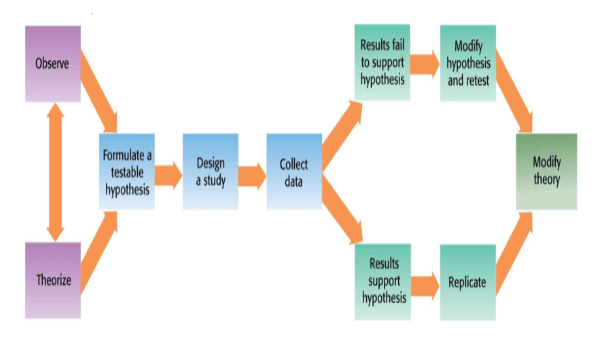
What are the steps to the scientific method?
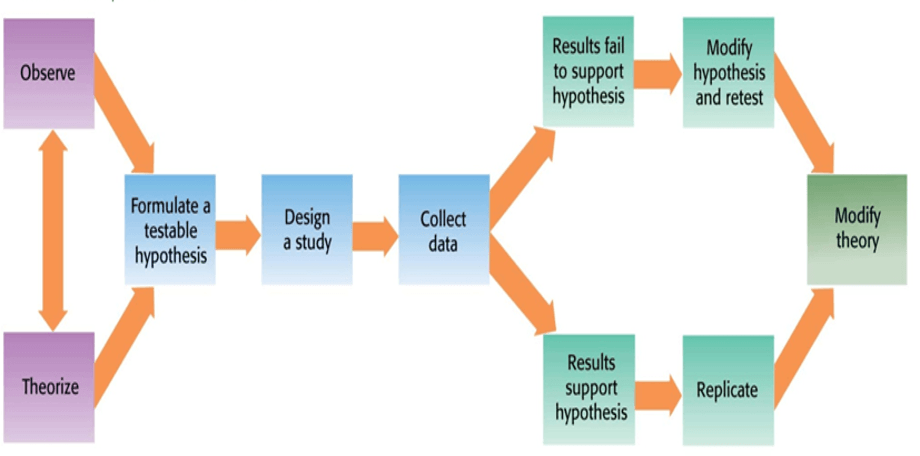
1. Observe, hypothesize, create a study, collect data, and either support or fail to support.
500
A psychologist wants to study if caffeine affects the cognition of students. One group of students consumes 100mg of caffeine and the other group of students drinks water. The psychologist then observes how well they do on a concentration test.
In the experimental method, what is the independent variable (IV), dependent variable (DV), experimental group (EG), and control group (CG)?
IV: Caffeine
DV: How well they do on the concentration test
EG: Group of students consuming caffeine
CG: Group of students drinking water
________________________________________
IV = What is being manipulated, what I change
DV = What is being measured, what I observe
EG = Group that receives IV, group the experimenter is messing with
CG = Group that doesn't receive the IV, comparison/baseline group
:max_bytes(150000):strip_icc()/control-and-experimental-group-differences-606113-FINAL1-5b7ad7d0c9e77c00574b71b5.png)