Separation
Methods
Methods
Filter
Which of the following is NOT a chemical change?
A. metal rusting
B. burning wood
C. melting ice
D. decomposing milk
Which of the following is NOT evidence of a chemical change?
A. change of color
B. production of gas
C. formation of a precipitate
D. change of size
D. Change of Size
Which are the two types of pure substances?
A. elements and solutions
B. matter and mixtures
C. elements and compounds
D. homogeneous and heterogeneous mixtures
C. Elements and Compounds
Which of the following substances is a homogeneous mixture?
A. pure water
B. oil and vinegar dressing
C. maple syrup
D. sugar crystals
C. maple syrup
A chemist mixes iron filings and sulfur powder and places a magnet near the mixture. The magnet pulls the iron away from the sulfur.
Explain why the magnet can separate the iron from the sulfur.
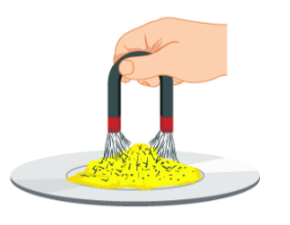
The substances in a mixture preserve their own properties. Iron is magnetic, and sulfur is not, even when mixed.
Which of the following is an example of a chemical change?
A. blend milk and a banana to make a smoothie
B. break a rock
C. cook an egg
D. hammer metal until it becomes a foil
C. cook an egg
As the diagram shows, when an antacid tablet is added to a glass of water, it is fizzy. Which of the following statements describes why this is a chemical change?
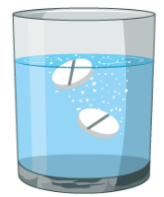
A. Bubbles are visible, which is evidence of a change in thermal energy.
B. Bubbles are visible, which indicates a gas is forming.
C. The tablet disappears because it is a precipitate.
D. The tablet becomes smaller and disappears, so we know it has reacted with water.
B. Bubbles are visible, which indicates a gas is forming
Which statement is NOT true?
A. A pure substance can be separated into elements and compounds by physical methods.
B. A pure substance is made up of one type of particle.
C. Each substance has unique properties, such as the melting point and boiling point.
D. Elements and compounds are pure substances.
A. A pure substance can be separated into elements and compounds by physical methods.
What type of matter is shown in this photo?
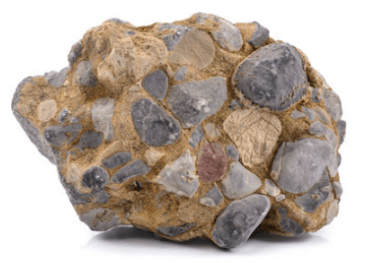
Heterogeneous Mixture
Four students are carrying out different experiments as shown in the table.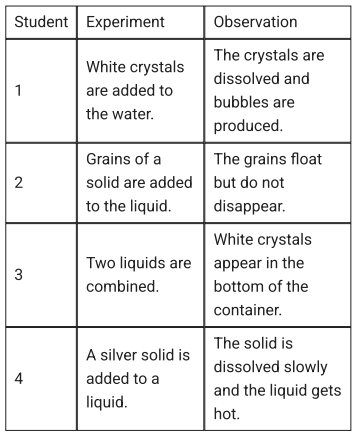 Which of the students' experiments should NOT result in a chemical change?
Student 2
A student combines vinegar and baking soda. The results are shown in the photo. What evidence is there that a chemical change occurred?
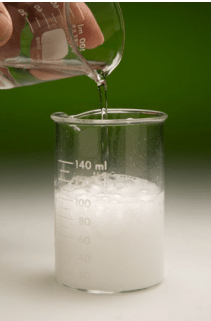
Bubbles occur when substances are combined, indicating the release of gas.
Which statement about mixtures is NOT correct?
A. The substances of a mixture preserve their identity and individual properties.
B. All mixtures are solutions.
C.Mixtures can be separated through physical changes, though some mixtures are hard to separate.
D. Magnets, centrifuges, filters, and other materials can be used to separate mixtures.
B. All mixtures are solutions
A student carried out four experiments combining a solid and a liquid. The table summarizes the liquids and the solids that were mixed and their observations.
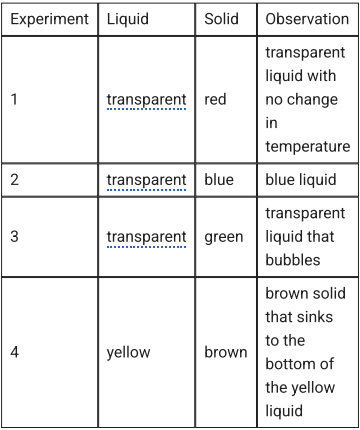
Which observation is most likely to have been caused by a chemical change?
Experiment 3
A rusty nail is an example of which chemical change evidence?
A. Gas production
B. Temperature Change
C. A precipitate forming
D. An unexpected change of color
D. An unexpected color change.
What is the difference between a homogeneous and heterogeneous mixture?
Homogeneous mixtures are uniform, or the same throughout, and you cannot easily see all the components
Heterogeneous mixtures are uneven or not uniform throughout, and you can easily see all the components.
Label each as a chemical or physical reaction. If it is a chemical reaction, tell me your evidence.
1. Burning of a fuel in a car
2. Blowing up a balloon
3. Drying clothes
4. Rusty nail
5. Boiling Water
6. Calcium in water forms a solid in the pipes
7. Adding baking soda to vinegar
1. Burning of a fuel in a car: Temperature change --> heat energy is released during combustion
2. Blowing up a balloon: Physical
3. Drying clothes: Physical change
4. Rusty nail: color change-->Iron changes from a gray metallic color to reddish-brown rust.
5. Boiling water: physical
6. Calcium in water forms a solid in the pipes: a forming of a precipitate--> A solid mineral deposit forms.
7. Adding baking soda to vinegar: Gas production--> bubbles and fizzing occur because CO2 is released