Articles of Confederation
Constitutional Convention & Compromises
The Constitution & Government
Federalists, Anti-Federalists & Ratification
Thinking About the Constitution
100
Under the Articles of Confederation, each state could set a _____ on goods it imported.
duty
100
At the Constitutional Convention of 1787, the Great Compromise resolved the issue of
representation.
100
The U.S. Constitution was based on the concept of dividing governmental powers between the national and state governments, which was called
federalism
100
Many Anti-Federalist fears were laid to rest when the Federalists agreed to add a ______ to the Constitution.
bill of rights
100
Large landowners and merchants supported the Constitution because it
gave the national government power to protect property and regulate trade.
200
The Northwest Ordinance outlined the process for
achieving statehood.
200
Which of the following proposed a legislature that was divided into two houses?
the Virginia Plan
200
The presidential power of the ______ checks and balances the power of Congress.
veto
200
Most anti-Federalists were against ratifying the Constitution because it
did not protect civil liberties or states’ rights.
200
Which of the following is an opinion about the Constitution?
A By 1790, all states had ratified the Constitution.
B A major concern in writing the Constitution was how many representatives each state would have.
C Under the Constitution, the federal government could raise money to operate.
D Because of the Constitution, the United States has the best government in the world.
300
Shays’s Rebellion was viewed by many powerful people as
a sign that the national government was too weak.
300
What did the New Jersey Plan want for representation in Congress?
Each state would have equal representation
300
To keep any one branch of government from becoming too powerful
checks and balances
300
The Federalist essays were published in 1787 and 1788 to help gain support for
the ratification of the Constitution.
300
To what does the cartoonist compare the states that have ratified the Constitution?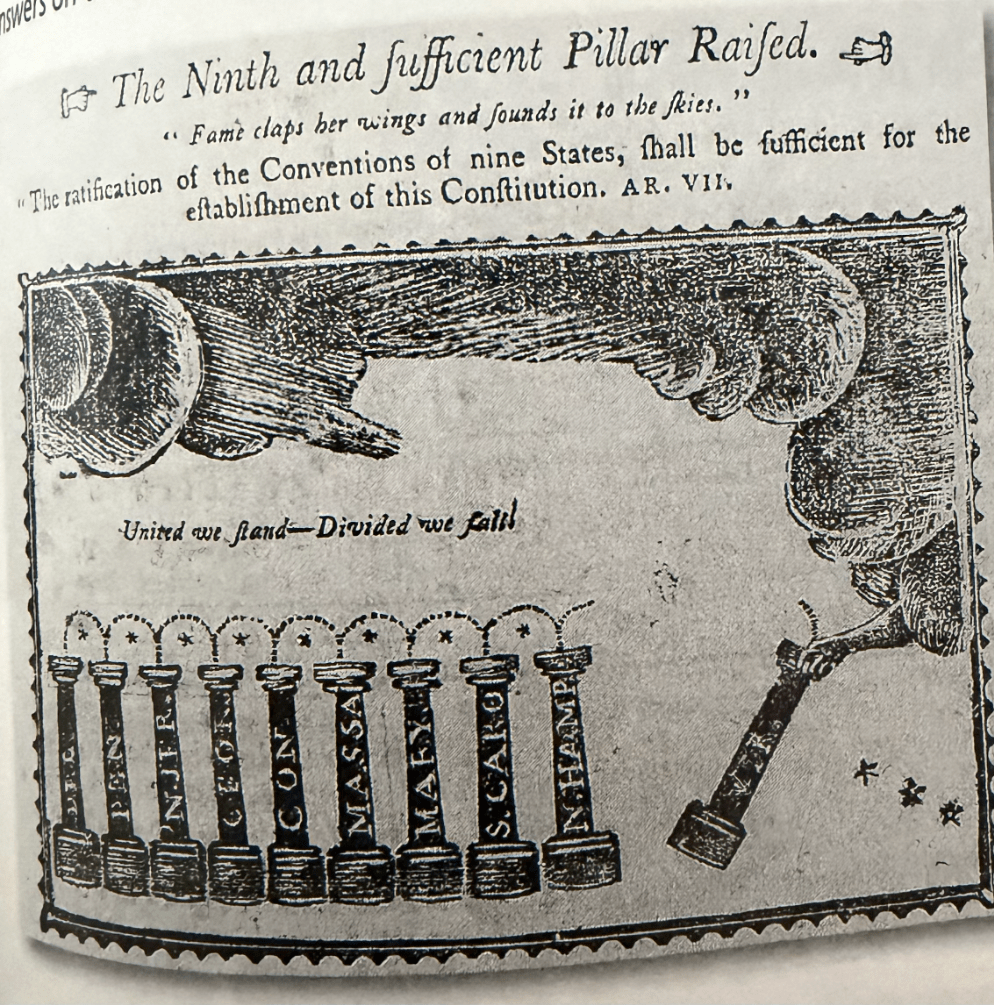
A pillars supporting the nation
B storm clouds of controversy
C stepping stones to ratification
D a woven basket of unity
400
Under the Articles of Confederation, governmental power
rested much more with the states than with the central government.
400
How did the Great Compromise settle the disagreement between large and small states?
The House of Representatives would be based on population, and each state would have two senators.
400
The Framers provided for a separation of powers in the federal government by
establishing executive, legislative, and judicial branches.
400
Which two states were the last to ratify the Constitution?
Rhode Island and North Carolina
400
Which state had the largest land claims in the West?
Virginia
500
What was one major weakness of Congress under the Articles of Confederation?
Congress had no power to tax.
500
What Compromise talked about enslaved population would be counted for representation and taxation.
Three-Fifths Compromise
500
The Framers ensured that the Constitution could evolve over time by
establishing a process for amending it.
500
Who wrote The Federalist essays?
Alexander Hamilton, James Madison, and John Jay.
500
Which two states were the last to ratify the Constitution?
Rhode Island and North Carolina.