Transversals & Angle Pairs
The Corresponding Angle Postulate & Friends
The Distance Formula
The Midpoint Formula
Slope
Equations of Lines
100
What is a transversal?
A line that intersects two or more coplanar lines in two or more distinct points.
100
Lines a and b are parallel, cut by transversal t. m∠2 = 100° (see figure). Find m∠6.
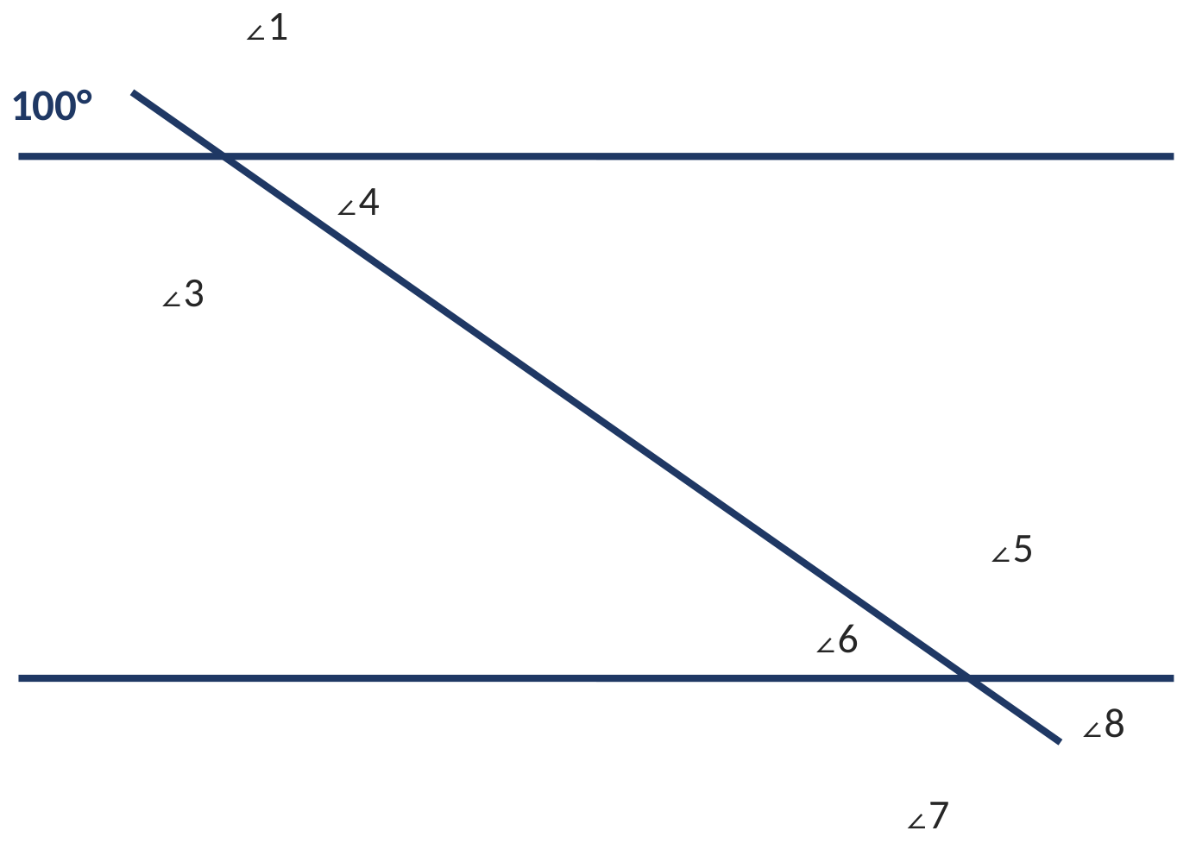
∠2 and ∠6 are corresponding angles, so they're congruent: m∠6 = 100°.
100
State the Distance Formula.
d = √[(x₂ − x₁)² + (y₂ − y₁)²].
100
State the Midpoint Formula.
M = ((x₁ + x₂)/2, (y₁ + y₂)/2).
100
What is the formula for the slope between two points?
m = (y₂ − y₁)/(x₂ − x₁).
100
What two things does slope-intercept form, y = mx + b, tell you directly about a line?
Its slope (m) and its y-intercept (b).
200
Two angles are on the same side of the transversal and between the two lines. Are they congruent or supplementary if the lines are parallel?
Supplementary
200
Lines a and b are parallel, cut by transversal t. m∠3 = 118° (see figure). Find m∠5.
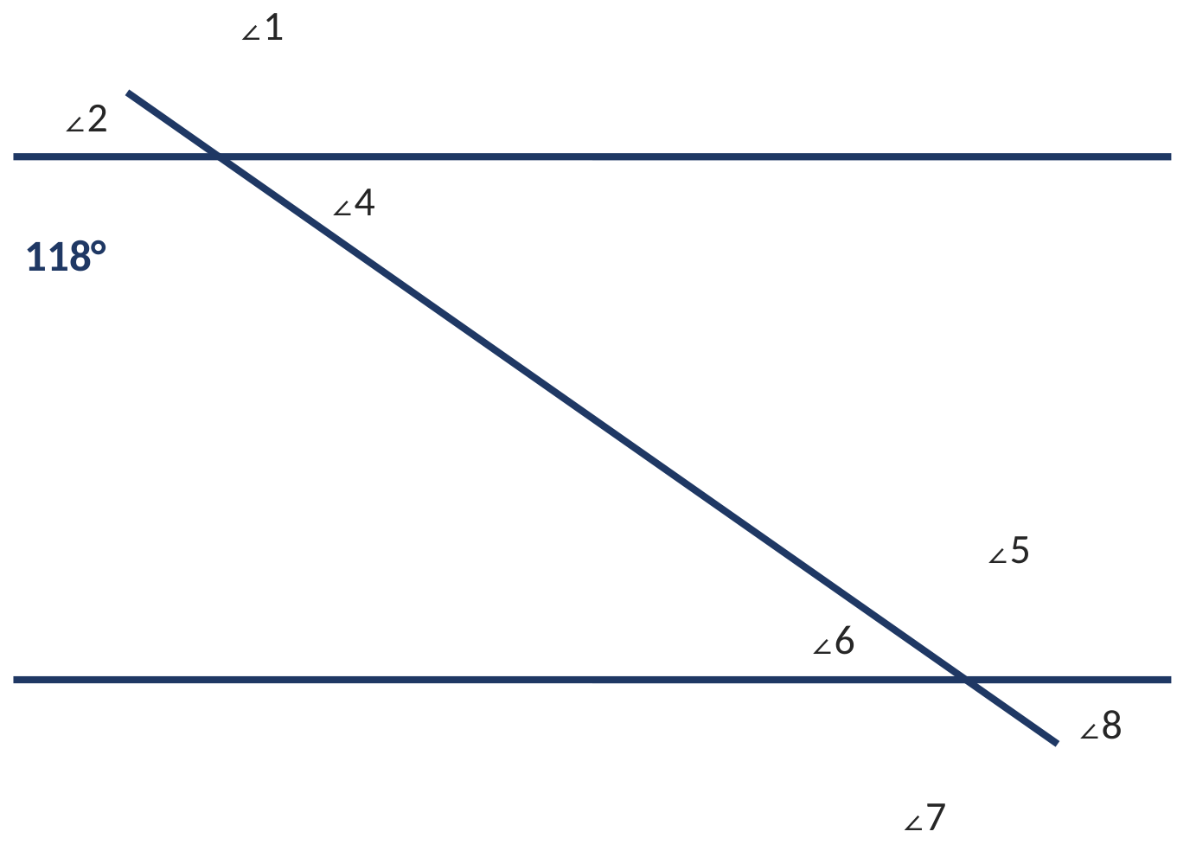
∠3 and ∠5 are alternate interior angles, so they're congruent: m∠5 = 118°.
200
Find the distance between (0, 0) and (6, 8).
√(36 + 64) = √100 = 10.
200
Find the midpoint of the segment from (2, 4) to (8, 10).
(5, 7)
200
Find the slope of the line through (1, 1) and (4, 13).
(13 − 1)/(4 − 1) = 12/3 = 4
200
Find the x- and y-intercepts of 5x + 2y = 10.
x-intercept (2, 0); y-intercept (0, 5)
300
Two angles are on opposite sides of the transversal and outside the two lines. Are they congruent or supplementary if the lines are parallel?
Congruent
300
Lines a and b are parallel, cut by transversal t. m∠4 = 75° (see figure). Find m∠5.
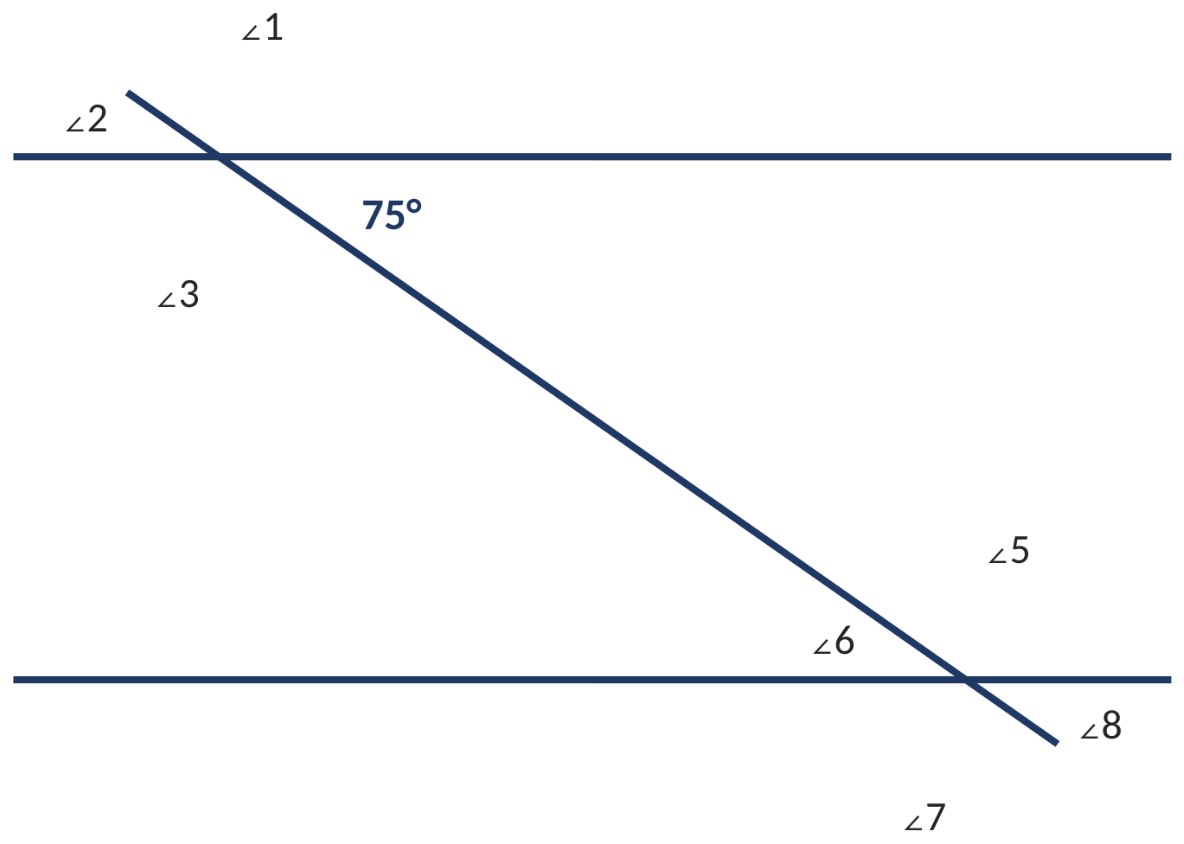
∠4 and ∠5 are consecutive interior angles, so they're supplementary: m∠5 = 180° − 75° = 105°.
300
Find the distance between (−1, 2) and (5, 2).
√(36 + 0) = 6.
300
Find the midpoint of the segment from (−3, 5) to (3, −1).
(0, 2)
300
Line p has slope 3/5. What slope would a line perpendicular to p have?
−5/3
300
Write the equation of the line through (0, 5) with slope 2.
y = 2x + 5
400
Lines a and b are parallel, cut by transversal t (see figure). What must be true about m∠1 and m∠7?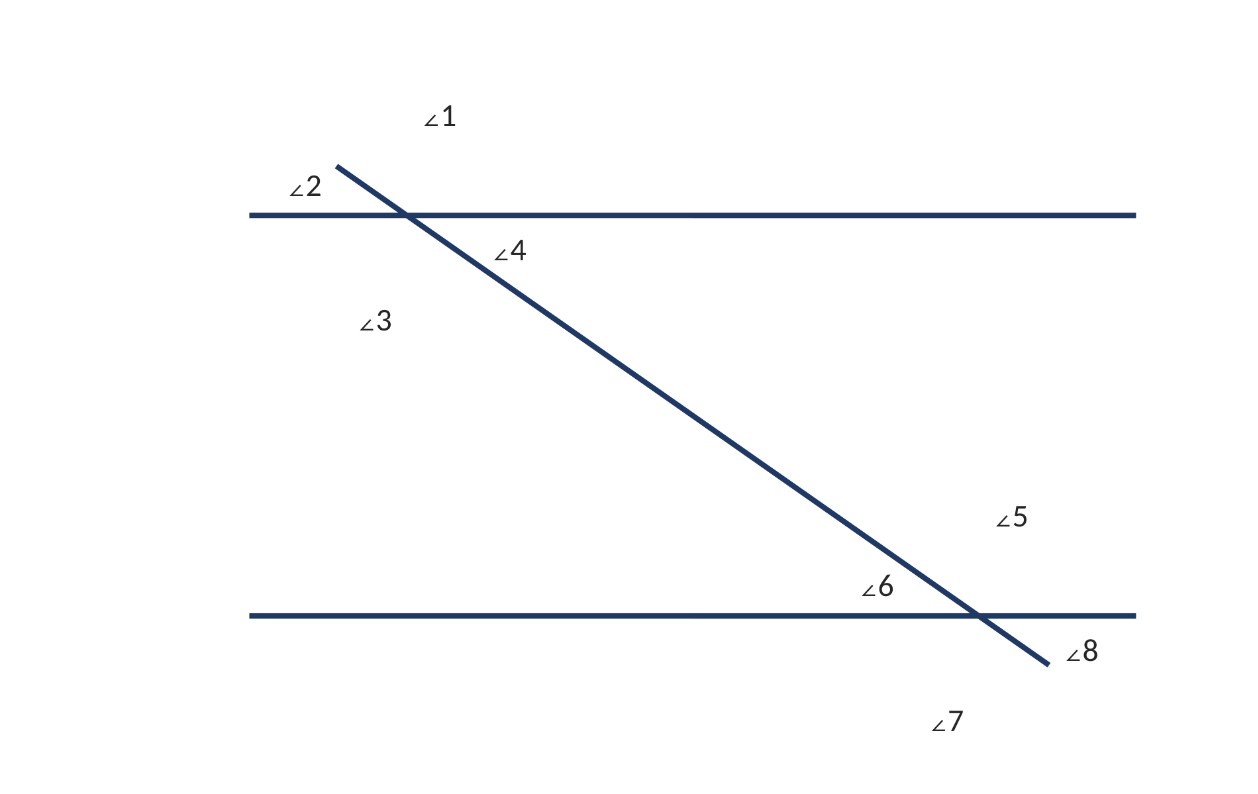
m∠1 = m∠7 — they're congruent.
400
Lines a and b are parallel, cut by transversal t. m∠1 = (5x − 8)° and m∠7 = (3x + 12)° (see figure). Find x.
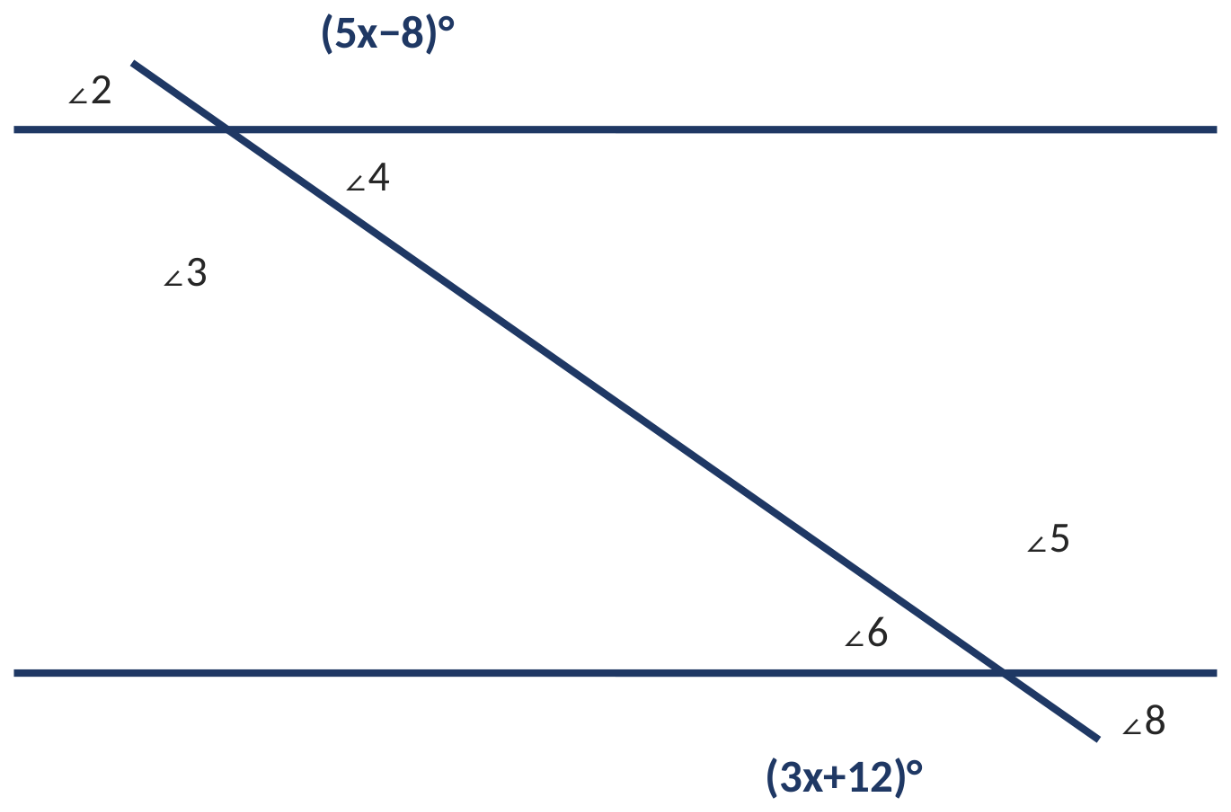
∠1 and ∠7 are alternate exterior angles (congruent): 5x − 8 = 3x + 12 → 2x = 20 → x = 10.
400
Find the distance between (3, −4) and (−1, −1).
√[(−1−3)² + (−1−(−4))²] = √(16 + 9) = 5.
400
M(4, 1) is the midpoint of AB, and A is at (0, −3). Find B.
(8, 5)
400
Line m passes through (1, 1) and (3, 5). Line n passes through (0, −1) and (2, 3). Are m and n parallel, perpendicular, or neither?
m_m = 4/2 = 2, m_n = 4/2 = 2 — equal slopes → Parallel.
400
Write the equation of the line through (2, 1) with slope −4.
1 = −4(2) + b → b = 9 → y = −4x + 9.
500
Lines a and b are parallel, cut by transversal t (see figure). What must be true about m∠3 and m∠6?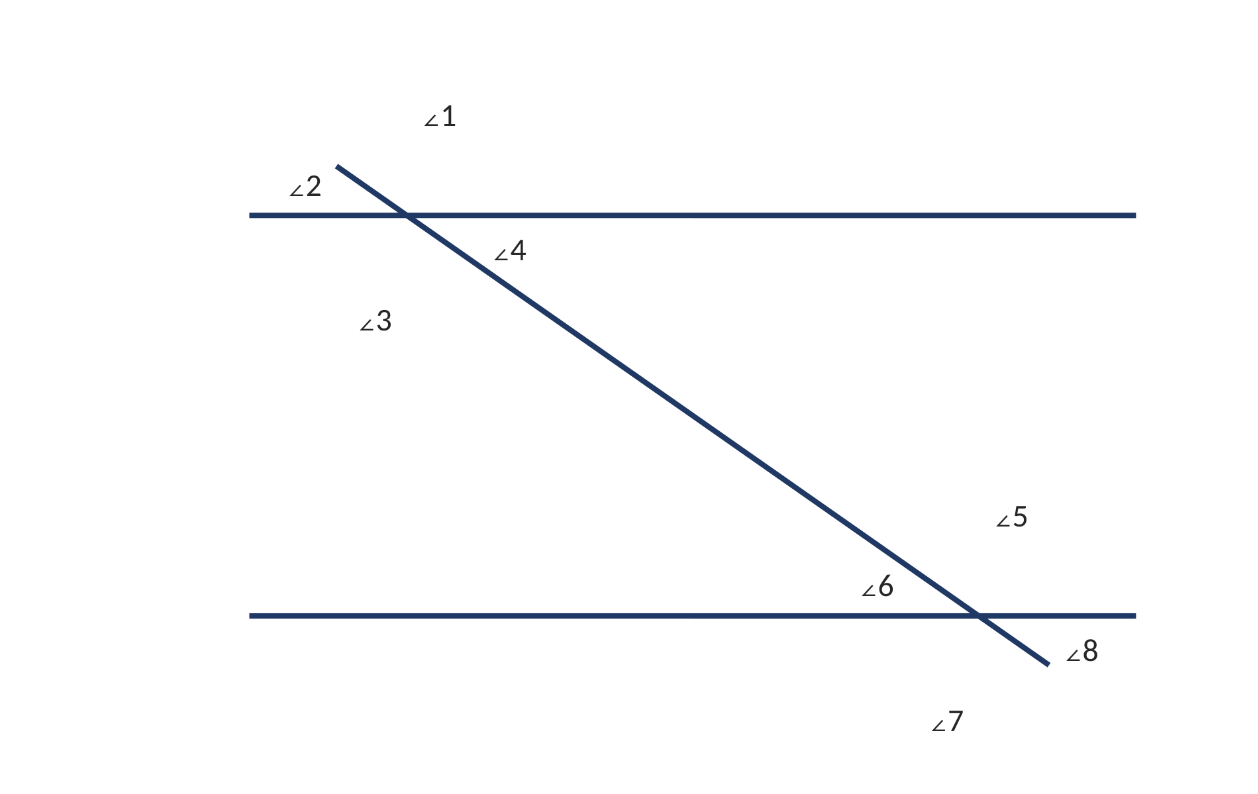
They're supplementary, so m∠3 + m∠6 = 180°.
500
Lines a and b are parallel, cut by transversal t. m∠2 = (4x + 6)° and m∠6 = (6x − 24)° (see figure). Find x.
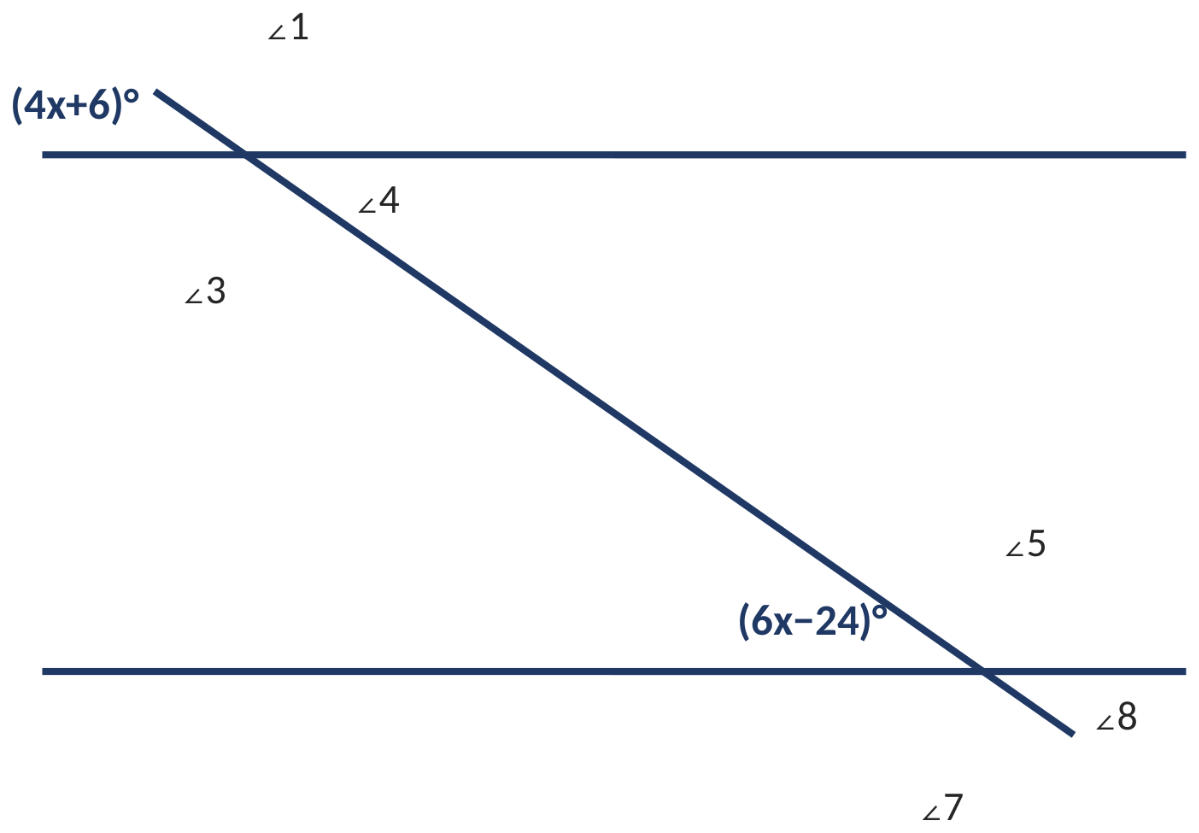
∠2 and ∠6 are corresponding angles (congruent):
4x + 6 = 6x − 24 → 30 = 2x → x = 15.
500
Find the perimeter of a triangle with vertices (0, 0), (3, 4), and (3, 0).
Sides are 3, 4, and 5 (a 3-4-5 right triangle) — perimeter = 12
500
M(−2, 6) is the midpoint of PQ, and Q is at (5, 10). Find P.
(−9, 2)
500
Line j passes through (0, 0) and (4, 6). Line k passes through (0, 1) and (3, −1). Are j and k parallel, perpendicular, or neither?
m_j = 3/2, m_k = −2/3, product = −1 → Perpendicular
500
Line k has equation y = 3x − 2. Write the equation of the line through (1, 5) that is perpendicular to k.
m = −1/3; 5 = −1/3(1) + b → b = 16/3 → y = −1/3 x + 16/3.