Continental Drift
Plate Boundaries
Effects of plate tectonics
Vocab/ Demonstrate
100
What is continental drift?
the idea that Earth’s continents were once all connected together as one big landmass and have slowly moved apart over millions of years.
100
This type of plate boundary involves one plate sliding past another plate
Transform
100
These features are produced on earth when two continents collide.
Mountains
100
With you hands show me a convergent boundary.
Hands coming together
200
This is the name of the proposed "supercontinent" where all the earth's continents were once joined together.
Pangea
200
What plate boundary is created when two plates collide? Give an example of this plate boundary.
Convergent- mountains/ volcanoes
200
What features are produced on the coasts of continents where oceanic crust moves underneath the continent?
Volcanoes
200
Where is Oceanic crust found? Where is Continental crust found?
Oceanic- under the ocean
Continental- under the land
300
What are the two types of evidence that were initially used to support the Theory of Continental Drift?
Fossils and coastlines
300
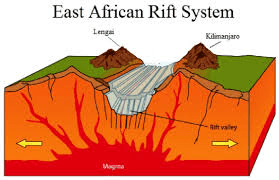
A rift valley is an example of what type of plate boundary?
Divergent Plate boundary
300
These natural disasters occur when a sudden movement occurs along transform boundaries.
Earthquakes
300
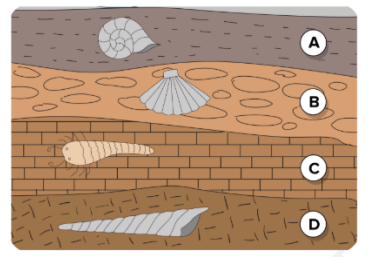 According to the law of superposition- what is the SECOND oldest layer of rock?
C
400
Lystrosaurus is a type of land reptile that lived around 250 million years ago. These large reptiles were herbivores that used their tusks to dig up the roots of desert plants. Fossil remains of Lystrosaurus have been found in Antarctica, India, and Africa.
How does the fossil evidence support the idea that Earth has changed over time?
A. It shows that some land animals survived extinction.
B. It shows that desert plants grew at the South Pole in Earth’s past.
C. It shows that continents have not always been in their current locations.
D. It shows that the fossil record reveals little about a large percentage of animals.
C. It shows that continents have not always been in their current locations.
400
Which table correctly compares features of divergent plate boundaries and convergent plate boundaries?
A.
B.
C.
D.
A- both divergent and convergent boundaries can be volcanic
400
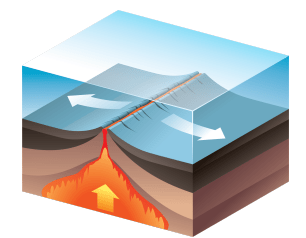 What land feature does the photo represent? Explain what is happening in the photo and the type of plate boundary.
Mid Ocean Ridge
Divergent plate boundary
Magma is rising causing the seafloor to spread and will lead to the creation of underwater mountains
400
This is the term for one plate being forced underneath another plate.
Subduction
500
What formed the supervolcano at Yellowstone?
A. the presence of multiple volcanoes at Yellowstone
B. the North American plate moving over a stationary hot spot
C. the collision of the North American plate and the Pacific Ocean plate
D. the separation of the North American plate and the Pacific Ocean plate
B. the North American plate moving over a stationary hot spot
500
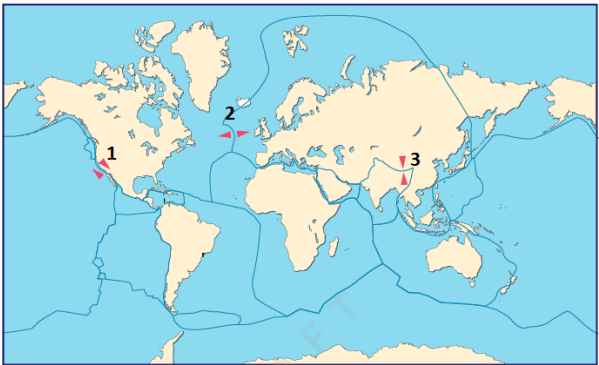 What are the type of plate boundaries shown at 1, 2, and 3?
1- transform
2- divergent
3- convergent
500
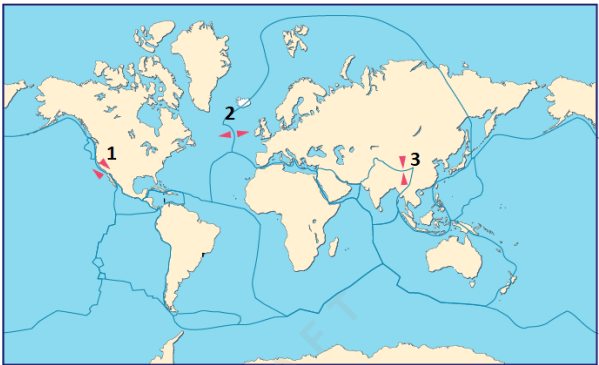
What type of land feature would be created at 1, 2, and 3? (Not plate boundary)
1- Earthquake
2- Mid Ocean Ridge/ Seafloor spreading
3- Mountains
500
The map shows the location of “The Ring of Fire.” This area accounts for 75% of active and dormant volcanoes on Earth.
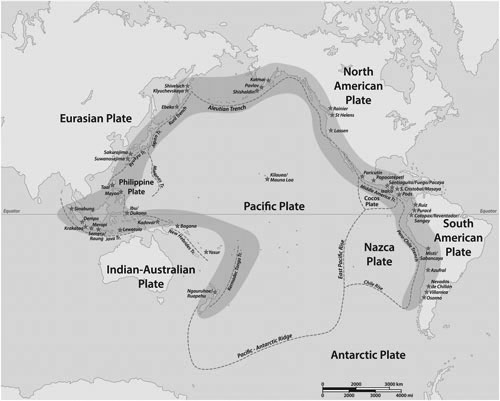
Which interaction BEST describes the plate tectonics that create volcanoes in this area?
A. subduction of an oceanic plate under a continental plate at a divergent boundary
B. subduction of a continental plate under an oceanic plate at a divergent boundary
C. subduction of an oceanic plate under a continental plate at a convergent boundary
D. subduction of a continental plate under an oceanic plate at a convergent boundary
C.subduction of an oceanic plate under a continental plate at a convergent boundary