Chapter 9.1: Conservation of Mass
Chapter 9.2: Mole Relationships in Chemical Equations
Chapter 9.3: Mass Calculations for Chemical Reactions
Chapter 9.4 Limiting Reactants
Chapter 9.5 Percent Yield
Chapter 9.6 Energy in Chemical Reactions
100
In a chemical reaction the total mass of all the reactants must be equal to the total mass of all products this is known as:
Law of Conservation of Mass
100
Write all of the mole-mole factors for each of the following chemical equations:
a. 2SO2(g) + O2(g) → 2SO3(g)
b. 4P(s) + 5O2(g) → 2P2O5(s)
a.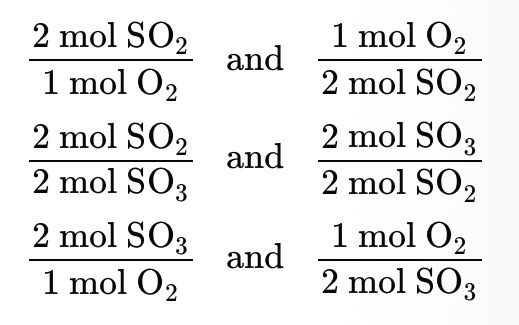
b. 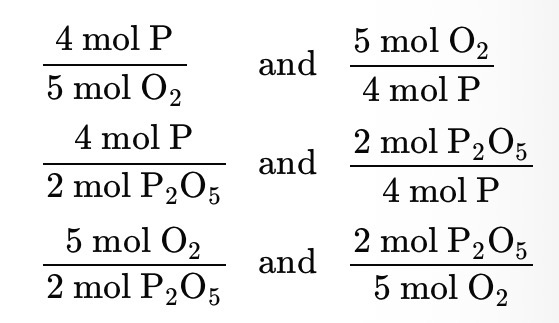
100
Sodium reacts with oxygen to produce sodium oxide.
4Na(s) + O2(g) → 2Na2O(s)
a. How many grams of Na2O are produced when 57.5g of Na reacts?
b. If you have 18.0g of Na, how many grams of O2 are required for reaction?
c. How many grams of O2 are needed in a reaction that produces 75.0g of Na2O?
a. 77.5g of Na2O
b. 6.26g of O2
c. 19.4g of O2
100
The reactant that is completely used up or produces the least amount of a product is the:
limiting reactant
100
Define these terms:
a. theoretical yield
b. actual yield
c. percent yield
a. The amount of product we expect if all reactants react
b. The amount of product we actually get from experiment
c. The ratio of the actual yield for a reaction to the theoretical yield possible for the reaction.
100
Define the following terms:
a. heat of reaction
b. Exothermic reaction
c. Endothermic reaction
d. Hess’s law
a. The heat absorbed or released when a reaction takes place at constant pressure.
b. A reaction that releases heat
c. A reaction that absorbs heat
d. Heat can be absorbed or released in a single chemical reaction or in several steps.
200
How do you determine molar mass of a compound?
By adding the atomic masses of each element, multiplied by their respective subscripts or coefficients in the formula or balanced equation, within the compound. ie) CO2 = C 12.01g + O2 16.00g x 2 =44.01g/mol
200
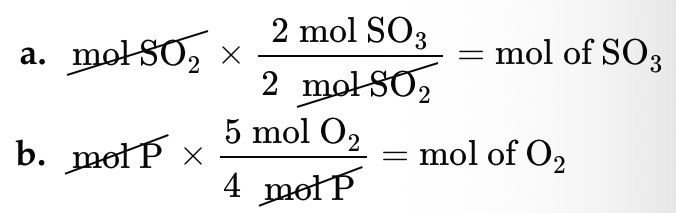
Using the chemical equations listed, write the problem setup with the correct mole-mole factor needed to find each of the following:
a. 2SO2(g) + O2(g) → 2SO3(g)
Moles of SO3 from the moles of SO2
b. 4P(s) + 5O2(g) → 2P2O5(s)
Moles of O2 needed to react with moles of P
200
Ammonia and oxygen react to form nitrogen and water.
4NH3(g) + 3O2(g) → 2N2(g) + 6H2O(g)
a. How many grams of O2 are needed to react with 13.6g of NH3?
b. How many grams of N2 can be produced when 6.50g of O2 reacts?
c. How many grams of H2O are formed from the reaction of 34.0g of NH3?
a. 19.2g of O2
b. 3.79g of N2
c. 54.0g of H2O
200
Nitrogen and hydrogen react to form ammonia.
N2(g) + 3H2(g) → 2NH3(g)
Determine the limiting reactant in each of the following mixtures or reactants:
a. 3.0 mol of N2 and 5.0 mol of H2
b. 8.0 mol of N2and 4.0 mol of H2
c. 3.0 mol of N2 and 12.0 mol of H2
a. 5.0 mol of H2
b. 4.0 mol of H2
c. 3.0 mol of N2
200
Carbon disulfide is produced by the reaction of carbon and sulfur dioxide.
5C(s) + 2SO2(g) → CS2(g) + 4CO(g)
a. What is the percent yield of carbon disulfide if the reaction of 40.0g of carbon produces 36.0g of carbon disulfide?
b. What is the percent yield of carbon disulfide if the reaction of 32.0g of sulfur dioxide produces 12.0g of carbon disulfide?
a. 71.0%
b. 63.2%
200
Classify each of the following as exothermic or endothermic:
a. A reaction releases 550kJ.
b. The energy level of the products is higher than that of the reactants.
c. The metabolism of glucose in the body provides energy.
a. Exothermic
b. Endothermic
c. Exothermic
300
What is the molar mass of CF4?
CF4 = 88.01g/mol
300
The chemical reaction of hydrogen with oxygen produces water.
2H2(g) + O2(g) → 2H2O(g)
a. How many moles of O2 are required to react with 2.6 mol of H2?
b. How many moles of H2 are needed to react with 5.0 mol of O2?
c. How many moles of H2O form when 2.5 mol of O2 reacts?
a. 1.3 mol of O2
b. 10. Mol of H2
c. 5.0 mol of H2O
300
Nitrogen dioxide and water react to produce nitric acid, HNO3, and nitrogen oxide.
3NO2(g) + H2O(l) → 2NHO3(aq) + NO(g)
a. How many grams of H2O are required to react with 28.0g of NO2?
b. How many grams of NO are produced from 15.8g of H2O?
c. How many grams of HNO3 are produced from 8.25g of NO2?
a. 3.66g of H2O
b. 26.3 g of NO
c. 7.53g of HNO3
300
For each of the following reactions, 20.0g of each reactant is present initially. Determine the limiting reactant, and calculate the grams of product in parentheses that would be prodeuced.
a. 2Al(s) + 3Cl2(g) → 2AlCl3(s) (AlCl3)
b. 4NH3(g) + 5O2(g) → 4NO(g) + 6H2O(g) (H2O)
c. CS2(g) + 3O2(g) → CO2(g) + 2SO2(g) (SO2)
a. Cl2 is the limiting reactant, which would produce 13.5g of H2O.
b. O2 is the limiting reactant, which would produce 13.5g of H2O.
c. O2 is the limiting reactant, which would produce 26.7g of SO2.
300
Aluminum reacts with oxygen to produce aluminum oxide.
4Al(s) + 3O2(g) → 2Al2O3(s)
Calculate the mass of Al2O3 that can be produced if the reaction of 50.0g of aluminum and sufficient oxygen has a 75.0% yield.
70.9g of Al2O3
300
Classify each of the following as exothermic or endothermic, and give the ΔH for each:
a. CH4(g) + 2O2(g) → CO2(g) + 2H2O(g) +802kJ
b. Ca(OH)2(s) + 65.3kJ → CaO(s) + H2O(l)
c. 2Al(s) + Fe2O3(s) → Al2O3(s) + 2Fe(l) + 850kJ
a. Heat is released, exothermic, ΔH = -802kJ
b. Heat is absorbed, endothermic, ΔH = +65.3kJ
c. Heat is released, exothermic, ΔH = -850kJ
400
Calculate the total mass of the reactants and the products for each of the following equations:
a. 2SO2(g) + O2(g) → 2SO3(g)
b. 4P(s) + 5O2(g) → 2P2O5(s)
a. 160.14g of reactants = 160.14g of products
b. 283.88g of reactants = 283.88g of products
400
Carbon disulfide and carbon monoxide are produced when carbon is heated with sulfur dioxide.
5C(s) + 2SO2(g) → CS2(l) + 4CO(g)
a. How many moles of C are needed to react with 0.500 mol of SO2?
b. How many moles of CO are produced when 1.2 mol of C reacts?
c. How many moles of SO2 are required to produce 0.50 mol of CS2?
d. How many moles of CS2 are produced when 2.5 mol of C reacts?
a. 1.25 mol of C
b. 0.96 mol of CO
c. 1.0 mol of SO2
d. 0.50 mol of CS2
400
When solid lead(II) sulfide reacts with oxygen gas, the products are solid lead(II) oxide and sulfur dioxide gas.
a. Write the balanced chemical equation for the reaction.
b. How many grams of oxygen are required to reaact with 29.9g of lead(II) sulfide?
c. How many grams of sulfur dioxide can be produced when 65.0g of lead(II) sulfide reacts?
d. How many grams of lead(II) sulfide are used to produce 128g of lead(II) oxide?
a. 2PbS(s) + 3O2(g) → 2PbO(s) + 2 SO2(g)
b. 6.00g of O2
c. 17.4g of SO2
d. 137g of PbS
400
For each of the following reactions, calculate the grams of indicated product when 25.0g of the first reactant and 40.0g of the second reactant are used:
a. 2SO2(g) + O2(g) → 2SO3(g) (SO3)
b. 3Fe(s) + 4H2O(g) → Fe3O4(s) + 4H2(g) (Fe3O4)
c. C7H16(l) + 11O2(g) → 7CO2(g) + 8H2O(g) (CO2)
a. 31.2 g of SO3
b. 34.6g of Fe3O4
c. 35.0g of CO2
400
When 30.0g of carbon is heated with silicon dioxide, 28.2g of carbon monoxide is produced. What is the percent yield of carbon monoxide for this reaction?
SiO2(s) + 3C(s) → SiCO(s) + 2CO(g)
60.5%
400
a. How many kilojoules are released when 125g of Cl2 reacts with silicon?
Si(s) + 2Cl2(g) → SiCl4(g) ΔH = -657kJ
b. How many kilojoules are absorbed when 278g of PCl5 reacts?
PCl5(g) → PCl3(g) + Cl2(g) ΔH = +67kJ
a. 579 kJ
b. 89kJ
500
Calculate the total mass of the reactants and the products for each of the following equations (round to the hundredths place):
a. 2Al(s) + 3Cl2(g) → 2AlCl3(s)
b. 4HCl(g) + O2(g) → 2Cl2(g) + 2H2O(g)
a. 266.66g of reactants = 266.66g of products
b. 177.83g of reactants = 177.83g of products
500
In the acetylene torch, acetylene gas burns in oxygen to produce carbon dioxide, water and energy.
2CcH2(g) + 5O2(g) → 4CO2(g) + 2H2O(g)
a. How many moles of O2 are needed to react with 2.40 mol of C2H2?
b. How many moles of CO2 are produced when 3.5 mol of C2H2 reacts?
c. How many moles of C2H2 are required to produce 0.50 mol of H2O?
d. How many moles of CO2 are produced when 0.100 mol of O2 reacts?
a. 6.00 mol O2
b. 7.0 mol CO2
c. 0.50 mol C2H2
d. 0.0800 mol CO2
500
When the gases dihydrogen sulfide and oxygen react, they form the gases sulfur dioxide and water vapor.
a. Write the balanced chemical equation for the reaction.
b. How many grams of oxygen are required to react with 2.50g of dihydrogen sulfide?
c. How many grams of sulfur dioxide can be produced when 38.5g of oxygen reacts?
d. How many grams of oxygen are required to produce 55.8g of water vapor?
a. 2H2S(g) + 3O2(g) → 2SO2(g) + 2H2O(g)
b. 3.52g of O2
c. 51.4g SO2
d. 149g O2
500
For each of the following reactions, calculate the grams of indicated product when 15.0g of the first reactant and 10.0g of the second reactant are used:
a. 4Li(s) + O2(g) → 2Li2O(g) (Li2O)
b. Fe2O3(s) + 3H2(g) → 2Fe(s) + 3H2O(l) (Fe)
c. Al2S3(s) + 6H2O(l) → 2Al(OH)3(aq) + 3H2S(g) (H2S)
a. 18.7g Li2O
b. 10.5g Fe
c. 9.46g H2S
500
When 56.6g of calcium is reacted with nitrogen gas, 32.4g of calcium nitride is produced. What is the percent yield of calcium nitride for this reaction?
3Ca(s) + N2(g) → Ca3N2(s)
46.4%
500
Calculate the energy change for the reaction
S(s) + O2(g) → SO2(g) from the following:
2S(s) + 3O2(g) → 2SO3(g) ΔH = -792kJ
2SO2(g) + O2(g) → 2SO3(g) ΔH = -198kJ
-297kJ