Organelles
Characteristics of life
Living vs. Non-living
Abiotic vs. Biotic
Cell theory
100
What is this organelle?

Mitochondria
100
Name all seven characteristics of life
1. Made of DNA, 2. Requires energy, 3. Grow and develop, 4. Must be able to reproduce, 5. Responds to stimuli, 6. Is made of cells, 7. Levels of organization.
100
All living organisms are made up of at least one of these microscopic units, which are considered the building blocks of life. Nonliving things do not have them.
Cell
100
In scientific terms, the prefix "bio-" means life, and the prefix "a-" means not or without. Based on this, state the fundamental difference between a biotic factor and an abiotic factor in an ecosystem.
a biotic factor is living, while an abiotic factor is non-living
100
According to Cell Theory, this microscopic structure is considered the basic building block and fundamental unit of all living things
Cell
200
What is this organelles function?

To aid in photosynthesis
200
All living things are built from these basic, microscopic units. Unicellular organisms have just one, while multicellular organisms have trillions.
What are cells?
200
Fire consumes wood for energy, releases gases, grows bigger, and can spread. Despite these traits, explain why fire is scientifically classified as nonliving.
What is because fire is not made of cells, does not contain genetic material (DNA)
200
Identify whether each of the following 4 pond components is Biotic or Abiotic:
Dissolved oxygen gas in the water
A lily pad floating on the surface
A dead, decaying log at the bottom
Temperature of the water
What is Abiotic?
What is Biotic?
What is Abiotic?
What is Abiotic?
200
State the 3 main tenets or principles that make up the Classical Cell Theory.
All living organisms are composed of one or more cells
The cell is the basic unit of structure and function in living things
All cells come from pre-existing cells
300
What organelle is this?
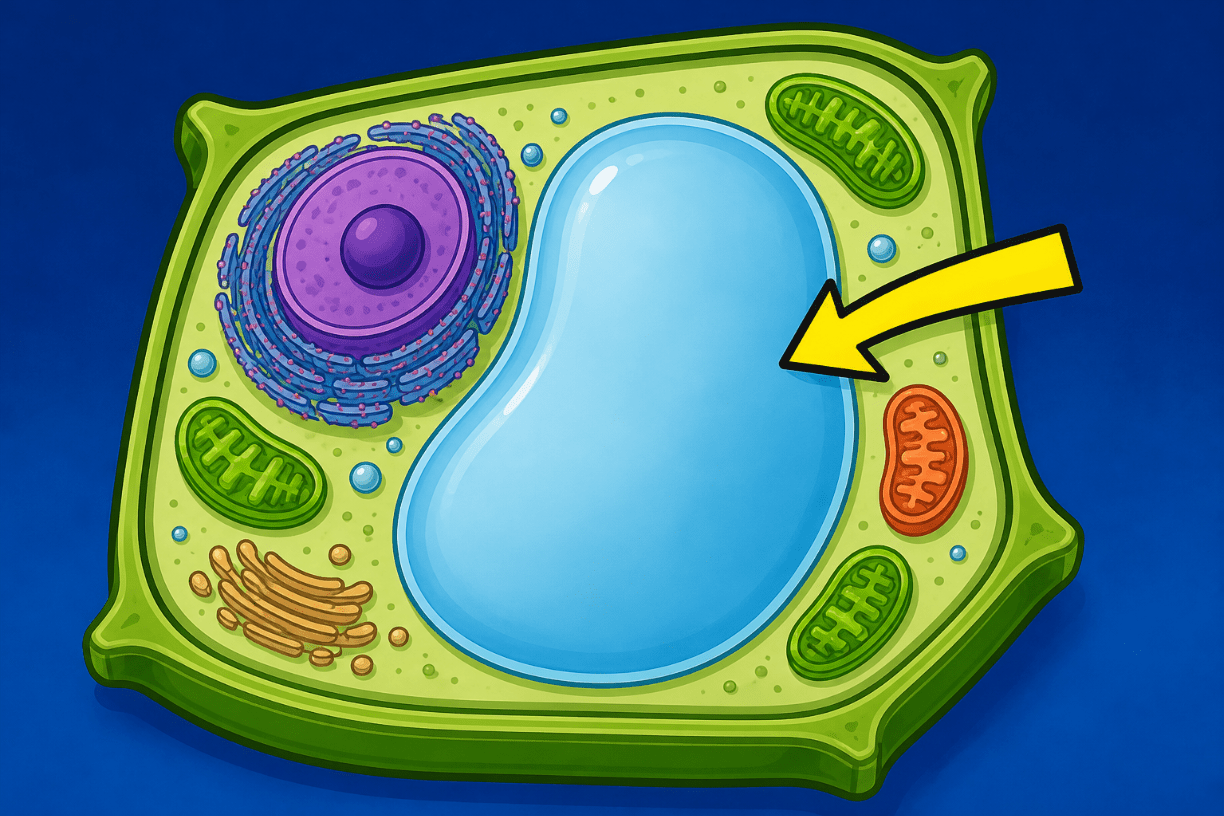
Vacuole
300
Plants absorb sunlight during photosynthesis, while animals eat food to fuel their cellular activities. Both are examples of living things carrying out this key requirement.
What is requiring energy
300
Another word for abiotic factors
Non-living things
300
Soil is often tricky because it contains a mix of both components. Name one abiotic material found in soil (like rocks or minerals) AND one biotic material found in soil (like decomposed leaves or bacteria).
What are abiotic parts like minerals, sand, clay, water, or air?
What are biotic parts like decomposing plant/animal matter (humus), worms, fungi, or bacteria?
300
Before this major technological tool was invented and refined in the 1600s, scientists were unable to observe cells or develop Cell Theory.
Microscope
400
Name two organelles that plant cells have that animal cells do not.
Cell wall, Chloroplast
400
A plant bending toward light, a person flinching when touching a hot pan, or your pupils shrinking in bright light are all examples of an organism doing this.
What is responding to stimuli?
400
When you step out into bright sunlight, your pupils automatically shrink to protect your eyes. Identify the stimulus and the response
What is the stimulus: Bright sunlight (or light)?
What is the response: Pupils shrinking (or contracting)?
400
A severe drought causes a river to dry up. As a result, the fish population drops rapidly, forcing local eagles to hunt elsewhere. Explain how an abiotic factor directly impacted a biotic factor in this scenario.
What is the decrease in water availability (abiotic) directly caused a collapse in the fish population and changed eagle behavior (biotic)?
400
A scientist discovers a non-living object like a virus or crystal. It can replicate or grow, but it does NOT contain cytoplasm, an outer membrane, or metabolize energy on its own. Using Cell Theory, explain why scientists classify it as non-living.
What is because Cell Theory states that all living things must be made of one or more cells
500
What organelle is responsible for aiding in homeostasis and name two examples of homeostasis.
Cell membrane, Sweating and shivering
500
In complex living things, life is organized in hierarchical levels from smallest to largest. Fill in the missing step in this order:

What is a tissue?
500
A virus contains genetic material (DNA or RNA) and can evolve over time, but it cannot reproduce on its own, use energy, or maintain balance without invading a host cell. Based on the characteristics of life, state whether a virus is living or nonliving, and give the primary reason why.
What is nonliving, because viruses are not made of cells
500
Imagine a thick forest canopy blocks most sunlight from reaching the ground. Explain how a biotic factor in this forest is altering an abiotic factor, and predict how that change affects the plants growing on the forest floor.
What is the tall trees (biotic) block the sunlight (abiotic), which limits the growth of small plants on the forest floor because they lack the sunlight needed for photosynthesis?
500
While all cells share basic features under Cell Theory, bacteria cells lack a membrane-bound nucleus to store their DNA. What specific scientific term describes these simple, nucleus-free cells?
prokaryotic cell